


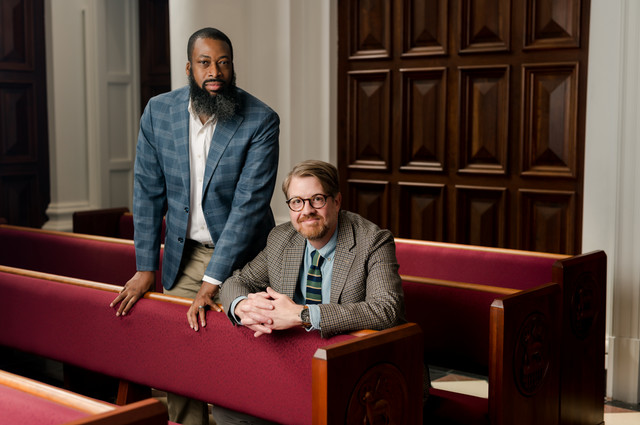
Samford’s Center for Congregational Resources is nearing its 25th anniversary as it continues to connect the university to congregations in need of assistance and continues to be a place where leaders across the campus community can advance God’s Kingdom together.
Keri Burns, director of the center, said the center supports clergy and congregations through its grant funding from the Lilly Endowment, offering retreats, workshops, peer groups and more. The center is currently working to support rural and small-town ministries, supporting churches at both the denominational and individual level by providing smaller grants from their own funding to those in need. "It has taken off like a rocket," she said. "We hit the ground running in 2025, and it's been great. We spent most of last year developing processes to help us, creating the structure to help us function as a regranting hub."
The center partners with the Alabama Center for Pastoral Resilience (ALCPR) to connect with churches in need. The ALCPR is led by Kent Michael, who teaches in Samford's professional studies program. He also teaches on an adjunct basis in Beeson's Master of Arts in Christian Counseling program, along with co-founder Immanuel Marsh, MDiv '13.
The focal point of the center's current work is a leadership cohort offered to pastors, which lasts an academic year. The course teaches ministers systems theory, providing them an opportunity to engage with their peers and build camaraderie. "We offer four buckets: coaching, consulting, training seminars and workshops/cohorts," Michael said.
Marsh said Burns, who is a current Master of Arts in Theological Studies student at Beeson, has opened up a whole new world for us. “Keri and the Center for Congregational Resources were our first major partnership, and we found each other at the right time," Marsh said. “It really bolstered our confidence and encouraged us to expand what we thought was possible. The projects I've been a part of have really stretched me personally and professionally. We couldn't have asked for a better partnership.”
Curriculum used by the center has benefited from its relationship with Beeson, as professors Gordon Bals, Doug Webster, adjunct professor Zac Hicks and associate dean Tom Fuller have helped create content to teach pastors. “We’re grateful for the work the center is doing and welcome any future opportunities to contribute to the work of the center," Fuller said. "When and where we can find opportunities to collaborate in the work of serving the church, I think we benefit from it, the work benefits from it, and it presents an even more unified Samford University."
Burns said the feedback on their work has been remarkable. The course helps ministers understand themselves and then their relationships with their families, congregations, communities and society. “Overwhelmingly, the response was, ‘I didn’t know I needed something like this, but it has completely changed the way I view myself and my ministry,’” Burns said.
Those who complete the training get a financial award for their congregation to use in some way connected to the course.
Working with others at Samford has been a good way to showcase Samford’s unity, Burns said. “We’re all working toward the same goal—to support congregations to further the Gospel message. Why wouldn’t we support one another?” she said. “There is a sense of unity on campus that needs to be presented. We’re all under the Samford umbrella. We’re all on the same team.”
Work will continue at the center, leveraging the resources already present on the Samford campus, at Beeson and beyond. “Why look outside of Samford when there are so many experts here?” Burns said.