


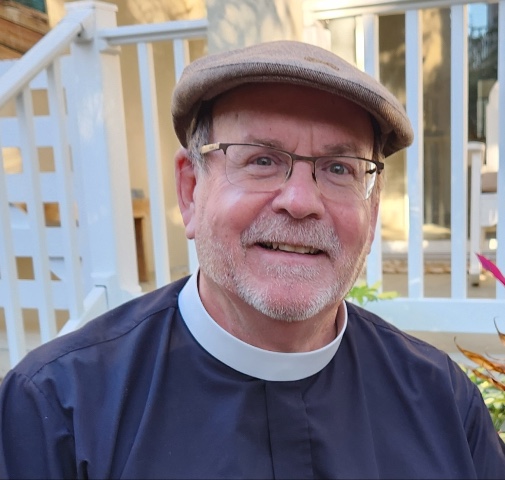
When he was in seminary during the 1980s, Bob Ayres met a deaf student at a Young Life camp and wondered who was reaching out to Deaf/Hard of Hearing (HH) teenagers.
This set Ayres and his wife, Kathy, on a journey that would shape their future in ministry, their friendships and even their own family.
The Deaf community is one of the least reached people groups in the world, based upon estimates that fewer than 4% identify as Christian. The Ayres adopted six children, two of whom are deaf. In 2000, they started Deaf Teen Quest, a national mission based on decades of ministry with both hearing and Deaf/HH young people. Deaf Teen Quest became a national ministry of Youth For Christ in 2009 and for 25 years has continued to minister with Deaf/HH teenagers.
In 2015, Ayres graduated with his Doctor of Ministry (DMin) from Samford University’s Beeson Divinity School.
“After deciding to go to Beeson, my focus became thinking about what the Deaf Church of the future looks like,” Ayres said.
For his dissertation, Ayres assembled a think tank of 12 Deaf/HH leaders from across the country who primarily worked with youth and young adults. The group gathered and discussed what the Deaf Church should look like going forward and provided research for what later became DeafChurch Together.
Ayres is now in the process of planting DeafChurch First Coast in northeastern Florida as a “test pilot.” This church planting model works to network home churches of various denominations doing discipleship that come together for worship, sacraments and community service, in an effort to build community among Deaf/HH believers.
Each home church, some of which predate DeafChurch Together, agree to a memorandum of understanding on the doctrinal essentials, while allowing for denominational differences. Ayres himself is an Anglican priest.
“The group is still in the early stages of development and meeting together,” Ayres said. Helping Ayres in this work is a Deaf Nazarene pastor, Rick McClain, DMin ’10. The pair wrote a book together summarizing their research, DeafChurch 21: A Vision for a New Generation.
Ayres’ role now is to “show how the church is designed and how to replicate it.” He wants those who are part of the church to be connected to hearing churches, especially as most Deaf people have hearing children.
“Our responsibility is not to make up Christianity but to contextualize it in a way that reaches lost people,” Ayres said. “We want to help people love God, love neighbor and love one another in scriptural and theologically sound ways.”
For hearing pastors who want to help Deaf people in their congregation, it’s important to recognize them as a linguistic cultural people group.
“The Deaf community has a different heart-language, traditions and customs and general sense of self and identity. They process life visually instead of auditory,” Ayres said.
Ayres is almost deaf now but didn’t know he would lose his hearing when he first began serving in Deaf-centered ministry. McClain, who was born deaf, saw from an early age “both the beauty of Deaf culture and the deep isolation many Deaf people experience—especially in churches that were not equipped to communicate the Gospel in our language. The isolation we all feel is not limited to language but must also include the emotional and personal aspect of being heard, understood and accepted.”
As Ayres and McClain discuss in their book, most Deaf people do not feel they are being recognized for who they are—people who just simply cannot hear. There is a strong consensus that Deaf people need to be embraced, accepted, heard and ultimately understood to bring the Gospel to them accurately.
McClain’s time at Beeson was transformative and deepened his understanding of what “faithful, Christ-centered leadership looks like.
“Beeson’s emphasis on spiritual formation, global mission and the integrity of pastoral leadership helped refine and strengthen what God had already placed in my heart,” McClain said.
McClain now serves as the assistant director of the Deaf group at Pioneer Bible Translators, whose mission is to bring the Word of God to the Deaf peoples of the world in their native sign language. He also leads DEAFs, Inc., a nonprofit serving Deaf people of Southwest Florida, and teaches American Sign Language at Canterbury School in Fort Myers, Florida, working with around 30 students in a private school setting. McClain also pastors a small Deaf community in Fort Myers.
Ayres credited Beeson with helping him and McClain better understand the church and how to lead well.
“Beeson helped us get a much more sustainable understanding about the church and worship, having a spiritual depth that disciples people into the fullness of faith,” Ayres said. “I always felt like there was a freedom to be creative and explore how this might look in application.”
To learn more about DeafChurch Together, visit DCT.church.