


Once there was a garden of delights from which four rivers flowed. God Himself walked in that garden in the cool of the day. The couple who lived there had everything. And I mean, everything. Blessings upon blessings. Even God’s company was theirs to enjoy, to have and to hold. It was all very good. God Himself declared it so. What more can you ask for? What more can you ask for beyond God’s friendship and devotion?
But then, all of a sudden, a different word was heard, carried by the breeze: “Did God really say?” A word of doubt amidst the blessings, a lying word, a reality-denying word, a tiny word yet audacious and arrogant, taking on the very word of God. It said, ever so subtly, “God is not good. He hasn’t been good to you. He is no good. No good at all. And none of all this is good, either.” It said this brazenly, in spite of everything! —And, unbelievably, it was believed. What followed was a loss of the garden, exile into inhospitable lands, regions whose soil bore thorns and thistles before anything else. What followed was God saying to the man and the woman, “As you want it, so be it. Be God-less; without me. Have at it!” The garden of plenty, the garden of heavenly delight was replaced with a land of scarcity, a barren land of misery.
Death ruled in that land. And through it a host of sins: jealousy, when a brother killed a brother. Exploitation, when the poor were being bought and sold for a pair of sandals. Adultery, with kings helping themselves to their subjects’ wives. Inhospitality, when guests were threatened with the loss of life, and innocent women bore the brunt of it all. Cheating, when a brother swindled another out of an inheritance. Murder, as the only way to stop an Egyptian from beating an Israelite. Ingratitude, when an act of salvation was turned against the one who had helped a brother in need. And above all else, disobedience. Even when God came to His people’s rescue, they repaid Him with grumbling, disloyalty and idolatry, questioning His kingship, wanting to be, above all, like the nations around them, wanting more gods, not just God. Death ruled in that land, for it all proved to be a chasing after the wind, a stupendous futility, a self-aggrandizement leading nowhere, a vanity of vanities.
Death still rules in this land. Man is still a wolf to another man. And indoor plumbing hasn’t made us any better. It is to us, too, that God says, “As you want it, so be it. Have at it!” And so it is. “Life’s but a walking shadow. A poor player that struts and frets his hour upon the stage and then is heard no more. It’s a tale told by an idiot, full of sound and fury, signifying nothing.”
And it would all end here, end in a dusty death among thorns and thistles growing over us, as we forever bite the dust; it would all end in a silence of the ages snuffing out our feeble breath; it would all end—if God had not continued to speak. And not just “Have at it!” For there is a word that abides forever, a word that cleaves the darkness, God’s good word. “‘Comfort, O comfort my people,’ says your God. ‘Speak tenderly to Jerusalem, and cry to her that she has served her term, that her penalty is paid, that she has received from the Lord’s hand double for all her sins’” (Is. 40). God’s word drowns out the lying voices that whisper, ever so helpfully and, oh, so deceitfully, “Did God say...? And even if He did, did He mean it?” God’s word gives the lie to the lie. It drowns out its suggestive subtlety with a resounding, “Thus, thussays the Lord.”
And what the Lord says is “Cry out!” And we—victims of doubt, perpetrators of sin, men of unclean lips—when God’s word finally stops us in our tracks, we are led to ask, “What shall I cry? Shall we announce that all people are grass, their constancy is like the flower of the field?” Yes, that, too! But above all else cry out that where there are prophecies, they will cease; where there are tongues, they will be stilled; where there is knowledge, it will pass away (1 Cor 13)—but the word of our God will stand forever (Is. 40). God’s word will stand forever! And His is a word of abiding love, of a love that never fails.
What is this powerful word, you might ask? WHO is this Word? Who is this Word that we are to acknowledge and confess? It is the Word which God speaks eternally as He delights in Himself, a living Word—the eternal Son of the eternal Father, the Son in whom God knows Himself as Father. God’s very own, intimate Word. This Word, before anything began, was already with God and was Himself God. But there is even more. Beside this Word, there is also the Spirt of love, the Holy Spirit, who embraces the Father’s knowledge of Himself in the Son, and the Son’s knowledge of Himself in the Father. For God’s knowledge of Himself is pure delight—real, unwavering, personal and abiding. And the Spirit does not keep this knowledge to Himself. Instead, the Spirit sounds forth this knowledge, this eternal delight of God. The Spirit of God’s delight pours out the knowledge of the Father and the Son. He, the Spirit was there over the restless waters of creation, speaking God’s love into a world-in-the-making. And He, the same Spirit, was there sounding God’s Word into the Virgin’s womb. For in many and various ways God spoke to His people of old by the prophets, but now in these last days He has spoken to us by His Son (Heb 1). The angel said to Mary, “The Holy Spirit will come upon you, and the power of the Most High will overshadow you; therefore, the child to be born will be holy; he will be called Son of God. Then Mary said, “Here am I, the servant of the Lord; let it be with me according to your word” (Lk. 1). And the Word became flesh and dwelled among us.
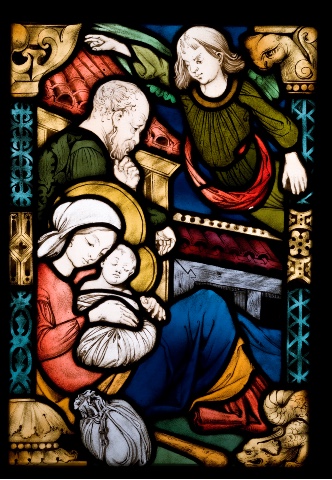
You couldn’t say this any more loudly, any more clearly, any more decisively. That’s how much God loves us! He loves us with His whole being. He loves us to the point of wanting to be among us, of wanting to be one of us. God loves us so much that He wants to know Himself—in our own flesh. And He wants us to know Him in our own flesh. Even more than that, God loves us to the point of submitting Himself to our sin, bearing it and bearing it away. Is there still any doubt left that can claim God is not good and so also no good? Look at the manger! And then look at His wounds! Look at Jesus’s wounded sacred head, His flesh stretched out on a gruesome cross. Look at the lifeless body laid in the tomb. Look at the Spirit hovering over the dry bones. What does it all say? What’s the final word? —Let there be life! Let there be light! The stone rolled away, the empty tomb. And Christ’s promise, “I’ll be with you always to the end of the age” (Matt. 28). For God now looks at us with His own human face. God’s Word says eternally, “I love you!” and He says it by means of our own human flesh. His own flesh!
The true light that gives light to everyone, the light through whom the world was made, was coming into the world. He came to that which was His own. And to all who did receive Him, to those who believed in His name, He gave the right to become children of God— children born not of natural descent, nor of human decision or a husband’s will, but born of God. (John 1, par.)
There is a light shining in the darkness, in the land of death. A light amidst the Satanic lie and all the dark shadow it casts. A light amidst the jealousy, exploitation, murder, ingratitude, cheating, lovelessness and disobedience. This light shines in the darkness, and the darkness has not overcome it. Look at the manger and the babe laid there. God’s Word of love spoken in our own flesh in these last days of the world. It abides so forever. A resounding Word, sounding forth God’s love even in the depths. God’s hand is now upon the world, and He will not let it go. Not ever. God’s company is ours to enjoy, to have and to hold. Grace upon grace. What more can we ask for? You tell me now—as we confess Him and His abiding love “for us humans and for our salvation” (Nicene Creed).