


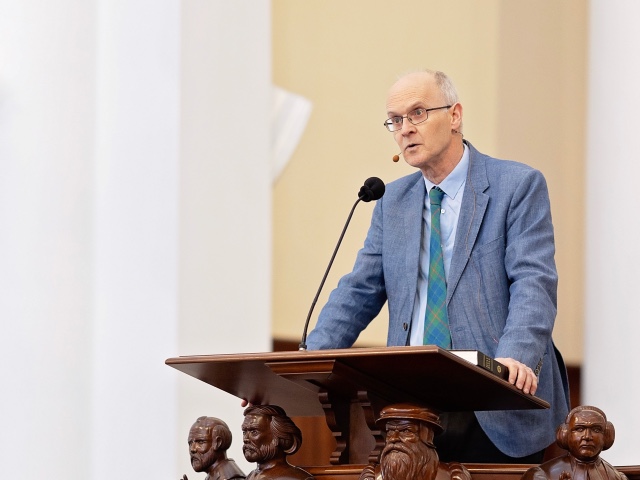
Samford University’s Beeson Divinity School recently welcomed noted New Testament scholar John Barclay to campus for this year’s Biblical Studies Lectures.
Barclay preached in chapel March 17 and delivered lectures on March 18 and 19. The theme of this year’s lectures was “Living in the Gift,” as Barclay discussed the difference between grace and humanism, the difference between love and altruism, and the impact those differences have for Christians as they understand God’s gift of grace and seek to live in it.
“Living in Gratitude”
Barclay, who recently retired from Durham University where he served as Lightfoot Professor of Divinity for more than 20 years, preached about living in gratitude, expounding on 2 Corinthians 9:6-15 and Deuteronomy 26:1-11.
Paul describes the world “as saturated in gift (from God)” to the church at Corinth, Barclay said.
“The very breath we breathe is an inhaling of God’s goodness,” Barclay said.
In a world so often focused on self, gratitude to God is “one of the most countercultural acts we can perform.”
Those who have received God’s grace are invited to enter more fully into that grace by reciprocating it with others, Barclay said.
“What’s the Difference Between Grace and Humanism?”
In his first lecture, Barclay argued the gift of God in Jesus Christ generates love for others in a way reason and humanism cannot, as the Gospel sweeps the Christian into God’s “circle of grace.”
Critiquing the views of 19th-century philosophers Auguste Comte and John Stuart Mill, who argued for a science-based society that was benevolent, not due to any guiding divine truth, but to empirical evidence of the need for benevolence.
Drawing from Paul’s collection from the church in Jerusalem as an example, Barclay pointed listeners to all the ways Paul inspires the church to give, reminding them of God’s grace which has been given to them, of how Christians are enabled to not only receive God’s gift but participate in it and how reciprocal giving from Christian to Christian deepens the believer’s relationship with the Lord and with the church.
“This giving deepens Christians’ experience of God’s, and leads them spiraling down into grace,” Barclay said.
“What’s the Difference Between Love and Altruism?”
In his second lecture, Barclay argued the secular understanding of altruism, while innocent at first glance, can lead to naivete, self-harm and is built upon a faulty understanding of self.
The binary choice set before the modern world, where one must choose between altruism and egoism, is a zero-sum game that is without precedent in the ancient world and in pre-modern Christian theology.
While solely focusing one’s efforts on self can be toxic, Barclay said, there can be an unhealthy understanding of altruism as “giving oneself away,” with no concern for one’s own good. Barclay said this often harms those expected to self-sacrifice more than others, especially women.
“Working for others (in the Bible) has the aim of benefitting the other and self,” he said.
Love for God embraces and includes love for both neighbor and self, Barclay said, drawing from the writings of Augustine.
Focusing attention on Philippians, Barclay said the language of the letter makes clear that the focus of giving, for the Christian, is on solidarity or partnership.
Paul is promoting a reciprocal community, where each individual is committed to the common good. Believers are called to consider “one another,” a better translation of Paul’s language in the letter’s second chapter, meaning no one is left behind.
All of this comes about as a result of the work of God, whose very aim in salvation is to not to simply give Himself away, but to establish relationship with His people so He can be with them, Barclay said.
“A dead Christ is not our salvation,” Barclay said. “He did for us in order to be with us and that we should be with Him. We follow Him, ultimately, not to lose ourselves, but because we know that in Him, we become completely what we were meant to be.”
Recordings of Barclay’s lectures are available on the Beeson online store.