


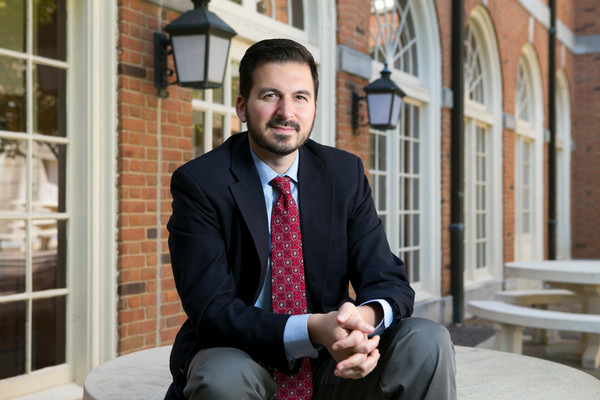
Being named one of The National Law Review's Top 50 Legal Innovators in Academia is the latest honor for Woodrow Hartzog '00, JD '02, but the recognition reflects a much longer journey. From his days as a journalism and mass communication student at Samford University to his time at Cumberland School of Law and now as the Andrew R. Randall Professor of Law at Boston University School of Law, Hartzog has built a career asking difficult questions about technology, privacy and justice and helping shape the answers.
"I’m deeply honored to be seen as an influential voice in the discussion around technology and policy," Hartzog said. "It is a mixture of community support, passion and luck how I arrived here. I'm incredibly grateful."
When Hartzog first began studying and writing about technology law and policy, it was a relatively niche area of legal scholarship. Today, the field increasingly shapes conversations around privacy, artificial intelligence, surveillance and the future of society.
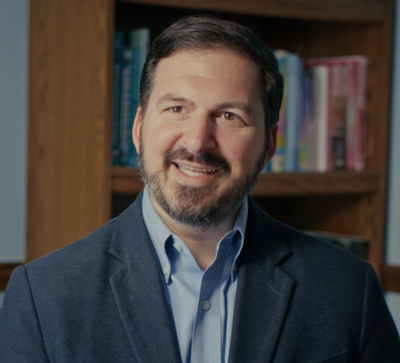 "I had no idea when I first started writing about technology law and policy all those years ago that it would be such a growth area," he said. "Technology has become such a powerful force politically, legally and socially."
For Hartzog, the field remains exciting because it is still evolving.
"We still don't have the full rulebook on how these technologies should be built and used," he said. "There's still space to make an impact, and that's thrilling and fulfilling."
Hartzog Career Highlights
- Named one of The National Law Review's Top 50 Legal Innovators in Academia for 2026
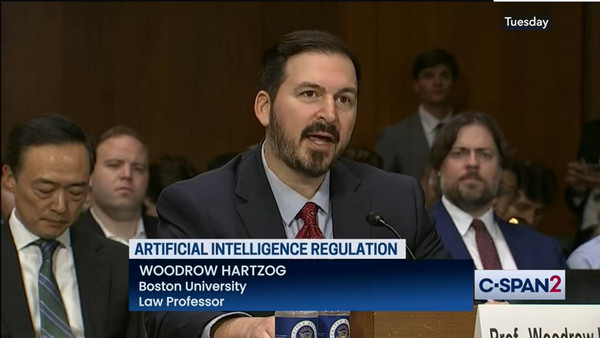
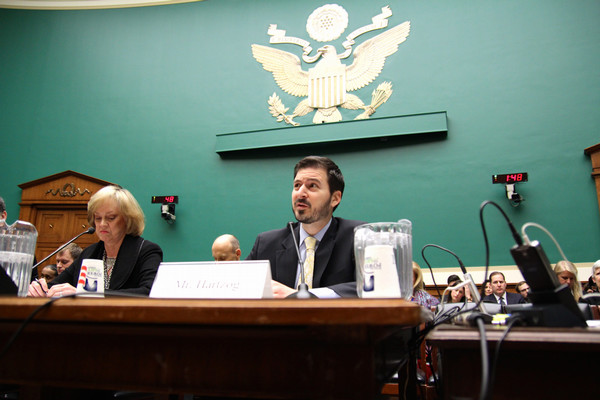
- Testified before Congress four times on issues related to privacy, technology and artificial intelligence
- Author of Privacy's Blueprint: The Battle to Control the Design of New Technologies (Harvard University Press)
- Featured among global experts and scholars in the December 2025 YouTube documentary, “Privacy People”
- Ten-time recipient of the Future of Privacy Forum's Privacy Papers for Policymakers Award
- Ranked among the nation's most-cited law and technology scholars
- Appointed to the Massachusetts Special Commission on Government Use of Facial Recognition Technology
- Recipient of teaching excellence awards at both Cumberland School of Law and Boston University School of Law
Learning to Ask Better Questions
Long before becoming a nationally recognized scholar, Hartzog was a Samford student whose professors challenged him to think critically about media, technology and the systems that shape society.
"I owe so much of my perspective and my journey to the mentorship that I received at Samford," Hartzog said. "I went from being a passive recipient of the world around me to actively challenging why things are built the way they are and why we do the things that we do with respect to technology and media."
One of those mentors, longtime professor David Shipley, later gave Hartzog the opportunity to teach media law as an adjunct instructor. It was the first class he taught and the experience that helped him discover his professional calling.
"I realized there was a job where I could work with students and teach while also engaging in research and writing," Hartzog said. "That's what being a law professor was."
After graduating from Samford, his path continued as a student at Cumberland School of Law during a period of significant technological and societal change. As the internet became increasingly central to daily life and the nation grappled with the aftermath of the Sept. 11, 2001, terrorist attacks, Hartzog evaluated questions surrounding privacy, surveillance and the law's ability to keep pace.
"I felt that our rules were not up to the task of protecting people's privacy and ensuring justice in such a rapidly changing world," he said.
Driven by those questions, Hartzog regularly sought out conversations with Cumberland faculty members, including Professors Alex Bolla, Ed Martin and Jack Nelson.
"The poor Cumberland law professors at the time were probably dreading hearing my footsteps," he joked. "Every day I wanted to talk about the ways technology was changing our world and whether our laws were keeping up."
Instead, Hartzog found a community of mentors who welcomed those conversations.
"The support and mentorship I received from the Cumberland professors was remarkable," he said.
Years later, he returned to Cumberland as a faculty member, hoping to provide the same encouragement and guidance he had received as a student.
Innovation and the Human Side of Law
Although he has been recognized nationally for innovation, Hartzog is cautious about how the term is often used.
"Innovation as a Silicon Valley buzzword rings strangely to me these days because it's so overused," he said.
 Instead, he views innovation as bringing thoughtful, conscientious approaches to complex challenges and helping move society forward in meaningful ways.
That philosophy extends to his views on legal education. While artificial intelligence and other technologies continue to reshape the profession, Hartzog believes the most important qualities of a lawyer remain unchanged.
"The thing that excites me most about the future of legal education is what has always been core to legal education," he said. "Critical thought, careful reading, the ability to write clearly and elegantly, strong relationships and strong moral commitment."
Those fundamentals also shape the advice he gives students.
"In the world of artificial intelligence, there is nothing more precious than developing your own authorial voice," Hartzog said.
He encourages aspiring lawyers to resist the temptation to let technology do their thinking and writing for them.
"No one has lived the same life as you," he said. "The ability to clearly convey your own perspective is only going to become more important."
Inspired by the Next Generation
Despite spending much of his career examining difficult questions about technology and society, Hartzog remains optimistic.
 "What powers me is the knowledge that these challenges are not insurmountable," he said. "I know it's easy to feel fatalistic in these times, but I don't feel that way."
That outlook is reinforced by the students and colleagues he encounters every day.
"I am inspired more than ever by my students, my colleagues and the people I interact with every day who are committed to justice and working to make the world better," he said.
For Hartzog, the latest national recognition is not a culmination but another chapter in a lifelong commitment to asking important questions, mentoring future leaders and helping society navigate an increasingly complex technological world.
