


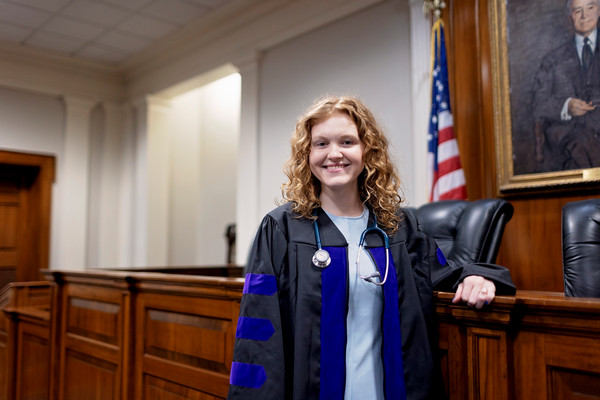
During some of the hardest days of people’s lives, Catie Bovey stood at their bedside.
As an emergency room and trauma nurse, Bovey spent her early career working in moments of crisis, translating fear into clarity, chaos into care. Long before she stepped into a law school classroom, she learned how to build trust in an instant, stay calm under pressure and make decisions that carried real consequences for real people.
Those skills did not disappear when she traded her scrubs for casebooks. Instead, they became the foundation of her legal education.
Bovey’s path to nursing felt almost inevitable. Her mother was a nurse, and growing up, Bovey absorbed stories from the hospital and watched firsthand what dedication to patients looked like. She loved science and felt drawn to work defined by service and responsibility.
“She is an excellent nurse,” Bovey said of her mother. “I learned a lot about service and responsibility from her.”
That sense of responsibility sharpened when Bovey entered professional practice, timing that placed her on the front lines of the COVID-19 pandemic. As a new nurse working in the ER and trauma unit, she found herself immersed in patient care while facing ethical and legal questions she felt ill-equipped to address.
“I frequently found myself in the middle of trying to address systemic issues I saw,” she said. “I was frustrated with the limits of what I could do within my role as a bedside nurse.”
For Bovey, the idea of law school was not sudden or impulsive. She had considered it throughout nursing school and early in her career. But during the pandemic, the disconnect between what she could identify as a problem and what she could change became increasingly clear.
“I really enjoyed my time working as an ER and trauma nurse,” she said. “I learned so many valuable lessons and still see how it shaped me as a person and as a professional every day.”
When Bovey shared her decision to pursue law school, the supportive reaction from her health care colleagues was unanimous. Managers and coworkers encouraged her and celebrated her ambition, and they continue to remain close friends.
“Honestly,” she said, “no one who knew me well was very surprised by my decision.”
That encouragement mattered. Leaving a demanding career for a new professional identity is no small leap, and the transition came with challenges. After years of physically intense work and frequent overtime, Bovey enrolled at Samford University’s Cumberland School of Law.
She at first had difficulty adjusting to the classroom-heavy pace of law school. But, over time, law school became a space where her background was not a detour, but an asset.
“Going from working almost every week in overtime to sitting in a classroom every day was a hard transition,” she said.
Nursing had trained her to see people at their most vulnerable, an experience that reshaped how she approaches legal advocacy.
“Everyone is working through so much more than what meets the surface,” Bovey said. “It’s important to remember that when advocating for clients, interacting with classmates and working alongside other attorneys.”
Her problem-solving style also stood out. Compared with law school classmates who came straight from undergraduate programs, Bovey brought a level of urgency and practicality shaped by the ER. She remained calm in high-pressure situations, prioritized efficiently and acted decisively.
It became clear early on that her health care background would intersect naturally with the law. During her first semester of torts at Cumberland, Bovey found herself analyzing causation, damages and risk through a lens her classmates could not replicate. That perspective only expanded as she progressed, particularly in courses involving medical decision-making and liability.
Trust, a trait central to nursing, proved equally vital in law. In emergency care, Bovey learned how to speak honestly with patients and families during crises while maintaining confidence and credibility. That same balance, she believes, will be essential as a new attorney.
“I learned to be honest about circumstances and not let someone’s reaction shake my confidence in my skills,” she said. “I also learned to ask questions and get help early.”
Bovey is now set to receive not one, but two degrees from Cumberland in May—the Juris Doctor and the Master of Laws with a focus in health law and compliance. Through the completed of these legal degrees, Bovey has found her professional home at the intersection of law and health care.
Following her law school graduation, Bovey looks forward to her own wedding, followed by studying for the Alabama Bar Exam and later beginning work at a civil defense firm, where she will primarily assist with medical malpractice defense.
Her understanding of how health care providers make decisions and operate day to day gives her an advantage that cannot be taught from textbooks. Reviewing medical records, parsing expert testimony and assessing causation come naturally when she has lived those systems from the inside.
Bovey’s vision for impact extends beyond individual cases. Her years in health care left her acutely aware of workplace violence against nurses, a reality she has seen affect coworkers. Advocacy for stronger legislation will remain a cause close to her heart.
If there is one takeaway she hopes readers gain from her story, it is confidence in the value of nontraditional paths.
“People with different backgrounds have valuable experience to contribute,” she said. “Coming from a profession where you are often at the bottom of the hierarchy, it was easy to assume no one wanted to hear my thoughts. That’s simply not true.”
For Bovey, the journey from nurse to lawyer is not a departure from service; it is a continuation.
She is still building trust, still advocating in moments that matter and still standing alongside people when the stakes are high, just through a different lens.
