


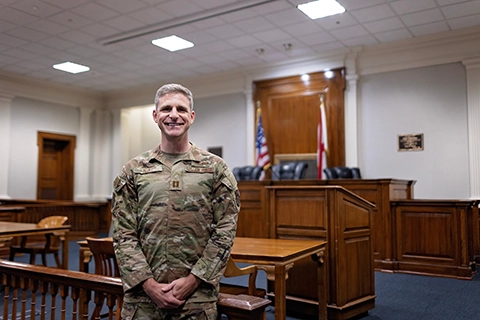
The following are opinions of those of Captain Burt, not the United States Air Force.
A commitment to service has shaped every stage of Russell Burt’s career—and now, that commitment is taking a new form through legal training, with his graduation from law school on the horizon.
An active-duty captain in the United States Air Force, Russell commissioned in 2018 and spent several years serving in operational flying roles before being selected in 2023 for the Air Force’s Funded Legal Education Program (FLEP), a competitive initiative that allows officers to attend law school and transition into the Judge Advocate General’s (JAG) Corps.
“I saw the impact JAGs made every day on the mission of the Air Force and wanted to be part of that impact,” he said.
That decision began a demanding and complex process for Russell. He began navigating dual application tracks—applying to law schools while simultaneously preparing his FLEP application materials—all while maintaining his military responsibilities.
Even preparing for the LSAT required careful coordination. Russell carved out study time between a deployment and a large-scale training exercise, leaning on every resource and bit of support he could find.
“I tried to do as much research as possible and asked for as much help as I could,” he said.
Ultimately, Russell chose Samford University’s Cumberland School of Law—a decision shaped as much by community as by academics.
“I would get any degree I could from Samford,” he said. “What Dr. Taylor and his team have done here makes it exciting to be part of. And at the law school, Dean Hudson’s approachability and genuine care for students really stands out.”
Since arriving at Cumberland, he has found the experience both challenging and rewarding. He credits the faculty with helping bridge theory and practice, preparing him for the realities of legal work ahead.
Russell also brings a distinct perspective to the classroom—one shaped by military service. His ability to think strategically and prioritize under pressure has translated well to the demands of law school.
“I have tried to use strategies I learned in the Air Force to help me think 'big picture' and prioritize tasks effectively while in law school," he said.
Through the FLEP, his primary focus has been on his legal education while maintaining minimal administrative obligations with the Air Force.
That focus, combined with the support of the Cumberland community, has made a lasting impression on Russell. He points back to the leadership of Dean Blake Hudson as a defining part of his experience.
“Dean Hudson’s encouragement and his ability to connect with students on a personal level really sets the tone,” Russell said. “The culture he’s built is reflected across the faculty and staff. It’s a blessing to be part of.”
As he prepares for the next phase of his career, Russell says his journey has reinforced the importance of resilience and adaptability—qualities essential in both military service and the study of law.
“Adaptability is 90% of law school,” he said. “Being able to think dynamically while performing with precision is critical. And resilience—just continuing forward no matter how tough things seem—is what gets you through.”
The transition from active-duty operations to legal training reflects a continued commitment to service—one grounded in discipline and guided by a desire to make a meaningful impact through the JAG Corps.
