


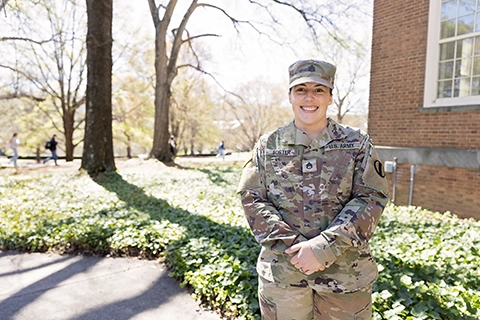
The following are opinions of those of Arielle Foster, not the United States Army.
Staff Sergeant Arielle Foster enlisted in the United States Army in 2018 as a paralegal specialist, beginning her military legal career. Her journey has taken her from Fort Bliss in El Paso, Texas, to Joint Base Elmendorf-Richardson in Anchorage, Alaska, and now to Samford University’s Cumberland School of Law, where she will graduate this spring as a member of the Class of 2026.
Selected for the military’s highly competitive Funded Legal Education Program (FLEP) as one of only a few enlisted soldiers in the program, Foster reached a goal she had been working toward since early in her Army career.
“I knew that was my shot,” Foster said after learning enlisted soldiers could apply for FLEP. “That was the goal that drove the career choices I made.”
Her interest in law is rooted in both family influence and personal ambition. Coming from a family with a history of military service, Foster said her father long encouraged her to consider becoming an attorney. Choosing to serve as a paralegal was, in many ways, an intentional first step toward becoming a judge advocate.
The road to the FLEP was shaped by determination and the mentors and colleagues who encouraged her along the way. Foster credits judges, judge advocates, noncommissioned officers and other trusted mentors with helping refine her application and affirm her pursuit of the program. Their guidance, she said, played a significant role in helping her navigate the process and ultimately earn selection.
“I am so grateful to everyone who helped me illustrate why I deserve this once-in-a-lifetime opportunity,” Foster said.
When it came time to choose a law school, Cumberland stood out for both practical and personal reasons. Proximity to family mattered, but so did the support she encountered from the start.
“Everyone I spoke to at Cumberland was eager to answer questions and discuss concerns,” Foster said. “They went above and beyond to make the transition seamless.”
Now, as she nears graduation, Foster reflects on a law school experience that has exceeded expectations. She points to Cumberland’s close-knit culture, supportive faculty and sense of community as hallmarks of her experience.
“The smaller school resulted in more of a community-team atmosphere instead of a highly competitive environment,” she said.
Her perspective in the classroom has also been shaped by years of military service. Foster says she brings a focus on responsibility and the human impact of the law—an outlook sharpened through service and strengthened through legal education.
Balancing law school, active-duty obligations and family life has required equal measures of discipline and support. A wife and mother of three, Foster is quick to credit her husband, family and friends for making the journey possible.
“Without my husband, I would have been 100% incapable of balancing all of these responsibilities,” she said.
Foster also points to faculty mentorship as one of the defining parts of her Cumberland experience, naming professors such as Matt Woodham, Corky Strickland, Ramona Albin and Laura Taaffe among those who have had a lasting impact on her. She also credits support from faculty during pregnancy and the birth of her third child while in law school as emblematic of Cumberland’s culture of care.
From admission through graduation , she says that the spirit of support has remained constant.
“Even people I do not personally know have shown their willingness to help others in need,” Foster said. “That has meant a great deal.”
Looking ahead, Foster hopes to continue in a criminal and military justice pathway within the Army’s Judge Advocate General (JAG) Corps, with aspirations to serve in the Office of the Special Trial Counsel and build a full career in military law.
As she prepares to graduate, Foster says the experience has deepened her understanding of resilience and adaptability.
“Resilience is a practice, not a feeling,” she said.
She describes adaptability in law school as a kind of cognitive resilience—the humility to learn from critique, adjust quickly and return stronger.
For Foster, the path from enlisted soldier to future judge advocate reflects more than professional ambition. It is a continuation of service—one defined by perseverance, sharpened through challenge and carried forward with purpose.
