


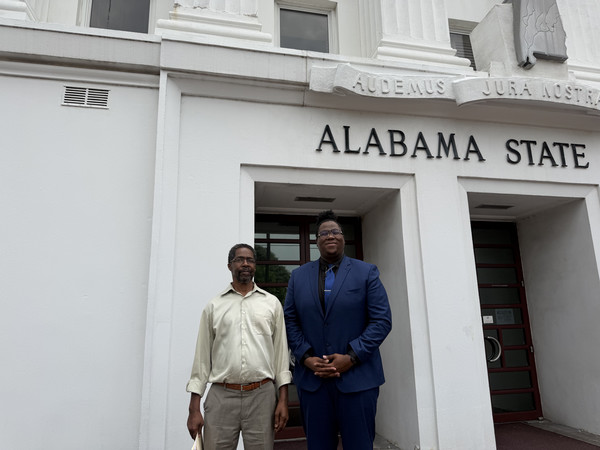
For Daniel Washington, the path to law school was never simply about earning another degree. It was about expanding his ability to serve others.
A third-year student at Samford University's Cumberland School of Law, Washington is also pursuing a Master of Public Administration at the University of Alabama at Birmingham. After earning a Master of Social Work and working in that field, he came to Cumberland looking for new ways to advocate for others.
Through the law school’s Innocence Clinic and a summer externship with Alabama Appleseed Center for Law & Justice, he has gained firsthand experience that is shaping his future in criminal defense and systems reform.
Learning the Power of Advocacy
This summer, Washington externed with Alabama Appleseed, a nonprofit organization dedicated to promoting justice and improving the lives of vulnerable Alabamians. His work included legal research, policy advocacy, client support and legislative engagement focused on criminal justice reform initiatives.
Washington attended an Alabama Prison Oversight Hearing alongside Alabama Appleseed client Carl Green, who spent 36 years incarcerated and now advocates for prison reform. During the hearing, Green shared his experiences inside Alabama's prison system, including serving as an unofficial "prison doctor" who provided emergency medical care to fellow incarcerated individuals when professional medical resources were unavailable.
"After spending 36 years in prison, Carl has become a powerful advocate for prison reform," Washington said. "His testimony was not about celebrating those extraordinary acts. It was a call for change."
Green urged policymakers to address the conditions that forced incarcerated individuals to rely on one another for lifesaving care, emphasizing the state's responsibility to provide safe, humane conditions and adequate healthcare for everyone in its custody.
"My externship showed me how legal advocacy, policy reform and community partnership can work together to create meaningful change," Washington said. "It strengthened my commitment to a career in criminal defense and systems reform."
Pursuing Justice Through the Innocence Clinic
Washington's commitment to criminal justice reform has also been shaped by his participation in Cumberland's Innocence Clinic. The clinic allows students to investigate claims of factual innocence by incarcerated individuals in Alabama. Students review case records, interview witnesses, investigate facts, research post-conviction relief options and help connect individuals with credible claims to legal representation.
"My time in Cumberland's Innocence Clinic was one of the most formative experiences of my legal education," Washington said. "What makes Cumberland's clinics so special is that students can do good work for real people while being guided by extraordinary professors and attorneys every step of the way.
"The Innocence Clinic allowed me to apply the knowledge I gained in the classroom to real cases, teaching me to critically examine records, investigate claims and advocate for individuals the criminal legal system may have left behind," Washington said. "It showed me that effective lawyering is often found in the details, the willingness to thoroughly review a record, question assumptions and think critically about every aspect of a case before concluding."
Most importantly, he said, the clinic reinforced the values that initially inspired him to pursue a legal career.
"It reinforced my belief that the pursuit of justice is one of the legal profession's highest callings and strengthened my commitment to being an advocate who approaches every case with diligence, integrity and compassion."
Building on a Foundation of Service
Dean Blake Hudson said experiential learning remains a cornerstone of Cumberland’s legal education because it allows students to develop practical skills while making a meaningful difference in the lives of others.
"The law is ultimately about service," Hudson said. "Through our clinics, students receive hands-on training while serving some of the most vulnerable members of our community. Daniel has fully embraced these opportunities and excelled in them. His commitment to justice, his passion for serving others and his willingness to engage deeply in this work embody the very best of Cumberland's mission."
As Washington prepares for his final year at Cumberland, he sees a direct connection between his background in social work, his legal education and his future career aspirations.
Through the Innocence Clinic and his externship with Alabama Appleseed, Washington has seen firsthand how advocacy can impact both individual lives and broader systems. The experiences have strengthened his commitment to criminal defense and reform while reinforcing the service-driven values that first inspired him to pursue a legal career.
During his third year, he and classmate Harper Cook will serve as Cumberland's public interest liaisons, helping connect students with similar opportunities for hands-on learning.
For Washington, helping people remains the goal. Law has simply given him another way to do it.
GIVE: Support clinical and experiential education at Cumberland School of Law.
