


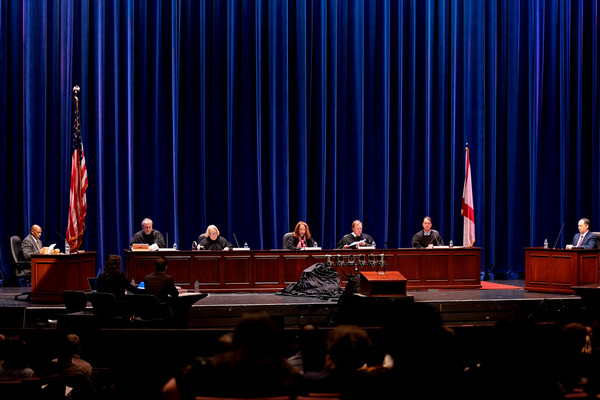
Samford University’s Cumberland School of Law and the Birmingham Bar Foundation partnered to host oral arguments of the Alabama Court of Criminal Appeals in Samford’s Wright Center on March 5. The event brought together Samford undergraduate students, Cumberland School of Law students, and high school students from the Birmingham area for a rare educational experience.
The program opened with welcoming remarks from Cumberland School of Law Dean Blake Hudson, who expressed the school’s gratitude to the Birmingham Bar Foundation and to the judges and attorneys participating in the day’s proceedings. Hudson emphasized the significance of hosting the appellate courts on campus, noting that while students spend countless hours studying appellate opinions in casebooks, opportunities to see the judicial process unfold in real time are invaluable.
“Seeing oral arguments firsthand helps illuminate how legal principles move from theory to practice,” Hudson said. “Experiences like this remind us that the law is not merely an academic discipline; it is a living system dedicated to the pursuit of justice.” He also highlighted the judiciary’s commitment to transparency and education, thanking the judges for bringing their work into the university community.
Following Hudson’s remarks, greetings were offered by several distinguished guests, including Candis McGowan, president of the Birmingham Bar Foundation, and Cumberland alumna Judge Elisabeth French, JD ’97, presiding judge of Alabama’s 10th Judicial Circuit.
The Alabama Court of Criminal Appeals—Presiding Judge Mary B. Windom and Judges J. Elizabeth Kellum, J. William Cole, Richard D. Anderson, and Cumberland alumnus Richard J. Minor, JD ’93—presided over the hearings. Windom introduced the panel and underscored the court’s goal for the day, stating, “By bringing these oral arguments to you, we hope you will garner a better understanding of our judicial system.”
During the session, the court heard arguments in two criminal cases. In one of the cases, Cumberland alumnus Kyle Beckman, JD ’11, assistant attorney general in the Alabama Attorney General’s Office, represented the State of Alabama.
The event offered attendees a firsthand look at the appellate process, allowing future legal professionals to observe the careful questioning, disciplined reasoning and professionalism that define appellate advocacy. Events like this affirm Samford's national standing, currently ranking #7 in the nation by The Wall Street Journal for student learning opportunities.
William Wethington, a third-year Cumberland School of Law student and editor-in-chief of the Cumberland Law Review, was among many law students in attendance. He said, “Attending the oral arguments was fascinating. It was a great opportunity to witness, in real time, the judicial process. I was also impressed with the attorneys who argued before the court. The cases were complex, and there is nowhere to hide up there. It’s just the attorneys and the judges. There was also a great deal of overlap in the principles I’ve learned during law school. The attorneys argued about the standard of review, statutory interpretation, and even the Constitution. I hope the Court returns to Samford in the future. It is a great experience for everyone, perhaps more so for a law student.”
