


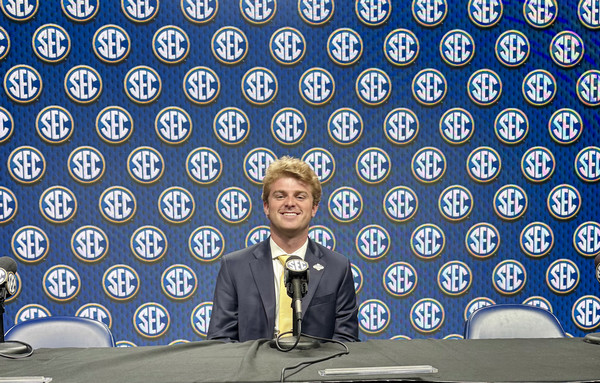
Carter Crum, a second-year student at Samford University Cumberland School of Law, has been participating in an externship with the Southeastern Conference (SEC) this spring. Crum has benefited from hands-on learning at the intersection of athletics, law, business and compliance. Crum will continue his experiential learning this summer while working in Auburn University’s athletics compliance office. With a Cumberland School of Law foundation and a myriad of experiences under his belt, Crum will be well-equipped to enter his career in collegiate athletics once he graduates.
Can you explain your role as a law student extern with the Southeastern Conference?
My work as an extern with the SEC has largely focused on basketball-related projects that help support the conference and its member institutions. A big part of what I’ve been doing involves working with NCAA Tournament metrics to help build arguments for SEC teams when it comes to tournament selection and seeding. My goal is to find the strongest possible way to present the data so that SEC programs are viewed in the best light compared to teams from other conferences. I’ve also worked on projects tracking players from last year’s SEC class who have appeared in at least one NBA game, so schools can highlight the conference’s success at the professional level. It has been a really interesting mix of analytics, research and advocacy that supports the conference’s work behind the scenes.
How has this experience expanded your understanding of how college athletics operate behind the scenes?
One of the biggest things I’ve learned is how conference offices balance neutrality with advocacy. The SEC represents 16 different schools, requiring the conference staff to remain neutral and treat each institution fairly. At the same time, there’s a strong sense of advocacy for the conference, wanting as many SEC programs as possible to succeed nationally. That means trying to position multiple teams for NCAA Tournament bids and strong seeding whenever possible. It’s interesting because even if one SEC team may clearly be stronger than another, the conference still wants to find ways to support the success of all 16 member institutions.
What are some responsibilities you’ve been trusted with during the externship?
A lot of my work has involved helping build arguments around NCAA Tournament seeding for SEC teams. That includes identifying metrics that support an SEC team receiving a No. 1 seed, stronger overall seeding across the bracket, or helping SEC bubble teams make the tournament. Sometimes the numbers are straightforward, but other times the challenge is finding creative ways to highlight the strongest data points that support an SEC program’s case. It becomes a process of organizing the metrics in a way that tells the best story about a team’s resume. The research related to former SEC players currently in the NBA showsand how the conference’s talent translates to the professional level. I’ve also spent time looking at transfer trends and how certain conferences compare in terms of player development after players move schools.
Which skills from law school have you relied on most in this role so far?
The biggest skill I’ve relied on is the ability to combine analytics with advocacy. Researching the data is pretty easy, but the real challenge is figuring out how to take that information and turn it into a persuasive argument. In many ways, it feels similar to building a legal argument where you’re identifying the strongest facts that support your position. Sometimes one team’s resume might look stronger at first glance, but there are ways to frame the metrics that highlight the strengths of another team. That process of finding the winning argument and presenting it clearly is something for which law school prepares you.
How has working at the SEC shaped your perspective on compliance and governance in college sports?
Working at the conference level has opened my eyes to how complicated compliance and governance have become in college athletics. Right now, the industry is trying to balance two goals that sometimes feel like they’re pulling in opposite directions. On one hand, schools want to preserve the traditions and structure that have defined college sports for decades. On the other hand, NIL and revenue-sharing conversations are pushing the system toward a new model where athletes have more financial opportunities. Most administrators genuinely want athletes to benefit from their success, but there’s concern about the current pace of change, the lack of guardrails for payment plans and how it is not sustainable long term. Watching those conversations happen in real time has given me a much deeper appreciation for how difficult it is to shape policy in this environment.
What have you learned about the legal challenges surrounding NIL and student-athlete rights?
One thing I’ve learned is that there really isn’t a clear legal solution to NIL right now. During the SEC Tournament, I attended a panel with a commissioner, an athletic director, a major agent and a coaching search consultant, and all four of them had unique perspectives on where things are headed and solutions to the problems. The two solutions that kept coming up were either Congress passing legislation addressing college athletics or some form of collective bargaining agreement between athletes and institutions. The problem is that both options come with major challenges, and neither side seems likely to agree on a single approach anytime soon. One idea that stood out was granting the NCAA a kind of hybrid legal status so the people involved in college athletics could work together to design a system that makes sense. Many people in the industry worry that if Congress writes the rules itself, the laws could easily be too narrow or too broad and create even bigger problems that are unforeseen.
What professional strengths have you discovered through this experience?
One thing I’ve learned about myself is that I really thrive in environments where I’m deeply interested in the work. College athletics has been a huge part of my life for a long time, and working in this field honestly feels more like something I enjoy than traditional work. Even when projects require a lot of time and patience, I find it easy to stay focused because I care about the subject matter. This experience has helped me develop more persistence when working through complicated problems. Sometimes these projects require a lot of trial and error before everything comes together. Being willing to stay patient and keep working through those challenges has been an important skill to strengthen.
What does it mean to you to contribute—even as a student—to an organization as influential as the SEC?
“It just means more.” This tagline for the SEC really sums up how I feel about this opportunity. The SEC has dominated college football for decades and has recently become one of the strongest conferences in college basketball as well. Being able to contribute this year to the continued success of the conference is something I consider a privilege. It’s also given me a completely new perspective on how conference offices operate and support their member institutions. I have now seen first-hand how much work goes into advocating for programs and helping position the conference nationally. Overall, this has been an absolute blessing from the Lord, and I am so honored to have had this opportunity.
What’s one takeaway from this externship that will stay with you throughout your legal career?
One of the biggest lessons I’ll take from this experience is the importance of helping others when you have the chance. I am very aware that the SEC did not have to accommodate my request to work for them this year. They rarely take on interns, and to my knowledge, this internship was the first of its kind. Their willingness to invest time and energy into helping me gain experience in such a competitive industry is something I’ll always be grateful for. It showed me how meaningful it can be when professionals take the time to support someone who’s trying to build a career. It’s something that I am excited to pay forward one day.
