


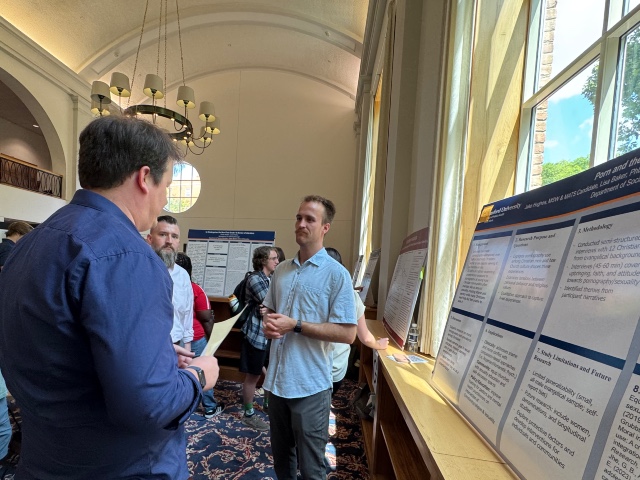
Jake Hughes, a student in Samford University’s Master of Arts in Theological Studies and Master of Social Work joint degree program, presented research on pornography consumption patterns among Christian men during the university’s fifth annual Student Research Colloquia on April 24.
According to his presentation, Hughes’ research explored how religious culture around sexuality shaped their experiences with pornography use, guilt and identity. Hughes conducted 45-60 minute interviews with 12 men from evangelical backgrounds and identified five major themes from those conversations:
- A lack of comprehensive sex education in church, home and school
- Early exposure to pornography typically between the ages of 8 and 13
- Pervasive guilt and shame that often created cyclical patterns of consumption and distress
- A perception that religious communities were not safe spaces for discussing sexual struggles
- Negative impacts on relationships and self-perception
“Pornography is a tragic epidemic, even within the church,” Hughes said. “At least half of Christian men report watching porn, and that’s assuming everyone is telling the truth. There is a great need for the church to take a hard look at this problem and provide education and support for those struggling.”
Hughes’ findings align with existing research on moral incongruence while revealing a need for clinical approaches to address that issue and the issue of shame, rather than solely focusing on behavioral change.
“Mezzo-level collaboration with faith communities must develop healthier sex education and support systems, while comprehensive programs at the macro-level would benefit by including religious communities,” Hughes said in his abstract.
Christian communities must transform the cultural conditions of silence, shame and inadequate sex education to help solve this problem, Hughes said.
As he pursues his joint degree, Hughes said he hopes his career entails regular work with those working through unwanted sexual expression.
“I’m hopeful my career entails significant work in secular and faith spheres, where each degree enhances my abilities uniquely,” Hughes said. “The MSW provides me with practical support and training. Already grounded in the Christian worldview, the courses work well with my studies at Beeson, helping frame all work within God’s greater vision of restoration. The MATS gives me an exciting opportunity to work hand in hand for and with the church in the future.”
Beeson has shaped his view of both God and the church’s purpose, Hughes said, helping him understand that the reason the church must be more active in conversations about sexuality and pornography is “not to shame individuals, but to point towards, and help create, a better way of life.”
The MSW has taught Hughes to look at social issues through a systemic lens, helping him see that pornography is not an isolated issue.
“It stems not from a boy with uncontrolled desire, but from failures on the macro and mezzo levels (school and church) to teach the goodness of sexuality and the addictive dangers of pornography,” Hughes said. “If these conversations are framed as pushing one towards healthy expressions of their humanity and God-given sexuality, then porn loses its grip of shame. The MSW has helped me understand that one’s unwanted behavior is the result of more than a momentary choice, but the symptom of greater societal problems.”