


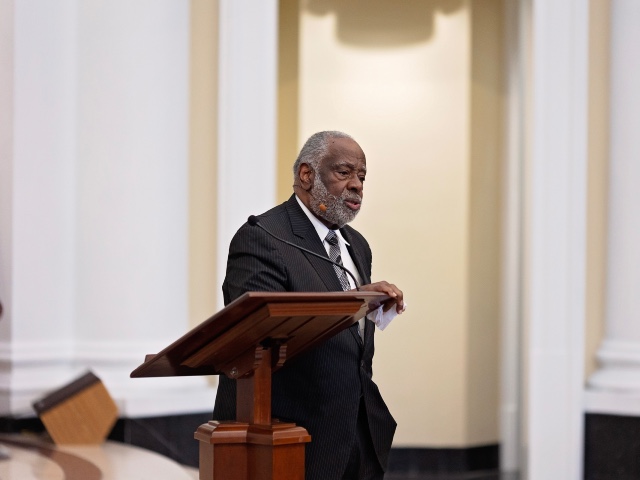
In late March, Samford University’s Beeson Divinity School welcomed longtime preaching professor Robert Smith Jr. back to campus for the 2026 William E. Conger Biblical Preaching Lectures.
Smith preached in chapel, delivered two lectures and spent time talking with students and guests about his career in preaching during a lunchtime conversation facilitated by Beeson’s Spirit and Power Project.
In his sermon, “I Don’t Know Where I’m Going, But I Ain’t Lost,” Smith preached about the necessity of tested faith.
“Faith in the promises of God is not based on knowledge of where we are or knowing when we will get there, but on the knowledge of the One who is guiding us,” Smith said. “Untested faith is no faith at all,” Smith said. “God must test us, God must try us, in order to refine us, in order to make us more and more like Himself.”
Drawing from the example of Abraham, who in Genesis 22 was tasked with sacrificing his son Isaac on Mount Moriah, Smith told guests that no matter how their ministry has been going, they will go to “your Mount Moriah.
“But joy will come in the morning,” Smith said. “God is always on time. He is never early and He is never late. You may not know where you’re going, but you’re not lost, because God is leading you.”
Preaching Beyond Mere Words
Smith focused his lectures on the need for preachers to use images and imagination in their preaching.
“For every doctrine, there is a picture,” Smith said. “Find the picture in the Bible. An effective teacher turns ears into eyes, so that what is heard is now seen.”
Smith reminded listeners to preach from both the Old and New Testaments and not to let the picture be divorced from faithful exegesis.
“The point of the picture is to point to the text and not itself,” Smith said. “Make sure your picture is right. Retain the theological dictionary but expand your vocabulary and let it include imagistic words so that people can see what you’re saying.
“The pulpit is not a lecture stand; it is a witness stand,” Smith said.
In this day and age, it can be difficult for preachers to use their imagination, Smith said. Likening the imagination to the number on a gift card that must be scratched to be revealed, Smith encouraged listeners to dig deep and bring their imagination to their preaching.
“Our imagination, I believe, is drying up or has dried up,” Smith said. “I don’t think we pause enough, scratch enough to be imaginative. We want it to automatically appear because we’ve got these buttons (on our phones). Technology is outrunning our imagination.”
“We’ve lost our wonder with God’s Word,” Smith said. “We think we’ve seen it all. To be fresh, you’ve got to fall in love with the Bible again.”
“My Experience Has Caught Up With My Exegesis”
In a lunchtime conversation with students and guests, Smith talked about the preachers who impacted him, encouraged listeners to read more theology and urged them to have a right response to their own preaching.
In his early years, Smith said he wishes he would’ve read more theology. He also said he tended toward self-praise and self-criticism, rather than resting in Christ.
“I’d celebrate more,” Smith said. “I always asked my students if they had fun preaching (when they preached in class).”
Talking about how his preaching changed after the murder of his son, Tony, in 2010, Smith said his “experience has caught up with my exegesis.” The experience has enabled him not only to preach about suffering in the abstract, but also as someone who has walked through the flames.
“It’s one thing to preach about the three boys in the fiery furnace,” Smith said. “But people want to know if you’ve been in that fiery furnace. Did the fourth man show up before you got there?” You move to, ‘I know,’ not, ‘I hope.’
“Because of past experience, I have present confidence because of what God has done,” Smith said.