


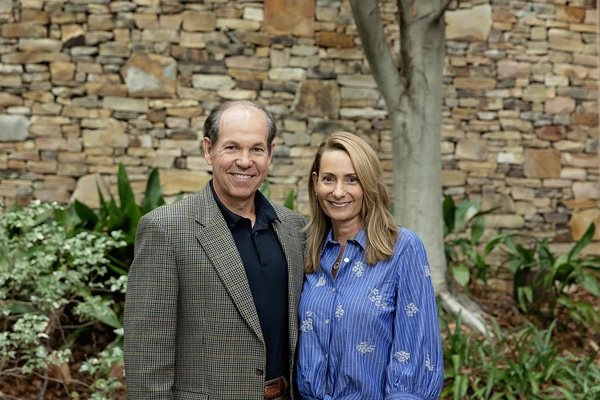
This fall, Samford University’s School of Health Professions launched the Listening and Spoken Language Focused Study Initiative (LSL-FSI), a program made possible by a transformative gift from Samford parents Andi and Steve Hill.
More than 90% of babies who are deaf or hard of hearing are born to parents with typical hearing. Andi and Steve Hill understand this deeply. All three of their children, Jessica, Jared and Julianne, were diagnosed with recessive sensorineural deafness.
“From the start, our focus was simply on giving our children the same opportunities as everyone else,” Andi said. “We took one step at a time, learning as we went.”
With limited early detection and intervention at the time, the Hills explored every option for diagnosis and communication. For their children, they chose the Listening and Spoken Language (LSL) communication mode.
“Our journey required quick learning, hard work, perseverance and faith,” Andi said.
The LSL communication mode relies on optimized hearing technologies, specialized early intervention with certified professionals and robust parent-professional partnerships. These cornerstones ensure children develop language skills comparable to their hearing peers by first grade. It is one of several communication approaches available to families of children who are deaf or hard of hearing.
“Many factors influence family choices, but what unites them is the desire to give children the foundations to reach their potential,” Andi said. “For kids who are deaf or hard of hearing, time-sensitive steps must be taken to build that foundation.”
The Hills’ experience differed with each child. Andi’s advocacy, combined with her children’s unique experiences, revealed barriers that inspired their desire to create new opportunities for families and students.
“One of the biggest needs is for certified LSL professionals not just in Alabama, but across the country and around the world,” Steve said.
For more than a decade, Samford has been a meaningful presence in the Hills’ lives. Their daughter, Jessica, earned her Bachelor of Science in exercise science from Samford in 2016 and, ultimately, her Doctor of Physical Therapy, becoming the first person in Alabama born deaf, using cochlear implants and the LSL communication mode, to achieve an advanced degree. Julianne, their youngest daughter, graduated from Samford in 2023 with a Bachelor of Science in sports medicine and will complete her Master of Science in Physician Assistant Studies this December. Their son, Jared, operates his own business, and their two sons-in-law are also Samford alumni. The Hills value Samford’s national reach and commitment to expanding academic opportunities.
In 2024, after a series of meetings and much prayer, the Hills partnered with Alan Jung, then dean of the School of Health Professions, department chair Angie Barber and assistant professor Kameron Carden to lay the groundwork for the LSL-FSI.
“God has given us unique experiences and blessed us with resources. We want it to be easier for those who come after us, and we want more people equipped with the professionalism and excellence needed to serve these children and their families,” Steve said.
Housed in the Department of Communication Sciences and Disorders, the LSL-FSI program will provide master’s students in speech-language pathology with advanced experiences and courses in the LSL communication mode, preparing them to serve children who are deaf or hard of hearing.
Carden, who will lead the initiative, is a certified Listening and Spoken Language Specialist with more than 15 years of experience in language development, assessment and eligibility for preschoolers who are deaf or hard of hearing. Her expertise will be vital as she guides students through evidence-based training and prepares them to help the children they serve.
“Samford students will leave this program confident in evidence-based practices and prepared to help children learn to listen and talk as well as their families,” Carden said.
Certified LSL specialists complete advanced training and mentorship focused on early intervention, auditory-verbal techniques and speech development. This family-centered approach empowers parents to build language into daily routines, helping their children thrive. Samford’s LSL-FSI program will also support research, travel, clinical placements, recruitment and marketing through the Hill LSL Endowed Excellence Fund.
The Hills’ experience reflects the impact professionals can have when they partner with families in a spirit of empathy, faith and shared growth.
“We long for the day when children who are deaf or hard of hearing and their families face fewer barriers, equitable access to their desired communication mode, better support and enhanced access to appropriately qualified certified providers,” Hill said.
Guided by God’s grace, the Hills’ gift to create Samford’s LSL-FSI program supports early intervention for children who are deaf or hard of hearing, demonstrating the power of partnering with families in faith, empathy and shared growth. Their story reflects how professionals can positively impact families when these principles are applied.
“What began as a season of grief and an unexpected career change became decades of work on behalf of people who are deaf and hard of hearing,” Andi said. “It has transformed into something far beyond what we could have expected or imagined. With the lessons we’ve learned and the way God has grown our hearts, it’s a privilege to partner with Samford in making the LSL-FSI a reality.”
The LSL-FSI program exemplifies Samford’s national distinction, ranked by The Wall Street Journal as #3 in career preparation and #7 in student learning opportunities, showcasing the university’s commitment to hands-on, career-ready education.
GIVE: Join the Hills in supporting the Listening and Spoken Language Initiative.
Listening and Spoken Language Focused Study Initiative
