


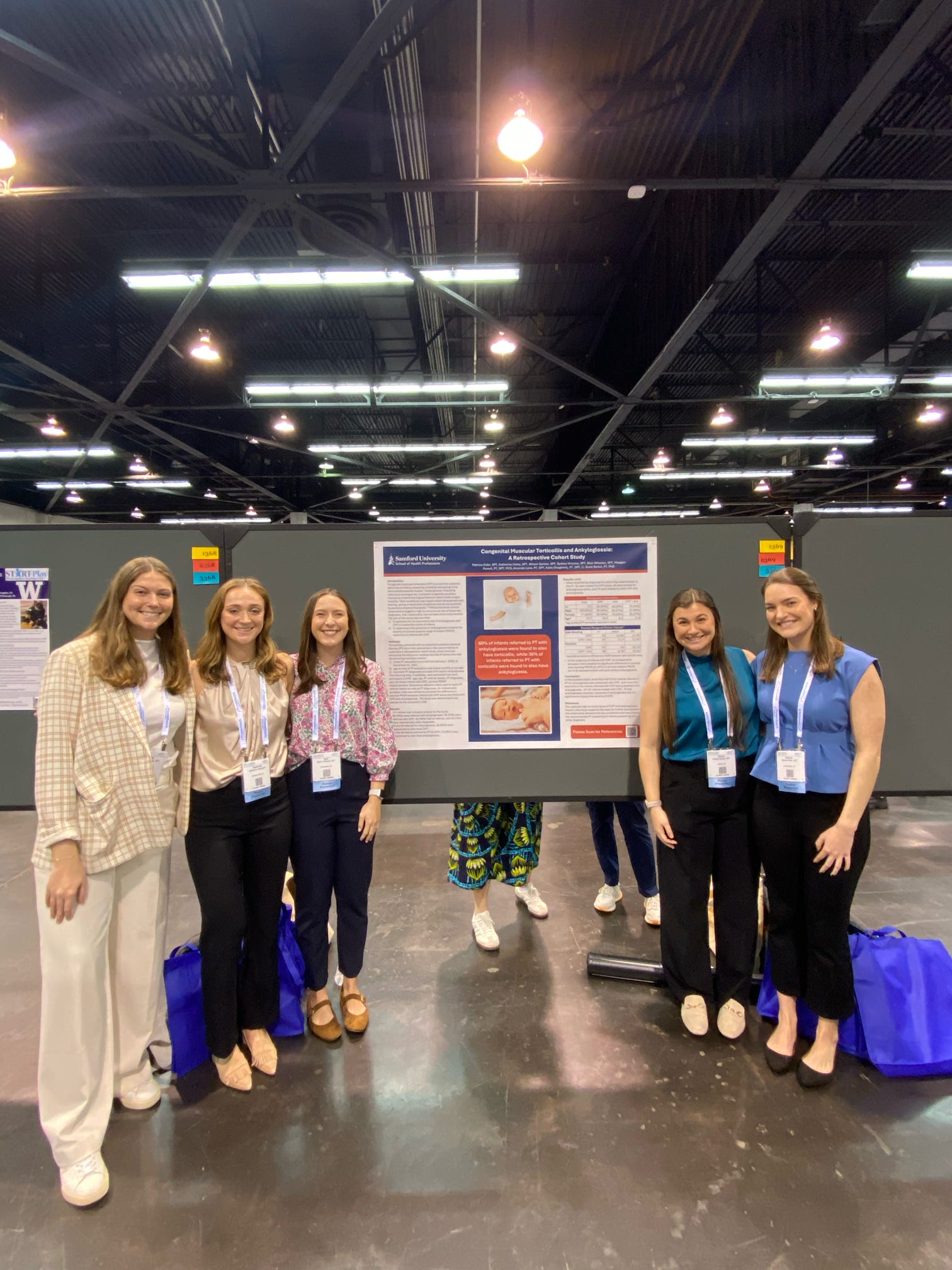
Each year, second-year students in Samford’s Physical Therapy program select capstone research projects inspired by their own passions or interests and have the opportunity to present at national conferences or to be published in peer-reviewed journals.
This year, two of these student groups were selected to present their work at the American Physical Therapy Association’s Combined Sections Meeting in Anaheim, California. This is the physical therapy profession’s largest national conference, with more than 15,000 attendees this year.
Patsy Elder, Blair Wheeler, Katherine Haley, Allison Sartain and Sydney Vincens presented "Congenital Muscular Torticollis and Ankyloglossia: A Retrospective Cohort Study.”
Abbie Sims represented the rest of her group (Anna Flebotte, Hannah Deloney, Lacy Jones) in presenting: "Patient Perceptions of Quality of Care among Spanish-Speaking Patients in a Student-led Physical Therapy Clinic.”
Wheeler and her group’s research explored the relationship between two conditions – congenital muscular torticollis and ankyloglossia, which are commonly seen in infants. The research explored whether the presence of ankyloglossia impacted the severity of the restriction of cervical passive range in infants with congenital muscular torticollis.
“This project became much more meaningful to us as we partnered with a local pediatric clinic and spent time each week reviewing hundreds of patient charts,” Wheeler said. “It was a very hands-on process, requiring patience and careful attention as we worked through objective data and clinical assessments. Knowing each chart represented a real child and family made the work feel purposeful and motivated us to approach the research with both diligence and compassion.”
Presenting their findings was “incredibly rewarding,” Wheeler said.
As she pursues her career in physical therapy, Wheeler said the research has made her more “intentional and aware, prompting me to look beyond a single diagnosis and consider the possibility of co-occurring conditions that could influence a child’s development.”
“I feel more equipped to think critically and advocate for my patients in a more holistic way,” Wheeler said. “Presenting our work reminded me that even as a student, I can play a role in improving care and outcomes for the patients that I serve.”
Abbie Sims said her groups’ research was the result of a personal “passion project.”
“When we chose this topic, our group had just begun working with Cahaba Medical Care, which partners with Samford’s Department of Physical Therapy to provide physical therapy services in medically underserved populations,” Sims said. “Having had experience serving in medical missions in Spanish-speaking countries, I understood how much can get lost in translation, and I sought to make sure this was not the case within the sphere of Samford.”
Sims said most patients reported high satisfaction with their care, they reported language was a significant barrier, despite the availability of translator services on site. The research will help the clinic address this deficit and elevate the standards of care for all populations, Sims said.
The project helped Sims become more aware of the needs in her community and “more cognizant of how I can be a change agent and more intentional in the time I take with each patient, no matter their background,” she said.
Being at the conference allowed Sims and her group the opportunity to affect change in physical therapy across the country, build meaningful personal connections as they move forward in their career and represent Samford on the national stage, she said.
“Attending this conference has opened avenues across the country to increase the quality of care in all patient populations and has provided me with connections that will elevate my opportunities to serve in the field of physical therapy,” Sims said. “In representing Samford, I was able to carry the mission and values of the School of Health Professions with me and display the heart of 1 Peter 4:10.”
Assistant Professor Maegan Powell said presenting at these conferences helps students gain skills in the “development and performance of primary research, the submission and review process for professional presentations and the communication skills necessary to concisely convey their research findings to colleagues.”
“Even if they are not planning on being primary researchers once they graduate, their ability to access and understand research and communicate effectively and professionally will help them serve their future patients well,” Powell said.
These students’ accomplishments also bolster Samford’s reputation, Powell said.
“Having students present at the national conference year after year shows prospective students our commitment to contributing to the body of research that guides our profession, as well as to helping them achieve all of their professional goals,” Powell said.
