


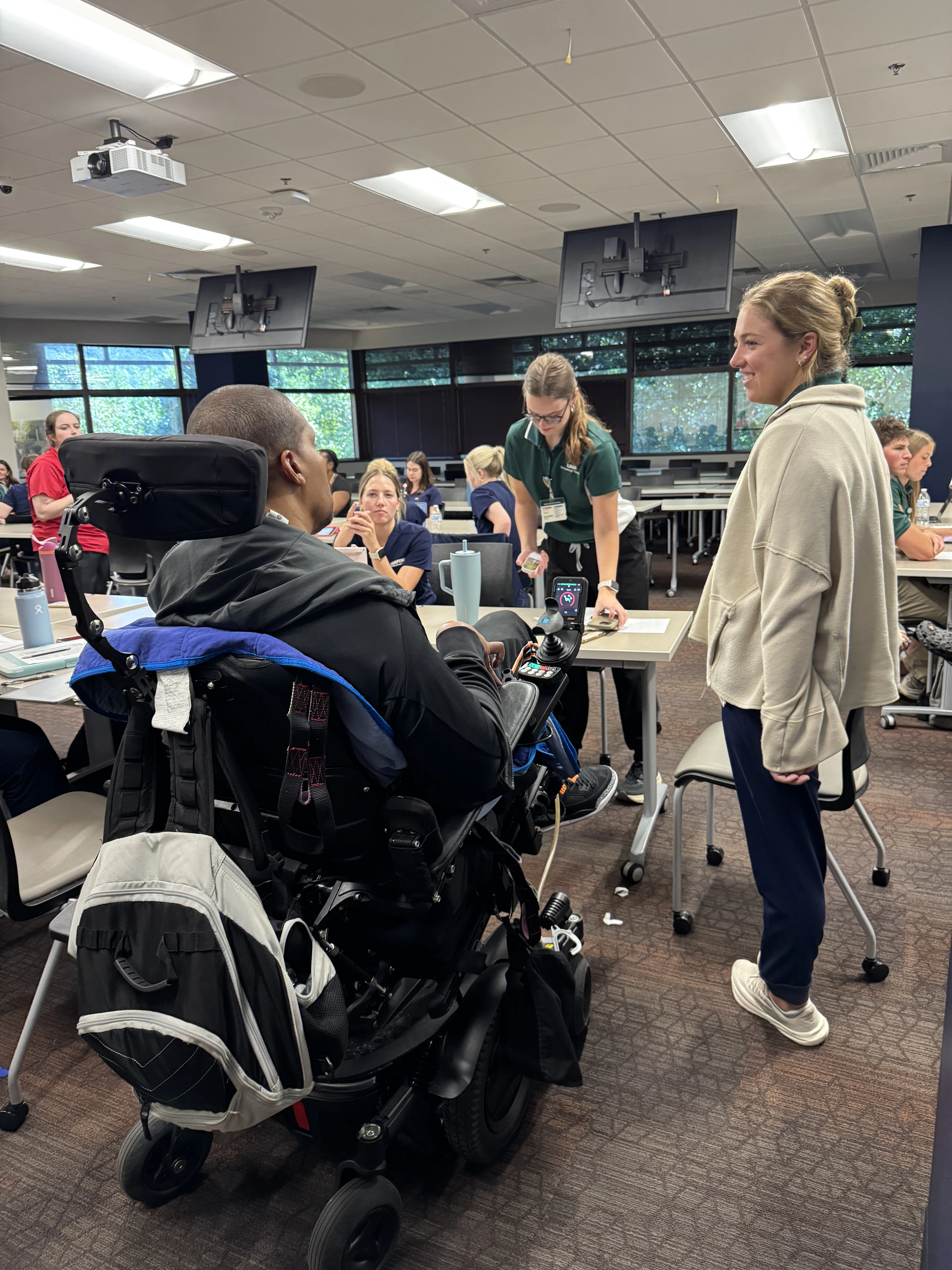
For three days each summer, students in majors across Samford University's College of Health Sciences step beyond the classroom to work directly with survivors of traumatic brain injury (TBI).
Physician assistant, physical therapy and speech-language pathology students partner with occupational therapy students from the University of Alabama at Birmingham to evaluate TBI survivors, develop individualized treatment plans and experience firsthand how collaborative care can change lives.
Hosted in partnership with the Alabama Head Injury Foundation (AHIF), Bright Ideas TBI Camp has brought students, survivors and caregivers together each summer since 2018. The camp provides individualized assessments, therapeutic interventions and practical strategies for survivors while giving future healthcare professionals an immersive interprofessional learning experience.
A traumatic brain injury can result from events such as falls, motor vehicle accidents or sports injuries and may affect movement, communication, memory, emotions and independence.
"This camp delivers targeted services to TBI survivors and their caregivers while giving students a unique chance to collaborate across disciplines and serve a population they may not typically encounter," said Kelly Atkins, associate professor in Samford's physical therapy program.
Unlike a traditional clinical rotation, students spend three consecutive days with the same participant, building relationships and gaining a deeper understanding of each person's goals and challenges. Throughout the week, teams evaluate participants, develop treatment plans and adapt activities to help each individual meet their goals.
For third-year Doctor of Physical Therapy student Mason DiPasquale, the experience shifted the focus from limitations to possibilities.
"Our camper had been told so much about what they would never be able to do," DiPasquale said. "Every discipline worked together to educate, encourage and help both our camper and caregiver see new opportunities for recovery."
Students used activities such as fishing, basketball, kayaking simulations, Wii Sports and dancing to improve strength, mobility, communication and everyday function.
"We can apply what we've learned throughout school while challenging ourselves to think outside the box," DiPasquale said. "We found ways to make treatment engaging and uniquely suited to every camper, regardless of the severity of their injury."
For Lily Prout, a second-year Master of Science in Speech-Language Pathology student, the experience reinforced the value of interprofessional care.
"It was rewarding to see each discipline contribute its unique expertise while working toward the shared goal of providing the best possible care for our client," Prout said. "I learned so much from the other professions and gained an even greater appreciation for patient-centered care."
Beyond developing clinical skills, Prout said the camp reflected Samford's mission of serving others through faith.
"At Samford, we have the opportunity to view our future careers not just as professions but as ministries through which we can serve others and glorify God," Prout said. "From providing hope and encouragement during therapy to praying with our client and caregiver, it was a gift to be part of her story."
Second-year Master of Science in Physician Assistant Studies student Anne Madison Trammell said the relationships formed during camp made the experience unlike any other in her education.
"TBI Camp has been one of my favorite parts of PA school so far," Trammell said. "It taught me so much about treating the individual, not just their condition."
According to Scott Powell, executive director of the Alabama Head Injury Foundation, those relationships are one of the camp's most valuable outcomes.
"It's good for the students to experience how quickly those relationships can develop because that's something they'll carry throughout their careers," Powell said.
