


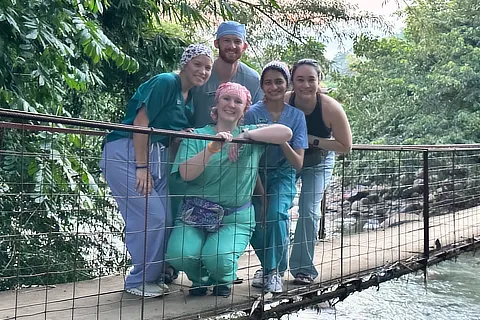
During a trip to Montellano, Guatemala, last year, several nurse anesthesia students from Samford University, accompanied by adjunct faculty member Mary Beth Greenway, DNP, CRNA, responded to a patient’s life-threatening complication and saved a life. What began as a routine surgical mission became a defining experience that illustrated how service, learning and faith intersect in real time.
The team traveled with Health Talents International, a Christian nonprofit supporting medical evangelism in Guatemala, and served at a rural hospital in Montellano that continues to recover from pandemic-related disruptions, regulatory changes and the effects of a recent earthquake.
While serving on the mission, a postoperative patient developed complications that required an immediate blood transfusion. The patient’s blood type was identified as A-positive, a relatively rare type, especially in this region of Guatemala
“There is no on-site blood bank, and regulations prevent our hospital from storing or administering blood without formal approval,” Greenway said. “A representative from the regional blood bank had to travel after hours to evaluate the patient and authorize an emergency collection.”
During that process, two Samford students discovered they were exact matches. After approval from the blood bank representative, the students donated and transfused their own fresh whole blood on-site, a practice rarely used outside military settings. Within minutes of the transfusion, the patient’s vital signs stabilized.
“This was one of those experiences that stays with you,” Greenway said. “Students stepped into a situation they could not have anticipated, and they responded with calm, confidence and care.”
After returning from Guatemala, Greenway and the team documented the experience as a case study, which was later published in the Journal of Christian Nursing. The study explains why whole-blood transfusion is uncommon in standard U.S. medical settings and outlines how the team applied principles often used in austere or military environments. The case now serves as a resource for clinicians preparing for emergencies when access to supplies and infrastructure is limited.
Experiences like these allow students to learn how to adapt when equipment, medications and systems cannot be taken for granted. Many plan to apply what they learned to future Doctor of Nursing Practice projects, including anesthesia preparation and creative approaches to medication formulation.
“The experience of providing anesthesia in a developing country is unmatched,” Greenway said. “Students learn how to use their knowledge and critical thinking skills to provide high quality care for patients using the resources in front of them, and that lesson carries into their future practice. The experience is life-changing, and the mission of service is imprinted on the hearts of our students.” Greenway began her surgical mission experience on a trip to Belize as a Samford Nurse Anesthesia student in 2008.
The impact of the Guatemala mission continues well beyond the trip itself, reminding students that nursing is both a science and a calling, and that some of the most important lessons are learned while serving others.
Since 2023, nine Samford University Nurse Anesthesia students have gone on trips with Health Talents International. Greenway has plans to return to Montellano twice in 2026 and another three Samford Nurse Anesthesia students are making plans to join on these trips as well.
