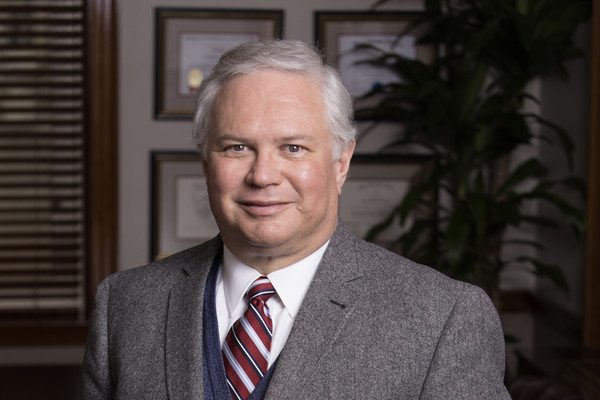
 After more than four decades in higher education, J. Michael Hardin, professor of quantitative analysis, will retire at the end of the spring semester, concluding a career defined by academic leadership, scholarly impact and service. Hardin came to Samford University in 2015 when he was hired as provost and vice president for academic affairs after serving as dean of the University of Alabama’s Culverhouse College of Commerce and Business Administration, where he also held roles as senior associate dean and associate dean for research. A nationally recognized scholar in quantitative analysis and data analytics, Hardin has played a central role in shaping academic excellence at Samford while also serving as a professor in Brock School of Business.
Below, Hardin reflects on his career and legacy as he looks forward to retirement.
What first led you to a career in higher education, and what kept you in it?
I’ve always wanted to teach. Early in my career, I worked in civil service with the Air Force, but I was teaching at night and realized that was what I really loved. When I was about 30, I decided if I was ever going to make the shift, I had to do it then. I left civil service in 1986 and moved into higher education, first at Mississippi State University and eventually at UAB, the University of Alabama and Samford.
What kept me in it was the opportunity to learn and help others learn. Higher education is demanding, but it’s meaningful work. Over the years, whether I was in the classroom or administration, I always felt called to serve students and institutions in a way that had long-term impact.
When you reflect on your time at Samford, what moments stand out as most meaningful to you?
It’s hard to point to just one moment, but commencement always stands out. Graduation is such a joyful and meaningful time for students and their families. As provost, my name was on every diploma, and earlier in my career as a dean, I had the opportunity to hand diplomas directly to students. Being part of that moment, seeing what it represented for families who had been dreaming about this for years was always incredibly moving.
Another meaningful season was guiding Samford through the COVID-19 pandemic. It was one of the hardest periods I’ve experienced professionally, but I was so proud of how the provost’s office and our academic leadership team came together. We worked long hours, including nights and weekends, to support students and keep the university moving forward in very unusual circumstances.
What do you hope students carry with them long after they leave your classroom?
More than anything, I hope students leave with an ongoing love of learning. College isn’t a "vaccine" where you get four years of education and never have to learn again. The world is changing too quickly for that. If students leave knowing how to keep learning, how to be curious and adaptable, that will serve them far better than any single course.
I try to teach in a way that encourages students not to shut the door on learning. Even in challenging subjects like statistics, my hope is that students see learning as something that continues throughout their lives.
Are there mentors or colleagues who had a lasting impact on your career?
I’ve been fortunate to work with many people who influenced me deeply. Dr. William Terrell “Dub” Edwards Jr., former Samford professor of religion and university chaplain, was a close friend and mentor, and someone I respected greatly. I also benefited from professional relationships with Samford leaders prior to my arrival, including Dr. J. Bradley Creed, former associate provost and executive vice president at Samford.
During my time as provost, I was supported by an exceptional leadership team. Colleagues such as Marci Johns, Susan Kalinich, Nidia Spence and many others in the provost’s office made everything we accomplished possible. Anything good that happened during that season was truly the result of teamwork.
What advice would you give to the next generation of students?
Stay curious and commit yourself to lifelong learning. Careers will change, industries will change, and many of the jobs students will hold don’t even exist yet. The most successful people will be those who know how to keep learning and adapting.
Education is not just about getting a degree—it’s about developing the ability to teach yourself new things as life unfolds.
What are you most looking forward to in retirement?
Spending more time with my family, especially my grandchildren. Both of my children live here in Birmingham, and being present for that season of life is a real gift.
I’m also looking forward to continuing my own learning. Music has become a big part of my life. I play piano, take classes and even participate in recitals. Learning doesn’t stop in retirement. For me, it’s just taking a different shape.