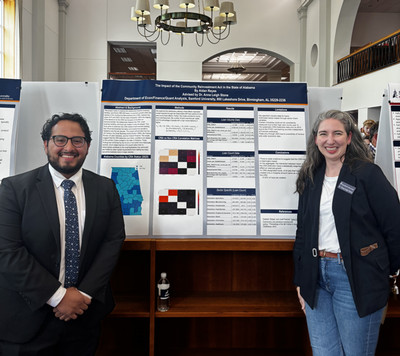
 Samford University’s Brock School of Business was well represented at the fifth annual Student Research Colloquia on Friday, April 24. The Research Advisory Collaborative, in partnership with the Office of Research, hosted the public forum where both undergraduate and graduate Samford students presented their scholarship and research. Brock Scholar Aidan Reyes, a senior finance and computer science major, was one of the winners in the undergraduate research category.
Reyes’ award-winning research examined the impact of the Community Reinvestment Act (CRA) on small-business lending and job creation across Alabama. Focusing specifically on SBA 504 loans between 2015 and 2023, Reyes explored how CRA-related lending influenced business formation and employment growth at the county level. While much of the existing research on the CRA centers on homeownership, Reyes’ project addressed a less-studied area by analyzing the law’s relationship to small-business development and local economic outcomes.
Using data from the U.S. Census, Small Business Administration, Bureau of Labor Statistics and the Federal Reserve, Reyes employed a fixed-effects regression model that controlled for unemployment rates, bank branches per capita and educational attainment. His findings indicated that CRA designation alone did not significantly contribute to job creation in Alabama, reinforcing long-standing concerns within the banking industry about regulatory constraints that limit small-business lending. Reyes was mentored by Anna-Leigh Stone, associate professor of finance, whose guidance supported the project’s rigorous quantitative approach.
Also representing Brock School of Business at the colloquia were fellow business students Sarah Childress, Anna Lynn Harms and Leah Watson, whose projects explored economic behavior and institutions from distinct but complementary perspectives.
Childress investigated how individuals’ expectations about future Social Security benefit reductions affected private retirement savings behavior. Drawing from the University of Michigan’s Health and Retirement Study, her analysis revealed that subjective expectations of reduced benefits were not a significant driver of savings behavior. Instead, traditional economic and demographic factors such as income, age and job tenure played a larger role, consistent with the life-cycle savings hypothesis. Mentored by Cam Pearce, assistant professor of accounting, Childress’ research highlighted a concerning disconnect between perceived policy risk and personal financial preparedness.
Harms examined how institutional barriers shape entrepreneurial activity and economic growth through a comparative analysis of the United States and South Africa. Her research explored how factors such as regulatory demands, inequalityand limited access to capital can discourage new business formation and suppress long-term growth. Drawing on measures of economic freedom and Total Early-Stage Entrepreneurial Activity, Harms analyzed how fewer institutional constraints are associated with higher investment levels and GDP per capita. Mentored by Art Carden, professor of economics, her work connected classical economic theory with modern data to illustrate how open and accessible institutions foster innovation, productivity and sustained economic prosperity.
Watson’s research bridged economic theory, history and institutional analysis through a study of social capital rooted in Alexis de Tocqueville’s Democracy in America. Mentored by Art Carden, professor of economics, Watson examined how early American institutions and civic norms contributed to long-term economic success and whether those characteristics persist today. By integrating modern measures of economic freedom and social capital into established growth models, her work raised thoughtful questions about institutional erosion while affirming the enduring importance of strong civic and economic foundations in sustaining prosperity.
Each of these student projects exemplified Brock School of Business’ commitment to cross-disciplinary exploration and calling-driven education. Whether exploring faith amid crisis, analyzing athletic finance or uncovering what made a ministry thrive, these students lead with purpose, in the classroom and beyond. This hands-on approach is part of what led The Wall Street Journal to rank Samford No. 3 in the nation for career preparation, recognizing the university’s strong focus on equipping students for life after graduation.