


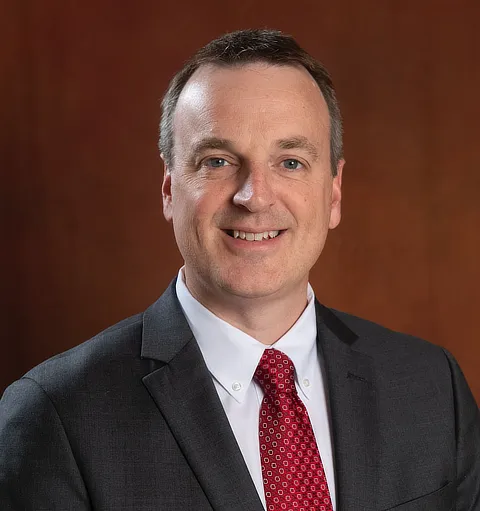
When Samford University alumnus Chad Holden, EdD ’18, steps into his new role as executive director of the Alabama Association of School Boards (AASB) on July 1, he will bring more than a title. He will bring perspective shaped by more than two decades in public education.
Holden has spent 24 years serving in nearly every corner of the K-12 system. He began as a classroom teacher and later served as a principal, superintendent, school board member, and parent. That breadth of experience now positions him to help guide education policy and advocacy across the state.
“I believe that puts me in a unique position to offer a perspective, regardless of the issue, that comes from experience in all of those roles,” Holden said.
Holden’s leadership has been widely recognized, including being named Alabama Principal of the Year in 2019. Since 2020, he has served as superintendent of Muscle Shoals City Schools. During that time, he was elected to the Lauderdale County Board of Education in 2010 and went on to serve six years, including two as board president. Earlier in his career, he taught history for 10 years at Muscle Shoals High School, where his passion for advocacy of public education first took root.
“The idea of educating, shaping lives and building relationships with kids and helping them pave their ways to whatever they want to accomplish in life is something I’ve always had a passion for,” he said.
That passion has remained constant, even as his responsibilities have grown.
Now, as he prepares to lead the AASB, Holden sees the role as both a professional milestone and a personal calling.
“To be one of the key voices in Montgomery when education policy is being shaped, or education laws are being considered, is very exciting,” he said.
Founded in 1949, AASB serves as the voice of public-school boards across Alabama, providing advocacy, training and support for local education leaders. In this role, Holden will help represent school systems statewide while working to strengthen public education at every level.
For Holden, that mission is deeply personal.
“My entire family, from my parents down to my children, are products of the public school system,” he said. “I believe that a public-school education is worth protecting and promoting because not everyone has the opportunity to receive a private education.”
He hopes to be a positive and steady voice in conversations that shape the future of education, particularly as schools navigate ongoing challenges such as funding pressures and evolving classroom practices.
“We have to work hard to improve education in the state and keep investing and believing that it is beneficial to our communities,” Holden said.
His experience in the Educational and Organizational Leadership doctoral program through Samford’s Orlean Beeson School of Education played a key role in preparing him for this moment. Holden describes the program as both rigorous and relevant, emphasizing relationships and real-world application, connections he still values today.
“I still maintain communication with many of the people I met throughout the program,” he said.
His dissertation research focused on the role of technology in transforming student learning, a topic that has only grown more complex in the years since. At the time, school systems varied widely in their use of instructional technology. Today, after the rapid shifts brought on by COVID-19, many educators are reexamining how technology should be used in the classroom.
That conversation has also taken shape at the state level. Recent legislation signed by Gov. Kay Ivey, the Healthy Early Development and Screen Time Act, places new limits on electronic screen use in early childhood education and licensed childcare settings.
“Fast forward nearly 10 years, and you can see that the world is finally realizing that even though technology is great for instructional purposes, there needs to be limits,” Holden said.
As he looks ahead, Holden remains focused on what he believes matters most: students, communities and the future they share. Because for Holden, the work of education extends far beyond the classroom.
“I want to be a positive voice to help reshape the narrative about the impact public on the kids we serve and the communities that we live in. The best thing that we can give to future generations is an educated public,” he said.
