


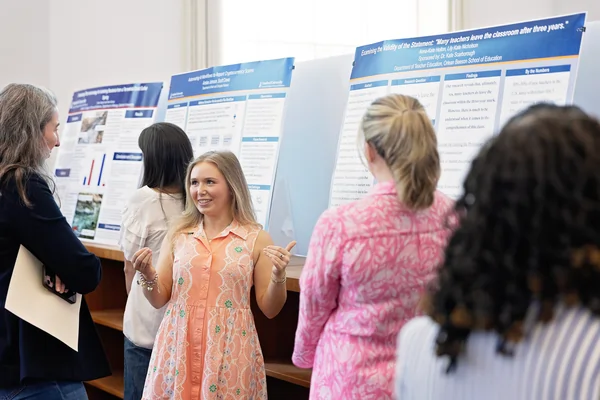
At Samford University’s Orlean Beeson School of Education, undergraduate research is a defining part of the student experience. In fact, 100% of students in Teacher Education and Human Development and Family Science (HDFS) complete original research projects, exploring questions that connect directly to their coursework and future professions.
“When students participate in research projects that allow them to explore questions connected to course topics, they gain a clearer understanding of how their academic work relates to their present experiences and future career aspirations,” said Kate Scarborough, assistant professor of teacher education.
Through conducting research, students learn appropriate practices, contribute to existing scholarship and develop confidence in communicating their knowledge.
“Presenting their research is a great way for students to practice this,” said Kayla Wenth, assistant professor of HDFS. “They gain a better understanding of why it is important to continue learning and investigating even after they graduate.”
That work culminates at the Samford Student Research Colloquia, where students present their findings to the campus community. This year, six School of Education students presented their work at the colloquia, with research spanning topics from classroom practice to developmental and behavioral interventions.
- “Should All Schools Be the Same? An Examination of Types of Schools”
- “Examining the Validity of the Statement: ‘Many teachers leave the classroom after three years.’”
- “Is Kindergarten the New First Grade? A Review of Literature”
- “Integrated Developmental Intervention Methods for a Pre-K Students with Autism Spectrum Disorder”
- “The Effectiveness of Behavioral Intervention Strategies to Improve Academic Performance for Students with Special Needs”
- “Overall Impact of Having a Sibling with Autism Spectrum Disorder”
Through this process, students move from initial questions to completed research, learning to examine assumptions, analyze evidence and consider multiple perspectives along the way.
“In the School of Education, our goal is to prepare our students to educate, lead and serve,” Scarborough said. “Student research gives an opportunity for students to put those words into action.”
Students are also guided through an intentional mentoring process, particularly in interdisciplinary fields like HDFS. Faculty help students refine broad interests into focused, meaningful research questions while providing consistent feedback throughout each stage of the project.
“Students become better, stronger advocates when they have personally participated in the research process,” Wenth said.
