


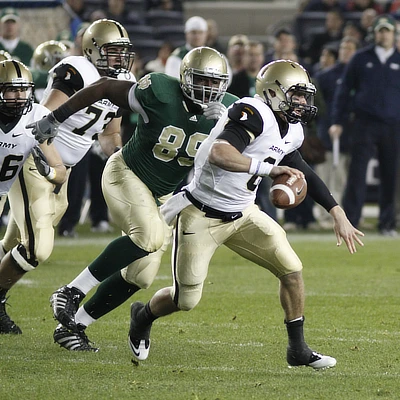
" Army-Notre Dame Football" by West Point - The U.S. Military Academy is licensed under CC BY-SA 2.0.
With two seconds on the clock and a one-point deficit, a player catches the inbound pass, squares up and releases. Millions of fans call this instinct or nerve. Researchers call it something more precise, a measurable interaction between physiology, cognition and training history. Understanding what happens inside an athlete's body and brain during these moments is reshaping how teams scout, train and evaluate talent.
Defining Clutch Performance as a Research Construct
Clutch performance refers to improved or sustained performance under heightened pressure, distinct from simple consistency or luck. Research on the topic has found considerable disagreement across the field, with conflicting definitions and inconsistent ways of measuring clutch performance. This is why data-driven approaches to pressure resilience in athletes have become so valuable. The sections below break down what that research actually shows.
Athletes, coaches and sport practitioners consistently point to self-efficacy, demand appraisal, mental toughness and task-focused attention as core ingredients of performing well under pressure. Preperformance routines, imagery, self-talk and simulated pressure training all show up as reliable interventions across elite competition.
Reading the Physiological Signature of Pressure
Before addressing performance, it helps to establish what happens at the extreme end of the pressure spectrum, since this baseline explains why pressure resilience in athletes can be trained rather than fixed. Panic represents the body's alarm system firing, and this response prepares a person to fight or flee from a threat. Clutch performance research draws on the same fight-or-flight framework, albeit at a lower intensity, to describe what athletes experience in the final minutes of a contest.
Adrenaline and cortisol increase heart rate, blood flow and alertness as the stakes rise, and this activation follows a well-documented principle. That same activation pattern shows up consistently once researchers isolate exactly where the line between helpful and harmful arousal sits.
Locating the Line Between Readiness and Overload
Performance improves with arousal only up to a certain point, then degrades. The stress response itself is not inherently negative, since adrenaline can sharpen focus and speed reaction time. The difference between a clutch outcome and a frozen one often comes down to whether an athlete interprets those sensations as readiness or as danger.
The same physiological markers that define panic, an elevated heart rate, muscle tension and a narrowed attentional field, also show up in athletes who perform their best under pressure. That difference lies almost entirely in appraisal and training rather than in the raw biological response itself.
Quantifying Clutch Performance With Data Science
Sports analytics has moved past anecdotal evidence to determine what actually predicts winning in high-pressure moments. Two decades of late-game data have produced a formula called the Estimation of Clutch Competency (EoCC), designed to objectively rank players in winning situations.
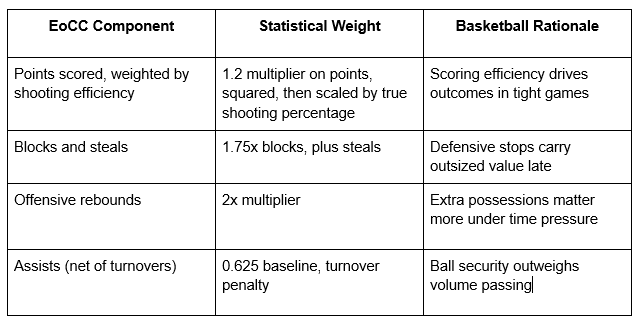
True shooting percentage correlates more strongly with winning than any other single variable tested, and the formula treats turnovers as a meaningful penalty against a player's clutch score. In the award's first season with real voting data to compare against, seven of the top 10 EoCC-ranked players matched the NBA's actual Clutch Player of the Year nominees, suggesting the formula captures something real rather than statistical noise.
Players do not typically improve their shooting percentages in clutch situations compared to their regular play. The metric was built around this finding, measuring a player's absolute performance level under pressure rather than any improvement over their regular-season numbers. This reframes clutch ability as resistance to drop-off rather than a burst of extra talent.
Unpacking the Psychological Drivers of Choking
Not every athlete responds to pressure the same way, and the athletes who falter provide as much research value as those who excel. Choking has been linked to two underlying drivers consistently. Both fear of failure and self-criticism weaken an athlete's belief in their own ability under pressure.
Self-criticism shows the stronger negative effect of the two. Together, these two factors explain roughly 32% of the variance in an athlete's self-efficacy heading into a high-pressure moment.
Attribution training gives coaches a direct lever against both drivers, teaching athletes to interpret failure through specific, controllable causes rather than fixed personal flaws. This approach significantly reduces fear of failure and self-criticism, which in turn supports the self-efficacy that separates a clutch performance from a choke. That mechanism mirrors the same fight-or-flight interference that disrupts calm decision-making in any high-stakes scenario.
Building a Scouting and Training Framework
For coaches, scouts and sport scientists, the research points toward a blended evaluation model rather than reliance on box scores alone. The framework below draws on three data categories that work best when tracked together.
- Physiological markers: These include heart rate variability, cortisol response curves and recovery speed after high-arousal moments, gathered through wearable sensors during simulated pressure drills.
- Psychological assessments: These include validated self-efficacy scales, fear of failure inventories and attribution style questionnaires, administered periodically rather than as a single intake test.
- Situational performance data: This isolates a player's statistics specifically within the final minutes of close contests rather than averaging across an entire game or season.
Programs that only track situational data risk missing the underlying cause of a decline. Programs relying solely on psychometrics miss whether those traits translate into actual on-field results. The strongest evaluation models pair both, tracking a player's psychological profile alongside situational statistics to see whether interventions shift late-game performance.
Cultivating Pressure Tolerance in Training Environments
Because clutch ability appears to be trainable rather than fixed, the practical implication for coaching staff is straightforward. Several specific interventions show measurable effects across the research reviewed here.
Gradual exposure to simulated pressure builds tolerance over repeated exposure rather than all at once. Deliberate rehearsal of preperformance routines locks in consistency regardless of the stakes. Structured feedback that reframes failure as a controllable input, rather than a character flaw, builds the confidence that sustains performance under pressure.
Turning Clutch Data Into a Competitive Advantage
None of these interventions requires exotic equipment, just consistent practice under conditions that mimic the emotional weight of real competition. Together, the physiological, statistical and psychological threads covered here point to the same conclusion for anyone building a roster or a training program.
The next time a broadcast announcer credits a buzzer-beater to a player simply having ice in their veins, the more accurate story is less poetic and more useful.
 Dan Parks is a senior writer at Modded.com, where he curates sports and lifestyle content. He’s passionate about the games themselves and the statistics behind them.
References
- Huang, D., Wang, H., Tang, Y., Lei, H., & Koh, D. (2025). Enhancing athlete performance under pressure: The role of attribution training in mitigating choking [Review of Enhancing athlete performance under pressure: The role of attribution training in mitigating choking]. Frontiers in Psychology, 16. https://doi.org/10.3389/fpsyg.2025.1435374
- Hufton, J. R., Vella, S. A., Goddard, S. G., & Schweickle, M. J. (2026). How do athletes perform well under pressure? A meta-study. International Review of Sport and Exercise Psychology, 19(1), 150–173. https://doi.org/10.1080/1750984X.2024.2414442
- Piercy, L., & Smith, H. (2026, March 16). Inside the clutch March madness moment: Expert Q&A on high-pressure play. University of Kentucky News. http://uknow.uky.edu/campus-news/inside-clutch-march-madness-moment-expert-qa-high-pressure-play
- Pennsylvania Psychological Association. (2025). Papsy.Org. https://www.papsy.org/resources/what-is-a-panicanxiety-attack
- Sarlis, V., Gerakas, D., & Tjortjis, C. (2024). A Data Science and Sports Analytics Approach to Decode Clutch Dynamics in the Last Minutes of NBA Games. Machine Learning and Knowledge Extraction, 6(3), 2074–2095. https://doi.org/10.3390/make6030102
- Schweickle, M. J., Swann, C., Jackman, P. C., & Vella, S. A. (2020). Clutch performance in sport and exercise: a systematic review. International Review of Sport and Exercise Psychology, 14(1), 1–28. https://doi.org/10.1080/1750984x.2020.1771747
- West Point. (2010). Army-Notre Dame football [Online Image]. On Flickr. https://www.flickr.com/photos/west_point/5198063719/in/photostream/


