


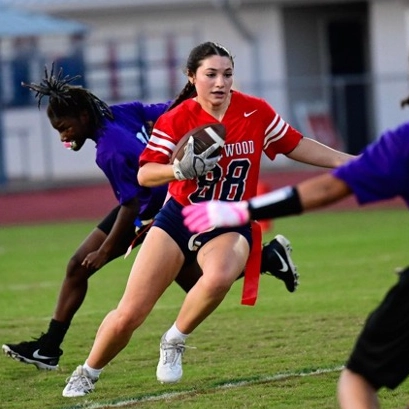
In the 2028 Summer Olympics, the sport of flag football will make its first appearance on the Olympic stage. This is a clear signal that flag football is growing as a sport on the global stage. Flag football is also expanding rapidly in Alabama and across the country, and Homewood High School’s girls flag football team exemplifies the sport’s increasing visibility, competitiveness, and overall quality. At Homewood, girls flag football began five years ago as part of a small pilot program, with only a handful of teams participating statewide. Since then, the sport has experienced remarkable growth, culminating in official sanctioning as a championship sport by the Alabama High School Athletic Association (AHSAA) in 2024.
Today, under the leadership of Coach Latta Johnston, who also serves as Homewood High Schools’ 9th Grade Assistant Principal, the program is thriving. Johnston has focused not just on wins, but on building a sustainable, enjoyable program for student-athletes. “I’ve been coaching for two years now. Last year, we were just learning what was going on, and this year, we were able to try some other things that we weren’t able to do before. The quality of flag football statewide is increasing leaps and bounds every year,” Johnston said. “The quality of athlete, the quality of coaching, the schemes you’re coaching against… if your team is the same next year as it was this year, you will lose more games. You have to be better just to keep up.” Progress has been clear on the field: In 2024, the team qualified for the state playoffs but lost in the First Round. In 2025, the team won a region championship and two playoff games to advance to the Quarterfinals.
The Samford Partnership
For the 2025 season, Homewood High School flag football team partnered with Samford University’s Center for Sports Analytics. Students from the Center, under the guidance of Dr. Stephen Hill (Associate Professor of Data Analytics and Center Fellow) assisted the team by collecting and analyzing data during games and providing a data dashboard summarizing team performance and tendencies. “Using the data we collected with Samford it was a lot easier to see what we are good at and what we need to improve. It helped us focus our practice on the plays that make the biggest impact,” Johnston noted. The collaboration helped Homewood to better define the team’s identity, determine which offensive and defensive strategies to prioritize, and streamline practice time efficiently.
While the program is still relatively young, the use of analytics mirrors trends seen at higher levels of sport, helping Homewood prepare athletes more strategically. “It helped me offensively call plays and refine what we were going to do,” Johnston says. “As the season went on, we started looking at defensive patterns as well. The insights let us focus on what we were best at and ensure we were ready for every opponent.”
Cross-Sport Talent and Player Development
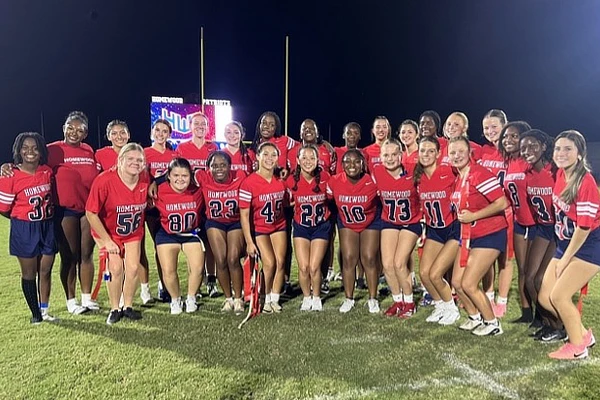
Homewood’s flag football team draws its players heavily from other sports, creating a diverse roster of athletes who bring varied skills and perspectives to the game.
“A lot of our flag football players are softball players. We get track athletes too, and some soccer players, although that’s harder here because our soccer program is really strong,” Johnston explains. Recruiting across sports allows the program to build a competitive team while fostering student-athletes’ overall athletic growth. Johnston also sees opportunities to expand the season and allow flag football to operate more independently from other sports, which could reduce scheduling conflicts and encourage more students to participate.
Looking Ahead
The future of girl’s flag football in Alabama and nationally looks bright, with growing opportunities at the collegiate level. Programs at the University of North Alabama, the University of West Alabama, and Alabama State University are in-place or developing, paving the way for high school athletes to continue the sport after graduation.
“We think there are going to be more opportunities at the college level. Once that happens, coaches will specialize in flag football, and players will take it more seriously,” Johnston says. Even as competitiveness increases, the Homewood program keeps enjoyment at the forefront. “One of our guiding principles is to always find joy in competing. That’s how we try to design the program,” he notes. “Even when you reach the Quarterfinals of the state playoffs, the foundation of joy stays in place.”


