


Live sports have always produced instant reactions. What has changed is that those responses are now visible, searchable and measurable the moment they happen. A missed penalty, a controversial call or a last-second win no longer lives only in the stadium or the living room — it plays out in real time across millions of posts.
For sports organizations, that shift is an opportunity. Social media analytics can tell teams, broadcasters and sponsors not just how much fans are talking, but what is driving the reaction and what it actually means for the brand. That distinction between noise and signal is what separates a passing spike in mentions from something an organization can act on.
Why Fan Data Matters More Than Raw Volume
A spike in mentions during a match is easy to spot. It is far harder to determine whether that spike reflects excitement, frustration or confusion. Treating volume alone as an engagement proxy risks missing the story entirely.
High activity does not automatically mean a two-way relationship is forming between an organization and its fans. So sentiment, audience composition and context must all be read alongside any volume spike.
Why General-Purpose Sentiment Tools Struggle With Sports Language
Sports commentary does not read like a product review or a customer service complaint, which is exactly the kind of text most off-the-shelf sentiment models are trained on. Slang, team nicknames, sarcasm and rapid-fire shorthand can confuse general-purpose classifiers. A single ambiguous phrase can flip an automated read of a post from neutral to positive or negative, especially in fast-moving, reactive text.
Research found that neural-network models trained on football-related posts outperformed generic tools like VADER and TextBlob, achieved Macro F1 scores in the low-to-mid 0.70s on football tweets, compared with 0.38 to 0.57 for the generic tools. That performance gap is largest in exactly the moments researchers care about most, when a post's tone hinges on team-specific slang or an emotionally loaded but literal description of the action.
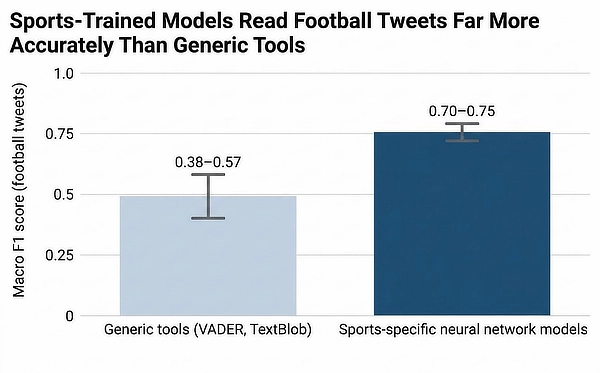
Graphic interpretation of data.
Source: Hettiarachchi, Al-Turkey, Adedoyin-Olowe, Bhogal & Gaber, Data (2022), Twitter sports/politics sentiment benchmark study
From this, it is clear that:
- Generic tools frequently misread emotionally charged but non-evaluative statements, such as a play-by-play description of a goal that contains no clearly positive or negative words.
- Confidence scores matter as much as the label itself. A model that reports how certain it is about a classification allows analysts to filter out noisy, low-confidence results before drawing conclusions.
- Purpose-built sports models consistently outperform generic sentiment libraries because they are trained on the vocabulary and phrasing fans actually use.
A generic, off-the-shelf classifier may perform well on product reviews without ever being tested on posts from a live match. The lesson for any organization building or buying a sentiment tool is to check whether it was trained on sports-specific language before trusting its output during a live event. Vendors that can provide sports-specific validation data are a safer bet than those relying solely on general benchmarks.
Why Engagement Needs More Than Likes and Follower Counts
Likes and follower counts are the easiest numbers to report, which is also why they can be misleading. Fans interact with platforms in different ways, and lumping them all into a single engagement score obscures who is actually driving value. A single aggregate number can rise or fall without revealing whether the underlying audience composition has actually changed.
Research on livestreamed sporting events found a steep divide in viewer behavior. Among more than 52,000 viewers of a single livestreamed match, researchers found that 96% never sent a chat message or virtual gift, while a "super co-creator" segment making up roughly 1.4% of the audience sent an average of 77 messages and 538 gifts each.
Treating that small, high-value group the same as passive viewers, or ignoring it in favor of aggregate view counts, means missing the audience segment with the most commercial and community value. Graphic data illustrates this finding.
This kind of tiered analysis, separating passive consumers, occasional contributors and high-value co-creators, gives organizations a more accurate picture of engagement than any single headline metric. It also reframes the goal of a fan-engagement program, shifting the focus from maximizing total interactions toward identifying and retaining the small group of fans doing most of the work. Ignoring that distinction risks investing equally in audiences that contribute very unequally.
How Culture and Language Shape Sentiment Analysis
Assuming fan sentiment behaves the same way across all languages and regions is a common mistake. Arabic- and Spanish-speaking football fans reacting to the same 2022 World Cup match showed meaningfully different emotional expressions. Posts by Spanish speakers were classified as emotional 50% of the time, compared with 72% for neutral Spanish posts, even after both were translated into a common language for analysis.
Machine translation also preserved emotional tone more reliably for one language than the other, which is a reminder that translation pipelines can distort sentiment before an algorithm even scores it. Content strategy research reinforces the same point from a different angle.
Content tailored to fans' cultural and language expectations, drawn from tweets posted around a professional sports league, consistently outperformed generic messaging in driving engagement. A single global sentiment model or a one-size-fits-all posting strategy will systematically misread or under-serve some segments of a fanbase.
What Individual Fan Posts Reveal Beyond Aggregate Sentiment
Aggregate sentiment scores are useful, but they can flatten out the moments that matter most to an organization's reputation. Individual posts, read closely, often surface information a dataset alone would miss. A single viral post can carry more reputational signal than a thousand routine mentions combined.
Retirement announcements are exactly the kind of moment where reading individual posts pays off. When NBA veteran Pau Gasol announced his retirement, English-language tweet volume grew nearly 200% within an hour of the announcement.
The most widely shared posts came almost entirely from news outlets and sports reporters rather than fans themselves. The analysis also surfaced an unplanned theme, as mentions of a former teammate who had since passed away became one of the most emotionally significant threads in the conversation, despite having no direct connection to the news itself.
That kind of finding illustrates the value of treating fans, and the accounts that amplify them, as a network of sensors. Monitoring who is driving a conversation, not just how big it is, helps organizations spot both reputational risk and unscripted opportunities for authentic engagement. It also means the loudest accounts in a conversation are not necessarily the ones an organization should be listening to most closely.
How Organizations Turn Fan Data Into Strategy
Analysis becomes useful in context. The organizations that benefit most are the ones that connect real-time fan signals to a clear internal strategy. Public sentiment can also move faster than most teams expect. An evolutionary machine-learning analysis of 2022 World Cup tweets found that some perspectives shifted from negative to positive during and after the tournament, as attention moved from pre-event controversy to the competition itself.
Executives across industries are increasingly relying on predictive tools that process millions of datasets to analyze patterns in customer sentiment and allocate resources effectively. Sports organizations are applying the same logic to fan data.
Three national sports federations shaped their presence around how they envision their audience’s social media use. One treated followers primarily as brand consumers, another prioritized building a tight-knit community and a third leaned on a more formal, one-way broadcast style. None of these approaches is inherently more correct. The right strategy depends on the relationship an organization is actually trying to build.
Strategic decisions impact:
- Teams and leagues that can use goal-triggered sentiment spikes to time real-time content and community management.
- Broadcasters who can use tiered engagement data to identify which moments in a broadcast are worth amplifying across platforms.
- Sponsors who can use culturally aware sentiment analysis to avoid one-size-fits-all campaigns that underperform among specific fan segments.
Common Questions About Measuring Fan Sentiment
A few questions come up often once teams start looking at this kind of data seriously.
Why do sentiment analysis tools sometimes get sports posts wrong?
Many tools are trained on general text and struggle with sports-specific slang, sarcasm and shorthand. Models trained specifically on sports-related posts tend to perform more accurately during live events.
Are all fans equally valuable to track?
No. Data from livestreamed events shows that a small share of highly active fans accounts for the large majority of messages and paid interactions, while most viewers never engage at all. Treating that small group the same as passive viewers obscures where the real value of engagement lies.
Does sentiment analysis work the same way across languages and regions?
Comparative research on fans posting in different languages found meaningfully different rates of emotional expression, and translation itself can distort tone before an algorithm ever scores it. Content and analysis built around a single language or culture will misread or under-serve other fan segments.
Can a single post reveal more than an aggregate sentiment score?
Sometimes, yes. Close reading of individual posts around a major sports announcement has surfaced who is actually driving a conversation, such as news outlets rather than fans, and unplanned emotional threads that a dashboard alone would not flag.
Should every organization use fan data the same way?
No. National sports federations studied for this piece each shaped their social media presence around a different view of their audience, as consumers, as a community or as a more formal, one-way audience and none of those approaches was inherently the right one. The best use of fan data depends on the relationship an organization is actually trying to build.
Reading Fan Reactions as a Signal
Social media will keep generating a flood of reactions during every live game, and context gives this meaning. The organizations drawing value from it are the ones pairing volume with sentiment, choosing sports-aware tools over generic ones and reading fan data through the lens of the specific relationship they are cultivating with their audience. That combination, more than any single metric, is what turns a feed full of noise into something an organization can actually use.
About the Author
Dan Parks is a senior writer at Modded.com, where he curates sports and lifestyle content. He’s passionate about the games themselves and the statistics behind them.
References
- Alhadlaq, A., & Alnuaim, A. (2023). A Twitter-based comparative analysis of emotions and sentiments of arab and hispanic football fans. Applied Sciences, 13(11), 6729. https://doi.org/10.3390/app13116729
- Broms, L. (2023). Fans, Fellows or Followers: A Study on How Sport Federations Shape Social Media Affordances. Journalism and Media, 4(2), 688–709. https://doi.org/10.3390/journalmedia4020044
- C, D. P., & Majumdar, A. (2023). Predicting sports fans’ engagement with culturally aligned social media content: A language expectancy perspective. Journal of Retailing and Consumer Services, 75, 103457. https://doi.org/10.1016/j.jretconser.2023.103457
- Future of work — how AI will change the future of the workplace. (2025, December 1). Leading Authorities. https://www.leadingauthorities.com/blog/future-work-how-ai-will-change-future-workplace
- Hettiarachchi, H., Al-Turkey, D., Adedoyin-Olowe, M., Bhogal, J., & Gaber, M. M. (2022). TED-S: Twitter Event Data in Sports and Politics with Aggregated Sentiments. Data, 7(7), 90. https://doi.org/10.3390/data7070090
- León-Quismondo, J. (2023). Social sensing and individual brands in sports: Lessons learned from English-language reactions on twitter to Pau Gasol’s retirement announcement. International Journal of Environmental Research and Public Health, 20(2), 895. https://doi.org/10.3390/ijerph20020895
- Liu, H., Tan, K. H., & Wu, X. (2022). Who’s watching? Classifying sports viewers on social live streaming services. Annals of Operations Research, 325(1), 743–765. https://doi.org/10.1007/s10479-022-05062-y
- Obiedat, R., Suleiman, D., M. Al-Zoubi, A., Al-Zain, Y., & Harfoushi, O. (2024). Analyzing world cup impact through an evolutionary optimization approach based on sentiment polarity with pre-trained word embeddings. Social Network Analysis and Mining, 14(1). https://doi.org/10.1007/s13278-024-01353-3


