A 10-part World Cup guide to the business of global football from Samford University's Sports Industry Program.
In Part 4 of this series, we watched clubs hand each other $100 million checks for a single player as if it were nothing. That raises an obvious question: Where does all of that money come from?
The answer explains almost everything else about the sport, including why a handful of clubs win nearly everything and most of the rest are just trying to hang on.
The 3 Big Streams
Most of a club's money comes from three places. Deloitte, the accounting firm, tracks this every year in something called the Football Money League, and for the game's biggest clubs, the split looks like this.
Let me take them one at a time.
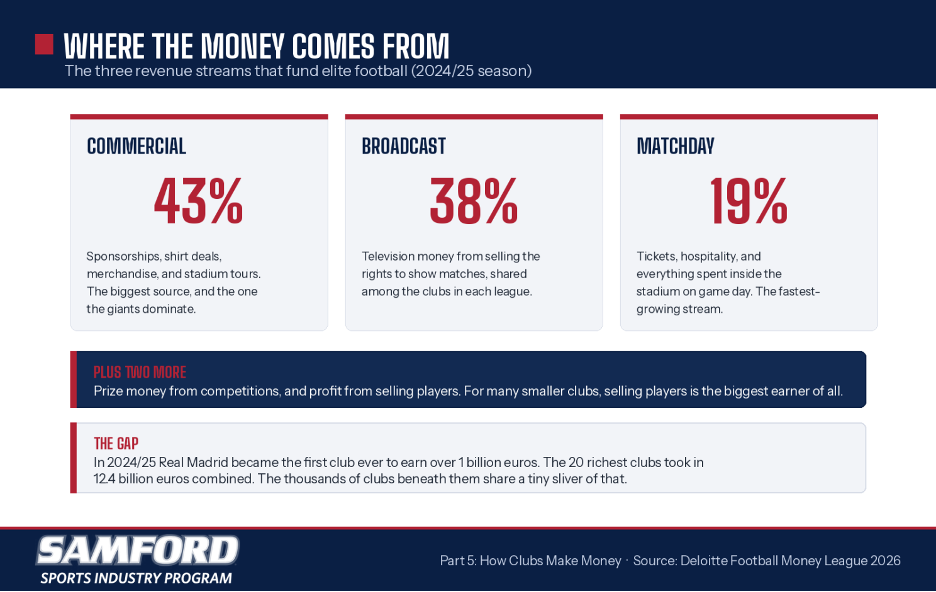
Broadcast money is the one Americans will recognize fastest. It is television money. A league sells the rights to broadcast its matches and then splits the revenue among its clubs. For the Premier League, this pot is gigantic, and it is exactly why, as I said back in Part 3, simply staying in the Premier League is worth a fortune. Drop out, and you are cut off from the richest broadcast deal in the sport.
Commercial revenue comes from sponsorships, shirt deals, merchandise, stadium tours, and naming rights. For the biggest clubs, this has become the single largest source of income. Real Madrid's commercial money alone, just their sponsors and their shirts and their brand, would be enough to rank them among the ten richest clubs in the world all by itself.
Matchday money is the oldest of the three. It is tickets, hospitality, and everything a fan spends inside the ground on game day. It is the smallest of the three streams, but it is growing the fastest, as clubs turn their stadiums into places that make money seven days a week instead of just on Saturdays.
More Ways to Revenue
Beyond those three, there are two other important sources.
The first is prize money. Winning matches and going deep in the big competitions pays, and one competition in particular, the Champions League, is an absolute goldmine. That is the entire subject of the next article, so I will save it.
The second is selling players. As we saw in Part 4, moving players is a business all its own, and for a lot of clubs, especially smaller ones, the profit from selling a player they developed is the single biggest check they cash all year.
Gap is Staggering
Here is where it gets sobering. In the 2024/25 season, Real Madrid earned more than 1 billion euros, about $1.35 billion. They are the only club on the planet that makes that kind of money, and they have now crossed the billion mark two years running.
Remember from Part 4 that there are more than 4,000 professional clubs in the world. The vast majority of them share a tiny sliver of what those top twenty make. This is the real engine behind why the same few clubs win almost everything. The giants have built enormous commercial machines because sponsors and shirt buyers flock to the biggest brands, and that money compounds year after year. Smaller clubs lean much more heavily on broadcast money, which is far more fixed. The rich club gets richer in a way the smaller club simply cannot match.
It also connects directly back to promotion and relegation. When I told you in Part 3 that going down is financially devastating, this is why. Relegation cuts a club off from the top division's broadcast money, and there is no commercial empire big enough at that level to replace it.
My club, Leeds United, is nowhere near that billion-euro world. Not close. And that is the reality for almost every club. When you have far less to spend than Real Madrid or Manchester United, your entire job is to make your money go further than theirs does. You buy undervalued players, such as the free transfers we discussed last time. You sell well. You develop young talent and cash in. You guard your place in the Premier League with everything you have, because that broadcast money is your lifeblood. Being a smaller club is not about outspending anyone. It is about being smarter with every single dollar.
Again, Leeds United, is a good example of exactly this. Leeds is chaired by Paraag Marathe, who spent more than two decades with the San Francisco 49ers as their salary cap architect and the head of their analytics department, and who also teaches at Stanford's business school. When the 49ers group took over Leeds, he brought that same Moneyball mindset with him—the same data-driven hunt for value that Brad Pitt made famous in the baseball movie. Leeds does not try to outspend the giants, because it cannot. It tries to out-think them.
You could see it in how they built the squad for our return to the Premier League last season. The year before, down in the second division, Leeds had been one of the smaller and more lightweight teams in the league. The data told them that they would get punished in the Premier League, where survival so often comes down to whether you can defend, win physical battles, and hold your own in the air. So they went out and deliberately signed taller, stronger, more physical players, using analytics both to figure out the type of player they needed and to find undervalued ones who fit that profile. It was not glamorous, but it worked. Leeds finished 14th and stayed up during a stretch when the promoted clubs before them had almost all gone straight back down. That is Moneyball in action, and it is how a club with a fraction of the money still manages to compete.
Why This Matters for the World Cup
National team football does not run on this model at all. A country's federation makes its money in completely different ways, and while a deep World Cup run brings real prize money and enormous prestige, the year-round financial engine of this entire sport is club football. And the single richest prize in club football, the tournament that turns good clubs into global giants, is the one we are covering next.
Part 1: How Global Football Is Governed
Part 2: Why Every Footballer Plays for Two Teams