A 10-part World Cup guide to the business of global football from Samford University's Sports Industry Program.
Here is something worth noticing about the World Cup's semfinalists — France, Spain, England and Argentina. Scattered across their four rosters is a whole collection of players who, just six weeks ago, were on the field in Budapest for the biggest club game on earth. England's Bukayo Saka, Declan Rice, and Eberechi Eze all play for Arsenal. So does Spain's Mikel Merino, the man who scored the goal that knocked out Belgium. And France's attack is loaded with the men who beat them all. These players finished their club season in the Champions League final, caught their breath, and walked straight into a World Cup. Three of the four teams still standing are carrying finalists from that night.
This article is about that first tournament, the Champions League, and why it is the golden ticket of world football.
What It Is
The Champions League is Europe's club championship. The Premier League crowns the best team in England, La Liga crowns the best in Spain, Serie A the best in Italy. The Champions League answers the bigger question: who is the best club on the entire continent? The best teams from every European country face each other across the season, alongside their normal league schedule, and the winner is, without much argument, the best club team in the world.
Do not mistake it for a regional event. The Champions League final is broadcast in more than 200 countries, with an average global live audience of around 150 million and roughly 450 million watching at least part of it. For comparison, the Super Bowl draws about 127 million viewers in the United States and far fewer beyond it. Every year, the biggest single game on the planet is not played in America. It is this one.
Six weeks ago, that game was Arsenal against Paris Saint-Germain in Budapest. Arsenal had just won the Premier League and led after five minutes. They still went home empty-handed, beaten on penalty kicks, while PSG lifted the trophy for the second year in a row.
How Teams Get In, and Why It Connects Everything
Here is the part that makes it beautiful. You cannot buy your way into the Champions League, nor can you be invited because you are famous. You qualify based on where you finish in your domestic league the season before. Finish in the top four or five of the Premier League, and you are in next year's Champions League. Finish sixth, and you are not invited, no matter how big your name is.
Remember the pyramid from Part 3 of the series?Promotion and relegation mean every match at the bottom of the table matters. The Champions League does the same thing at the top. A club in fifth place fighting for fourth in April is playing for tens of millions of dollars and a seat at Europe's top table. In England, they call it "the race for the top four," and some seasons it is more dramatic than the title race itself.
How the Tournament Works
The format received a facelift two seasons ago. Thirty-six clubs now start in a single giant table called the league phase, and each club plays eight matches against eight different opponents. The top eight advance straight to the round of 16. The teams that finish ninth through 24th go into a playoff round for the remaining spots, and the bottom eight go home. From the round of 16 onward, it becomes a knockout tournament with two games per matchup, culminating in a one-game final at a neutral site.
All of it happens midweek, on top of each club's regular league season. That is why European players' schedules are so brutal, and why the biggest clubs need multiple quality players at every position.
53 Nations, Happening During World Cup
Here is the scale most Americans never see. This is not a tournament for a handful of famous clubs. The new Champions League season that just opened will involve 81 clubs from 53 European nations, from England and Spain to the champions of Wales, Gibraltar, and the Faroe Islands. Only 29 of those clubs go straight into the main 36-team field. The final seven spots have to be earned through a summer-long qualifying gauntlet, four knockout rounds played in July and August, each over two legs, home and away.
Who gets a direct ticket and who has to fight through qualifying is determined by the UEFA coefficient, which is essentially a ranking of every country's league based on how its clubs have performed in Europe over the past five years. The strongest leagues, like England and Spain, send four or five clubs straight into the main field. The champion of a small nation, on the other hand, starts at the very bottom of the qualifying ladder and has to win round after round just to reach the field that the giants enter automatically. It is the pyramid from Part 3 all over again, just drawn across an entire continent rather than a single country.
And here is the part almost nobody in America realizes: it is happening right now, this very week. While the world is locked in on the World Cup semifinals, the first qualifying round of next season's Champions League is playing its second legs on Tuesday and Wednesday, the exact same days as France against Spain and England against Argentina. Twenty-eight champions of Europe's smaller nations—clubs like The New Saints from Wales and Ireland's Shamrock Rovers—are fighting through two-legged ties for the chance to keep climbing toward August's main draw. The final ended six weeks ago, and the new season has already begun. In this sport, the season never ends.
The Money, Step by Step
Now for the reason every owner, executive, and fan is obsessed with getting in. The Champions League is the single richest prize in club sports, and the money stacks at every step.
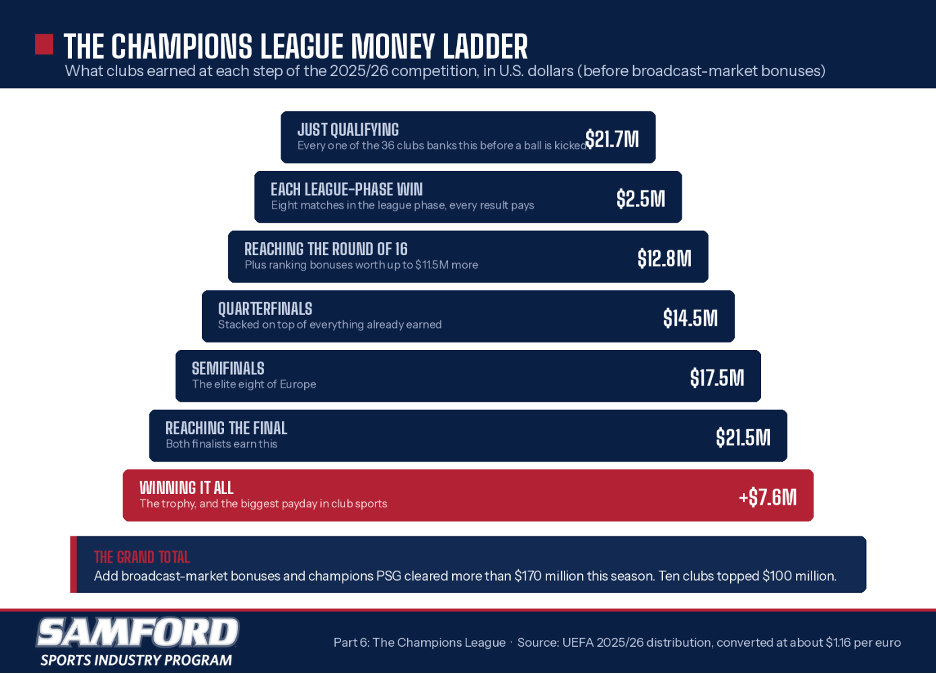
Just qualifying for the league phase is worth $21.7 million before a single game is played. Every win in the league phase adds $2.5 million. Reaching the round of 16 adds $12.8 million more, plus ranking bonuses. The quarterfinals add up to roughly $14.5 million, the semifinals to $17.5 million, and the two finalists each collect about $21.5 million, with an extra $7.6 million for the winner. Then, on top of all of that, there are broadcast-market bonuses that favor clubs from the big television countries. Put it all together, PSG cleared more than $170 million by winning it this season, and 10 clubs topped $100 million.
Go back to Part 5 for a moment. We saw that most clubs live on television money and sponsorships. Now drop a nine-figure bonus on top of that, available only to the handful of clubs that qualify, year after year. This is the engine driving the rich to get richer. The same clubs qualify, bank the money, buy better players with it, finish top four again, and re-qualify. Breaking into that cycle from outside is one of the hardest things to do in sports.
The Double
Here is a piece of history that could be written this week. France's attack is powered by three PSG players—Ousmane Dembélé, Désiré Doué, and Bradley Barcola—all of whom lifted the Champions League trophy in Budapest six weeks ago. Dembélé, the reigning Ballon d'Or winner as the best player in the world, scored PSG's goal in that final. He and his club teammates are now two wins away from winning the Champions League and the World Cup in the same summer, the rarest double in the sport. When you watch France against Spain on Tuesday, you are watching men chasing both of football's biggest prizes in a span of seven weeks.
Warning from My Own Club
I will tell you how dangerous that golden ticket can be when you chase it recklessly, because my club wrote the cautionary tale. Around the turn of the century, Leeds United was one of the best teams in England. It reached the Champions League semifinals in 2001, and the board decided the club belonged there permanently. So they borrowed enormous sums of money against future Champions League income and spent it on players, betting that qualification would come every year and that the loans would be paid.
Then one season Leeds finished fifth instead of fourth, missed the Champions League by a single place, and the whole thing collapsed. The debts came due, the best players were sold off one by one, and within a few years, Leeds fell out of the Premier League entirely, and eventually all the way down to League One, the third division we discuused in Part 3. It took Leeds the better part of two decades to recover. In England, they still call it "doing a Leeds" when a club gambles its future on qualification and loses. That is how powerful the money in this tournament is. It can build an empire, and chasing it can destroy one.
Other Tournaments, Quickly
Europe actually runs three club tournaments in tiers. Below the Champions League sits the Europa League, which Aston Villa just won, and below that the Conference League, for clubs from smaller nations and lower finishes. They pay a fraction of the Champions League, but they matter, because they give clubs like mine something real to aim at. For Leeds, the realistic dream for the next few years is not winning the Premier League. It is climbing high enough in the table to reach European competition at all. The night Elland Road hosts a European match again, of any kind, will be one of the great nights in that ground's modern history.
Why This Matters for the World Cup
The Champions League is the closest thing club football has to the World Cup, and the two tournaments feed each other. The stars you are watching this month built their reputations on Champions League nights, and the ones shining at this World Cup are being chased right now by the clubs that need them for next season's campaign. The transfer window we covered in Part 4 is already open, and clubs are doing business while the semifinals are still being played. Over the next few weeks, watch how many headlines connect a World Cup breakout to a Champions League club.
In fact, you do not have to wait for an example. It is happening to one of the U.S. Men's National Team players right now. Folarin Balogun, our striker, scored three goals at this World Cup and was the best player on the field for the United States for most of the tournament. The result: PSG, Chelsea, and Tottenham are all actively pursuing him as I write this, with Spurs reportedly making him their number one striker target and Borussia Dortmund circling as well. His club, Monaco, is preparing to sell, and here is the detail that ties this whole article in a bow. Monaco failed to qualify for next season's Champions League, so they need the money. They missed the golden ticket, and now they have to sell their best striker to balance the books, at the exact moment his World Cup has driven his price to its peak.
One tournament raised his value. The other tournament's absence is forcing his sale. That is the entire economy of world football in a single American player, playing out live in this week's headlines. Keep an eye on where Balogun lands. By the time you read Part 7, he may already be wearing a new shirt.
Part 1: How Global Football Is Governed
Part 2: Why Every Footballer Plays for Two Teams
Part 3: Promotion and Relegation
Part 4: How Football Buys and Sells Players
Part 5: Where Football's Billions Come From