


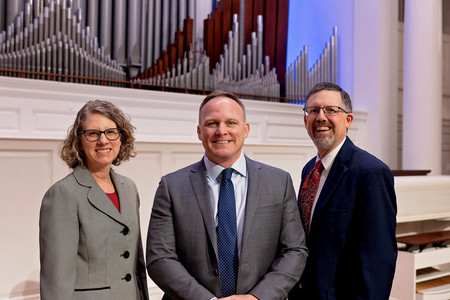
Samford University’s Howard College of Arts and Sciences hosted two events in Reid Chapel commemorating the 250th anniversary of the Declaration of Independence. The events, organized by the Department of History, invited campus and local community members to reflect on the document’s moral and philosophical foundations.
The lectures were intentionally coordinated with Samford’s freshman Core Texts program, where students were reading and reflecting on the Declaration and related themes during the same point in the semester, giving first-year students a timely opportunity to engage more deeply with the text.
On Feb. 23, Justin Dyer, dean of the School of Civic Leadership at the University of Texas at Austin, delivered a keynote address examining the Declaration’s assertion that human beings are “endowed by their Creator” with certain unalienable rights. The following afternoon, an academic roundtable turned to its enduring promise of “Life, Liberty and the Pursuit of Happiness.”
During the panel discussion, Jason Stevens of Ashland University reflected on the meaning and moral significance of life as articulated in 18th-century America. Cara Rogers Stevens, also of Ashland University, followed with an exploration of liberty and its constitutional and philosophical foundations. Carli Conklin of the University of Missouri concluded the roundtable by examining the historical understanding of the pursuit of happiness and its role in shaping American political thought.
The themes explored in the roundtable echoed those introduced by Dyer, who traced the intellectual and theological influences that shaped the Declaration, particularly the natural law tradition and its emphasis on moral limits to government authority.
“Power without goodness can’t make sense of authority, and goodness without authority can’t make sense of law and obligation,” Dyer said. “We have to have a unity of those two things for the establishment of the rule of law.”
Dyer emphasized that the Founders’ understanding of rights was rooted in a robust moral framework.
“The Founders’ answer to what it means to be endowed by our Creator with certain rights is far more complex than we at first might think,” he said. “They thought deeply about the source of our moral obligations, the unity of power and goodness in God’s nature and the limits of sovereign power.”
Jonathan Den Hartog, professor and chair of Samford’s Department of History, said the events offered an important opportunity for reflection as the nation approaches its semiquincentennial.
“I’m delighted to have hosted these events on Samford’s campus and to help students consider how the Declaration of Independence reflects our rights as endowed by God as Creator,” Den Hartog said. “As we celebrate America’s 250th birthday, these lectures encouraged students to think more deeply about their role as citizens, both now and in the future.”
These events are part of Samford’s broader recognition of America’s 250th anniversary and were made possible through the Carolyn and Don Drennen Endowment for American History, Civics and the Constitution. Established in 2024, the endowment advances education in American history and the U.S. Constitution by supporting campus lectures, faculty research and student engagement, strengthening the university’s ongoing commitment to civic education.
The events were also supported by a competitive grant from the Jack Miller Center, a national organization dedicated to advancing the teaching and study of America’s founding principles and history.
GIVE: Support impactful work at Howard College of Arts and Sciences.
