


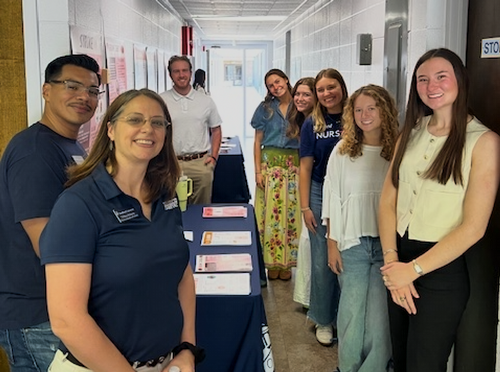
Samford University students and faculty partnered with local organizations to serve the Hispanic community at a recent health expo held at Primera Iglesia Bautista de Center Point, offering a holistic approach to care that combined medical education, screenings and spiritual support.
The event brought together representatives from Spanish, physiology and nursing, alongside community partners and volunteers, to meet both the physical and spiritual needs of attendees.
The collaboration was intentional, said Tiffany Robayna, assistant professor of Spanish, who helped organize the event as an extension of her Spanish for Medical Interpretation course.
“One of my primary goals is to help students understand the importance of working collaboratively within interprofessional health care teams,” Robayna said. “The event demonstrated that we can serve the Hispanic community more effectively when we work together and build on each other’s strengths.”
During the expo, visitors moved through several stations designed to provide comprehensive care. After receiving prayer and hearing a Gospel presentation, participants met with Samford students from Spanish and physiology, who shared information on eight diseases that disproportionately affect Hispanic populations, along with prevention and treatment strategies.
Betsy Dobbins, professor in the Department of Biological and Environmental Sciences and director of the STEM Scholars Program, said the experience helped students connect classroom learning with meaningful service.
“The experience of having students use their physiology knowledge to participate in creating bilingual infographics and presenting them in health care settings was powerful,” Dobbins said. “The students realized their academic learning enabled them to help others.”
From there, attendees visited the nursing station, where instructor of nursing Havilah Couvillion and her students provided hands-on instruction in checking blood pressure and glucose levels. They also distributed educational materials on hypertension and diabetes; conditions closely tied to those screenings and prevalent within the community.
Melanie Gaetan Sanchez, a pharmacy student who served as a translator, said the experience underscored the importance of communication in health care.
“This experience helped shape my understanding of serving the Hispanic community by highlighting the importance of effective communication in healthcare,” she said. “Being able to speak Spanish in an environment where English is primarily spoken allowed me to bridge the language barrier for patients who did not fully understand the information being provided to them.”
Lucy Jolley, a Spanish student who served as an interpreter, said the experience highlighted the importance of building trust with patients.
“As a future physician, I recognize the need to establish a relationship in order to gain trust and connect with my patients,” she said. “I witnessed firsthand the difference it made when I took time to build that connection before discussing their health.”
Madelyn Lyons, a nursing major enrolled in Robayna’s medical Spanish course, said the event revealed the importance of accessible health care in underserved communities.
“One thing that stood out to me within my field of study, nursing, was the need for accessible health care in underserved communities,” Lyons said. “Observing people receive treatment reminded me that every effort is worth it and there will always be a need to serve where I can.”
Itzel Leon Medina, a PharmD student, said the experience was especially meaningful because of its personal connection to her future career and community.
“I enjoyed connecting with patients and building a sense of mutual trust,” she said. “I was able to help educate members of my community on the importance of routine health screenings, particularly for conditions like diabetes and hypertension.”
Anika Richards, a biochemistry major, emphasized the cultural and relational impact of the event.
“The most meaningful part of getting to serve the community at the health expo was the ability to connect with people in the community on a personal and cultural level,” she said. “Being able to draw attention to the push for preventative care while connecting with others in the community left a lasting impact on me.”
Additional support came from Patty Jumbo, associate professor in McWhorter School of Pharmacy, who represented the Alzheimer’s Association and distributed educational materials.
Together, their efforts reflected Samford’s commitment to integrating faith, learning and service while meeting tangible needs in the Birmingham community.
