


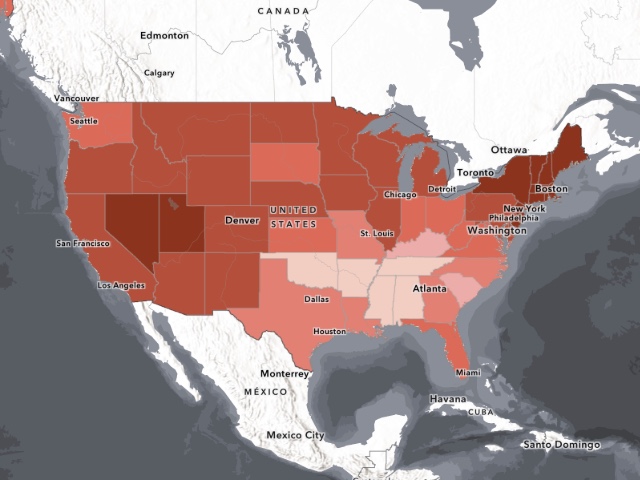
J.D. Payne, Thomas Welby Bozeman Chair of Christian Ministry at Samford University’s School of the Arts, recently presented research on the least-evangelical areas of the United States at two national conferences.
In mid-March, Payne served as a keynote speaker at the Great Commission Research Network and later led a breakout session at the Exponential Conference, both in Orlando. Using research compiled by him and students in the Department of Christian Ministry and at Samford’s Beeson Divinity School, Payne presented it in hopes of impacting future church planting ministries.
“While the greatest needs for the Gospel, church planting and ministry are outside of the United States, this study is for those laboring here,” Payne said. “The U.S. is the third-largest country in the world by population and is home to the third-largest number of unreached people groups, behind India and China.”
Payne said the presentations were well-received and the research was successfully shared through an interactive website developed by the Southern Baptist Convention’s International Mission Board. Payne has also written on his website about where best to plant churches in the U.S. and his research findings.
Payne praised the Department of Christian Ministry for its outstanding work training men and women for Kingdom service and said it is important others recognize the university’s strength in missiological and ministerial training.
Payne was assisted in his research by JP Gardner and Chase Mobbs, two Christian Ministry students, and Hutton Cate, MDiv ’24, a current PhD student at Beeson.
“We used data that is publicly available through the Association of Religion Data Archives (ARDA) to plot the growth and decline of evangelical churches in different parts of the country – at the state, county and metro-area levels,” Cate said. “We were especially interested in what areas have a high and rapidly growing concentration of evangelicals and what areas have a small and rapidly shrinking group of evangelicals, particularly for church planting strategy.”
Cate said he was struck by how new church movements, such as the Anglican Church in North America and the North American Lutheran Church, can affect data from one decade to the next.
“Knowing the diversity of groups, big and small, that all hold to evangelical norms in any given area is pretty eye- opening, especially in the pursuit of Christian unity across denominational lines when the right essentials are in place,” Cate said.
Gardner said he was surprised by the lack of churches in some areas, while Mobbs said it was fascinating to gain a broad view of the state of the church in the United States.
“I was encouraged by the progress that has been made in the last 40 years, but I was also struck by the current need for the Gospel in my own country,” Mobbs said. “Having grown up as a missionary kid in Uganda, I generally viewed the U.S. as the country that sent ambassadors of the Gospel. However, it is increasingly clear America is just as much a mission field as the villagers in sub-Saharan Africa. There is a deep need for healthy, thriving, Gospel-centered churches to be planted in the U.S., especially in urban centers.”
Payne said the research confirmed much of what he observed in a similar study he conducted in 2009.
“There are many locations in the United States, given our population, that have little Gospel witness,” Payne said. “This may come as a surprise when we consider there are 350,000 churches in the country.”
Payne said he hopes the research helps the church strategize well.
“The church needs clarity on where the neediest areas for Gospel proclamation and healthy churches may be found,” Payne said. “The call to follow Christ is a call to faithfulness in belief and action. This study was designed to assist with the latter. There is no place for laziness and haphazard actions in relation to the church’s global task – at home or abroad.”
