


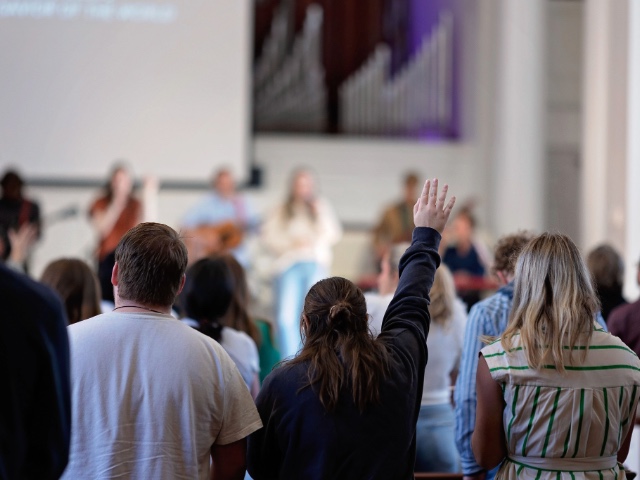
“Sometimes worship isn't just meant to ‘mean.’ Instead we're invited to ‘be’ before God, among one another.”
That conviction was reinforced this summer for Nelson Cowan, director of Samford University's Center for Worship and the Arts, during a weeklong Fellowship of Scholars at Mount Angel Abbey in Oregon. The gathering brought together leading liturgical scholars from around the world to explore how sight, sound, touch, taste and smell shape the experience of worship.
The fellowship's theme, “Liturgy and the Senses,” resonated deeply with Cowan's ongoing work in worship studies and spiritual formation. He believes many Protestant traditions have narrowed the worship experience by emphasizing only what worshipers hear and see.
“Corporate worship has the potential to be a profoundly sensory-rich experience, yet in the Protestant tradition, we often narrow our focus to just two senses: hearing and seeing,” Cowan said. “There is so much we can learn from traditions that naturally engage a wider spectrum of the human senses. How are we moving our bodies in worship? What are we smelling, tasting, and touching?”
The fellowship also carried personal significance. It was convened in memory of Cowan's friend and colleague, Nathan Chase, whose scholarship increasingly focused on worship and the senses before his death from leukemia at age 34.
“This fellowship not only carries his scholarly trajectory forward, but it also brings together the many friends and colleagues he loved to collaborate with,” Cowan said.
Participants represented institutions across North America, Europe and Australia, creating opportunities for extended conversation in a field where scholars are often separated by geography.
“The field of liturgical studies is a small field with scholars spread across the world,” Cowan said. “At this fellowship gathering, we were able to pray together, share meals, present papers and identify avenues for future liturgical scholarship on the senses.”
One of the week's most memorable presentations came from Teresa Berger, professor emerita of Yale University’s Institute of Sacred Music, whose work challenged attendees to consider humanity's relationship to the created world in fresh ways.
“She invites us to consider how we, as humans, can better become guests in the cathedral of creation,” Cowan said. “God's creation is already worshiping, so how can we best enable its song to flourish, and what cues can we take from creation's unique relationship with God?”
Those conversations affirmed ideas that continue to shape Cowan's teaching, scholarship and leadership at Samford. Increasingly, he is interested in how worship can create space for wonder, delight and participation rather than functioning primarily as an intellectual exercise.
“More and more, I am invested in corporate worship being understood as a site of play, a space for delight, wonder and awe before God,” he said. “Worship throughout church history has been far more dynamic, embodied and mysterious than that.”
Cowan hopes those insights will encourage the Samford community to think more deeply about the role of the arts in worship. By engaging the whole person, he believes the arts help create space for a fuller encounter with God and with one another.
“I struggle with a persistent habit of treating corporate worship like an intellectual exercise,” Cowan said. “But the arts offer a full-sensorial experience that invites us to get out of our heads and back into our bodies. Sometimes worship isn't just meant to ‘mean.’ Instead we're invited to ‘be’ before God, among one another.”
That vision reflects both the work of the Center for Worship and the Arts and the invitation at the heart of Christian worship itself: to engage God not only with the mind, but with the whole person.
