


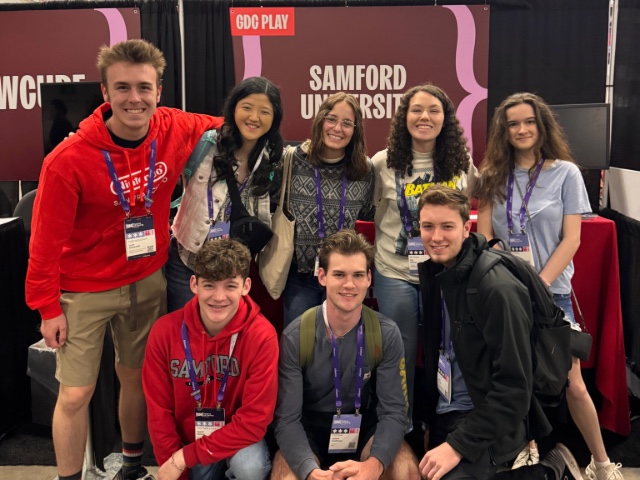
The noise really never stops at the annual Game Developers Conference. Project trailers echo from massive screens, professionals move briskly between sessions and conversations about design, failure and iteration happen everywhere at once. That hum became a classroom for a group of Samford University game design students.
Assistant professor and program director Wink Winkler and 12 students spent a week immersed in GDC in San Francisco, the world’s largest conference for game creators.
“I wanted to see how the work we’re already doing holds up in a real professional environment,” said Chloe Allen, a game design student. “Being there showed me how everything we practice connects.”
Throughout the week, students navigated sessions focused on real production challenges—from tech art and user interface systems to collaboration across large development teams. These weren’t theoretical discussions. Speakers dismantled active workflows, shared lessons learned mid-production and spoke candidly about what succeeds, what breaks and what gets shipped.
Allen said sessions on tech art stood out.
“Watching professionals walk through their pipelines helped me understand how iterative and collaborative the process really is,” she said. “It shifted how I think about refining work, not just finishing it.”
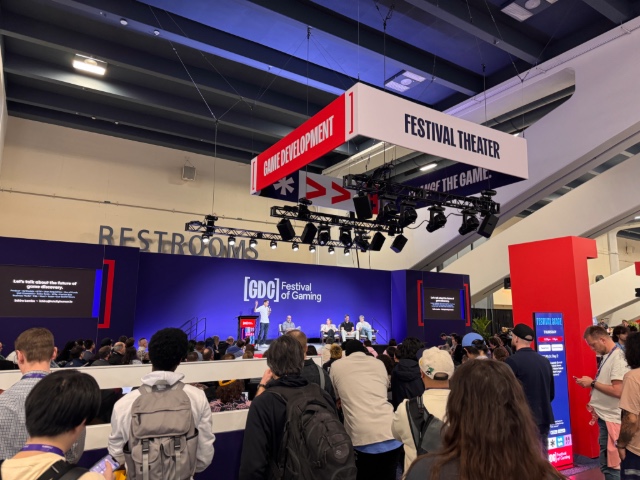 Tyson Morgan said seeing a full UI system broken down reshaped his understanding of development expectations.
“It made clear how much intentionality goes into every detail,” Morgan said. “It’s not just about making something work—it’s about how finished it feels.”
Outside formal sessions, informal conversations proved just as impactful. Talking with designers, artists and programmers gave students a clearer picture of the many roles inside the industry—and the skills that make candidates stand out.
“It helped me see how broad game design actually is,” Allen said. “There isn’t just one path. There are so many ways to contribute if you’re intentional about developing your strengths.”
Morgan said those conversations sharpened his focus on professional readiness.
“You quickly see how valuable polish and a strong technical foundation are,” he said. “It definitely changed how I think about approaching future projects.”
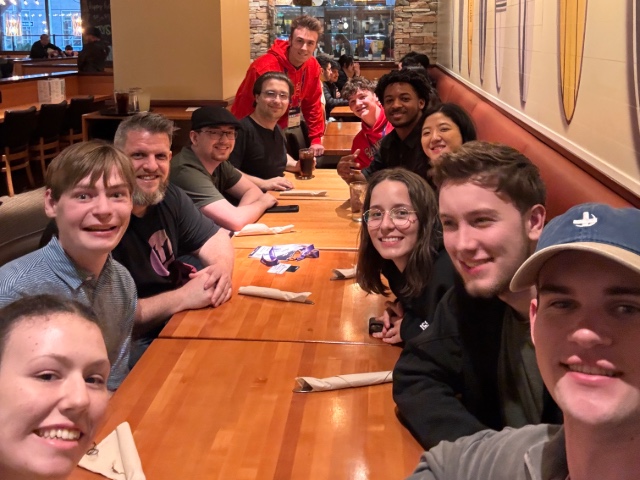
Attending GDC as a group mattered. Moving through an overwhelming conference together created space to process what they were seeing and encouraged students to step into conversations they might otherwise avoid.
“Having other Samford students there made things feel more approachable,” Allen said. “We talked through what we learned immediately instead of waiting until we got back.”
Morgan said peer encouragement pushed him to explore outside his comfort zone.
“Others encouraged me to attend sessions I wouldn’t have chosen,” he said. “That ended up being some of the most helpful content for me.”
For Winkler, attending alongside students reinforced the value of situating learning inside professional spaces.
 “GDC puts students face-to-face with how the industry actually functions,” Winkler said. “Not just how work is made, but how it’s talked about, presented and evaluated.”
He noted that themes emphasized throughout the conference—real-time workflows, collaboration and cross-disciplinary production—mirror the program’s lab-driven structure.
“The industry prioritizes people who understand pipelines and can work within teams,” Winkler said. “Those expectations align closely with how our students already create.”
The conference reframed how students think about their work.
“You see a shift happen,” Winkler said. “Students stop thinking in terms of assignments and start thinking in terms of portfolios and purpose.”
For Allen, that shift will stay with her long after the conference.
“GDC made it clear that what we’re making has weight,” she said. “It affects how people experience games, and that’s meaningful.”
By the time they returned to campus, spring break hadn’t been a pause in learning—it had been an acceleration. Armed with new perspective and renewed clarity, Samford’s game design students came back ready to create with greater intention and confidence.
