


For most of her time at Samford University, Anna Williams ’26 believed she understood what it meant to succeed in theatre. Success looked like preparation. It looked like strong performances, clear direction and roles that made sense on paper. It meant stepping into characters with names, arcs and moments to speak.
When Williams arrived at Samford, she was eager to grow as a performer and expand her understanding of the craft. What she didn’t realize was how much of her education would come not from standingcenter stage, but from learning how and when to step back.
“I had no clue what I didn’t know about theatre,” Williams said. “Samford didn’t just teach me skills. It taught me who I am as an artist.”
That lesson unfolded slowly, across rehearsal rooms, classrooms and seasons when expectations didn’t line up with reality. Through a wide range of productions in the Department of Theatre and Dance, Williams began to understand that storytelling wasn’t about visibility, but about responsibility—to the story, to the ensemble and to the audience.
One of the moments that crystallized that understanding came during her junior year, when Williams was cast in an underground theatre production of Eurydice.
She had no lines. Cast as part of a “chorus of stones,” Williams’ role was quiet, restrained and intentionally unsettling.
“At first, I felt almost alien,” she said. “Previously, I had only been cast in ingenue, ‘princess’ roles, so this was completely new to me.”
What initially felt confusing became one of the most formative experiences of her time at Samford. Setting aside her expectations and ego, Williams began to see theatre as an act of service rather than a platform for attention. The role forced her to slow down, to listen and to examine what she truly valued as an artist and as a person.
Another area where Williams’ perspective shifted most significantly was her exposure to Theatre for Youth.
Before experiencing it firsthand, Williams admits she underestimated these types of shows, assuming productions designed for young audiences carried less artistic or narrative weight.
“I had naively dismissed these kinds of shows as juvenile,” she said.
That perception changed quickly.
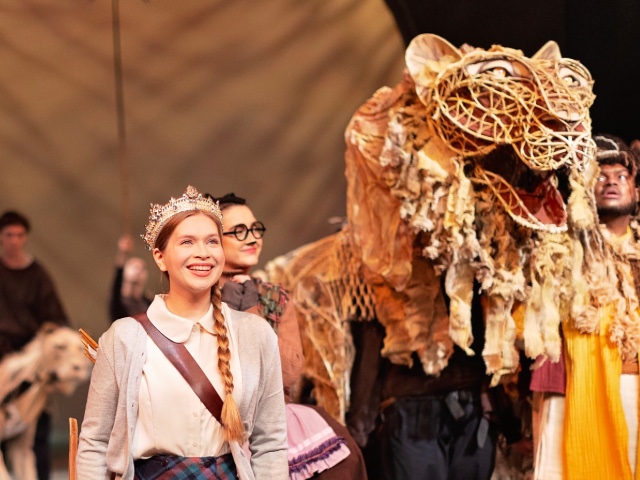
Cast as Susan Pevensie in The Lion, the Witch, and the Wardrobe, Williams saw the level of care, intentionality and responsibility required to tell stories well—particularly for young audiences, some of which wereencountering live theatre for the first time. The cast devoted time to world-building, ensemble work and thoughtful storytelling, treating the material with the same seriousness as any other production. Williams witnessed the immediate impact theatre can have when it is offered with sincerity and excellence.
“For 70 minutes, Narnia was real,” she said. “The excitement and participation from the children were incredibly encouraging.”
After each performance, the cast met audience members outside Harrison Theatre, answering questions and listening as children shared what resonated most. Those conversations revealed the lasting influence of storytelling rooted in service rather than spectacle.
“Getting to be part of something that meaningful reminded me why I do what I do,” Williams said.
Viewing theatre through a Christ-centered lens helped her see how storytelling can point beyond itself.
“I see how everything in creation points back to Him, and I loved studying music and theatre created by people who bear His image,” Williams said. “I believe that art allows its creators to be vulnerable and seek community, and we can find connection despite our different backgrounds.”
There were times when she was tested and sometimes disappointed—when opportunities didn’t materialize, and doors closed without explanation. In those moments, Williams trusted God’s providence rather than her own plans.
“I was forced to lift my questions to the Lord,” she said. “Every time, He answered—sometimes in ways I didn’t expect.”
Those seasons reshaped how she defines success. Performances end. Roles change. But faith remains steady.
Williams also found perspective outside rehearsals. She intentionally lived with non-theatre majors for much of her time at Samford, building friendships that helped her maintain balance and appreciate life beyond the stage.
“It was refreshing to escape the ‘theatre bubble.’ Living with people in other disciplines reminded me that my identity is bigger than any one role, she said.
Williams expanded her artistic experience through music as a member of Samford’s A Cappella Choir. The ensemble traveled to Belgium and the Netherlands in 2023 earning first place in the CantarodeInternational Choral Competition. The experience reinforced the power of unity and shared purpose.
“We sang with pure joy,” Williams said. “It wasn’t about individual talent but creating something meaningful together.”
She feels anchored by the foundation she has built artistically, spiritually and personally as she looks beyond Samford.
“God equips us through our experiences,” she said. “Even when the path doesn’t look like what we expected.”
Williams’ Samford experience wasn’t about learning how to be seen. It was about learning how to listen, how to wait and how to use her gifts with humility, for the sake of the story and for God’s glory.
