



In less than one month, the United States Men's National Team and 47 other countries will compete in the 2026 FIFA World Cup, the largest soccer tournament in the sport's history and the most-watched event humans collectively share. Earlier this week at The Rooftop at Pier 17 in Manhattan, USMNT head coach Mauricio Pochettino unveiled the 26-man roster that will represent the United States at a home World Cup for the first time in 32 years. The question every American fan should be asking now that this roster is set is also the question this article exists to answer: is this team good enough?
The honest answer requires American sports fans to reckon with something unusual. Americans are accustomed to dominance. We have the best basketball league in the world. The best football league. The best baseball league. We top the Olympic medal table almost every cycle. American athletes hold world records and gold medals across nearly every sport humans play. Except this one, the sport that 5 billion people on six continents engage with most. And so, when the United States walks onto SoFi Stadium's pitch on June 12 to open the tournament against Paraguay, we will not be among the favorites to lift the trophy at MetLife Stadium on July 19. We will be among the hopefuls. The eternal hopefuls.
Why? That is the question this analysis answers, drawn from a player-by-player developmental study at the Samford University Center for Sports Analytics and verified against publicly available FIFA and FBref data.
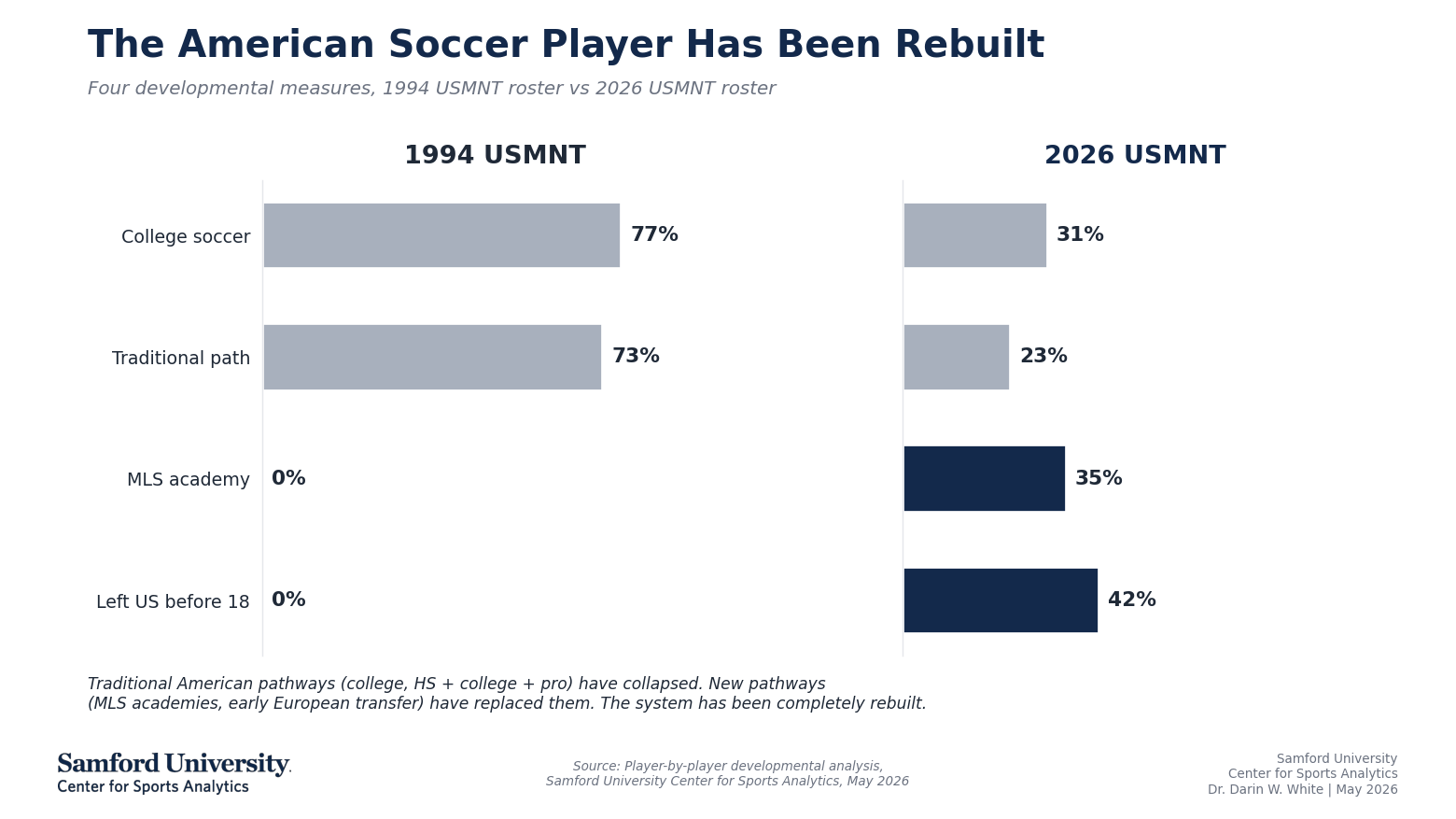
American soccer has been completely rebuilt since 1994. We are no longer the country that showed up at our last home World Cup with a roster of high school and college players competing against the world's professionals. We have built, in 32 years, a development system that structurally resembles those of England, Germany, France, and Spain. That is a real achievement, and Americans should be proud of it.
At the same time, the system has not yet caught up. Our pool of elite-tier players, the players who actually compete and play meaningful minutes in the world's top leagues, is still small relative to the soccer-playing population of every other serious soccer nation. We are closer to Türkiye and Mexico in elite output than we are to England and Germany.
Both things are true. We have come a long way. We still have a long way to go.
That is the story of where American soccer actually is in May 2026. The next two months are the test of what 32 years of rebuilding has produced. The data is below.
Quick Primer: What "The Big Five" Means and Why It Matters
For readers who don't follow club soccer closely, a quick orientation. International soccer is structured around domestic professional leagues. Within those leagues, five are universally recognized as the elite tier of global club football, the level where the world's best players compete week in and week out. They are:
- The English Premier League (England)
- La Liga (Spain)
- Bundesliga (Germany)
- Serie A (Italy)
- Ligue 1 (France)
Together, these are called "the Big Five" or "the top five leagues." When soccer analysts measure a country's elite player depth, they look at how many of that country's nationals are currently playing in those five leagues. The Netherlands' top league, the Eredivisie, is often included as a tier-1.5, since it produces and develops players who consistently transfer to the Big Five. Major League Soccer, the top American league, has improved dramatically over the past decade but is still considered a level below. 58 percent of the 2026 USMNT roster plays in the Big Five and the Eredivisie. Another 31 percent play in Major League Soccer, primarily defenders and goalkeepers. The remaining 11 percent play in other top-flight leagues, including Scotland's Premiership, Mexico's Liga MX, and England's second division. Where the players play, position by position, is itself a major part of the story this analysis tells
Finding 1: The American Soccer Player Has Been Rebuilt
In 1994, when the United States last hosted a World Cup, the path to the U.S. national team looked like the path to almost every other American professional sport. A player went to American high school, played varsity soccer if his school had a team, went to college on a soccer scholarship, played four years of NCAA soccer, and signed his first professional contract at age 22 or 23, almost always with a U.S. Soccer Federation contract because there was no functioning American top-flight league for him to play in. Major League Soccer did not exist yet.
That pathway produced 73 percent of the 1994 USMNT roster. It produces 23 percent of the 2026 roster.
The four developmental measures from the dataset:
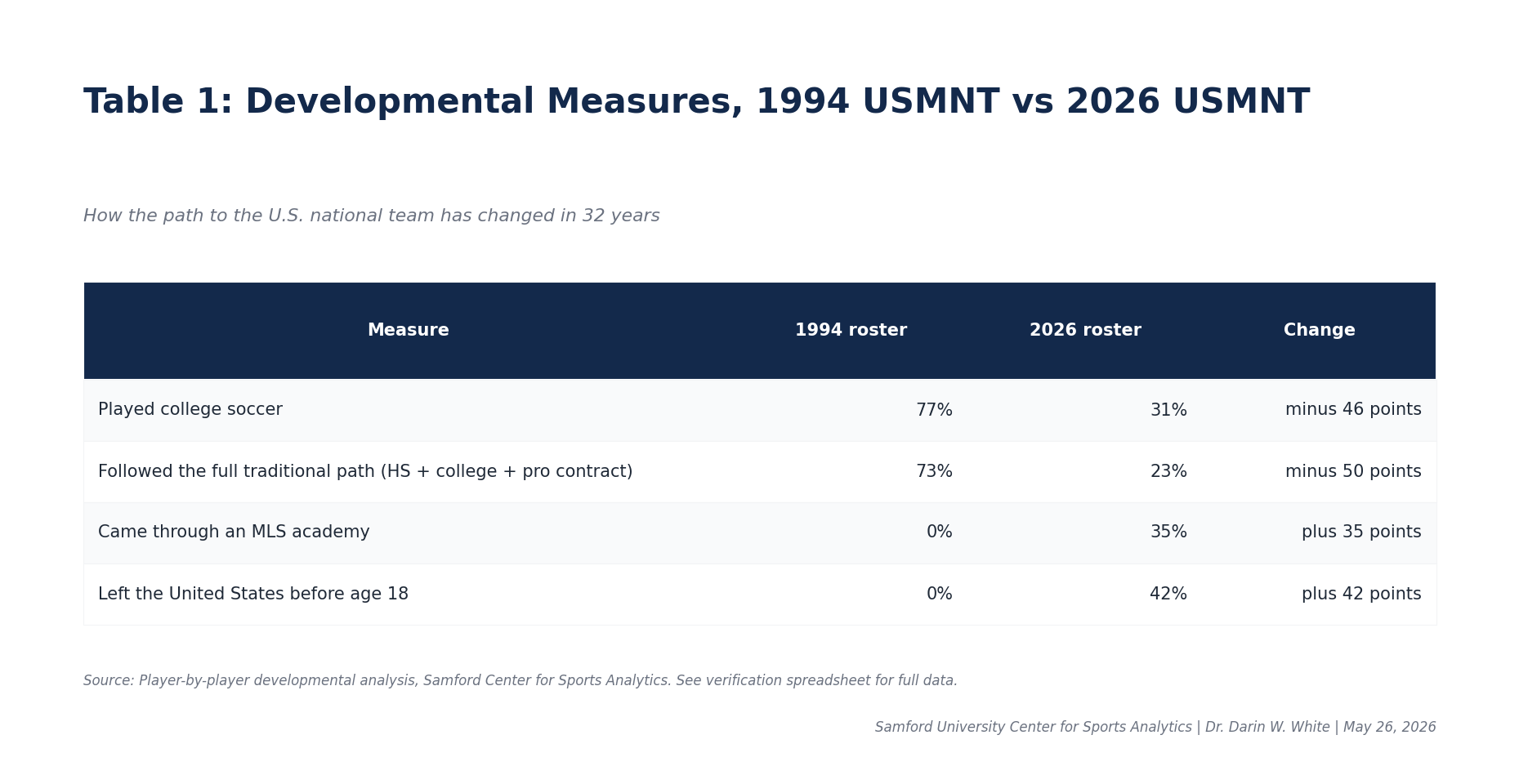
The transformation is not gradual. It is total.
In 1994, the United States produced national team players the way it produced baseball players. High school, college, draft, pro contract. In 2026, the United States produces national team players the way England, Germany, France, and Spain do. Federated academy programs starting at age 12 or 13, professional contracts at 16 or 17, transfer to a Big Five European league before turning 20.
The export pipeline is the clearest evidence. Eleven of the 26 players on the 2026 USMNT roster either left the United States before their 18th birthday or were developed entirely outside the U.S. soccer system.
The comparable number for the 1994 roster was zero. Several 1994 players (Harkes at Sheffield Wednesday, Stewart at Willem II, Ramos at Real Betis, Wynalda at Saarbrücken, Dooley at Kaiserslautern, Wegerle at Coventry) had reached European clubs by 1994, but every one of them got there as a fully formed adult professional after college, not as a teenager funneled through a European academy. The youth-export channel did not exist.
Christian Pulisic signed with Borussia Dortmund at 16 and has never played a professional minute for an MLS team. Gio Reyna joined Dortmund's academy at 16. Joe Scally signed with Borussia Mönchengladbach at 18. Weston McKennie left for Schalke at 17. Tim Weah came up at Paris Saint-Germain's academy from age 14. Chris Richards left for Bayern Munich at 18. Haji Wright joined Schalke at 16. These are not exceptions. They are how the system works now.
The infrastructure that produced the 2026 USMNT was built between 1996 and 2025. Major League Soccer, founded in 1996. The U.S. Soccer Development Academy, launched in 2007. MLS NEXT, the current youth pyramid, with 151 clubs and 16,000 players across six age groups. None of it existed in 1994. All of it exists now. And it is producing American players who can compete at the highest level of European club football.
"What 1994 showed us was what we didn't have. What 2026 shows us is everything we've built since then."
That progress is the optimistic half of the story, and it is the half that does not get told often enough. The American development system, as a system, is no longer a generation behind. The next generation of players coming through MLS academies and into European clubs is the proof.
The Five Paths
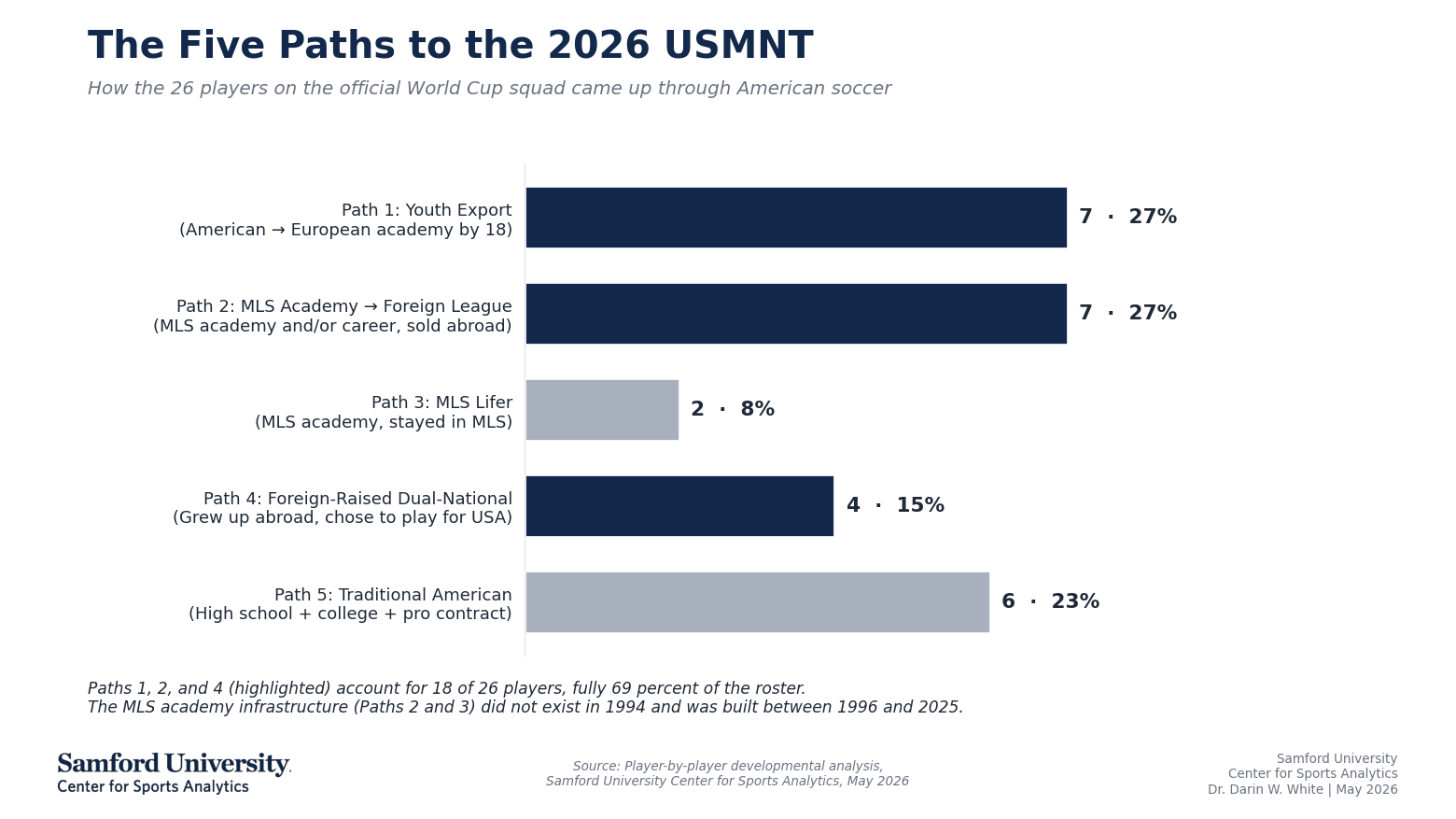
Every player on the 2026 USMNT roster fits into one of five developmental paths, defined by where the player developed between ages 11 and 18 and how he turned professional. The Center for Sports Analytics calls this framework the Five Paths Index for American soccer development. It describes what the modern American pathway actually looks like.
Path 1: The Youth Export.
American kid, sent abroad to a European academy before age 18, no senior MLS career. Seven players, 27 percent of the roster. Christian Pulisic, Weston McKennie, Chris Richards, Gio Reyna, Tim Weah, Joe Scally, Haji Wright.
Path 2: The MLS-Academy-to-Foreign-League.
Came through an MLS youth academy, played in MLS, was sold to a top foreign league. Seven players, 27 percent. Tyler Adams, Brenden Aaronson, Mark McKenzie, Ricardo Pepi, Auston Trusty, Alex Freeman, Alejandro Zendejas.
Path 3: The MLS Lifer.
Came through an MLS academy and stayed in the league. Two players, 8 percent. Chris Brady, Max Arfsten.
Path 4: The Foreign-Raised Dual-National.
Born and developed abroad, eligible to represent the United States through family heritage, chose to wear the U.S. shirt. Four players, 15 percent. Antonee Robinson (England), Sergiño Dest (Netherlands), Malik Tillman (Germany), Folarin Balogun (raised in England).
Path 5: The Traditional American Path.
High school, college soccer, professional contract. Six players, 23 percent. Matt Turner, Matt Freese, Tim Ream, Miles Robinson, Cristian Roldan, Sebastian Berhalter.
Paths 1, 2, and 4 together account for 18 of 26 players, fully 69 percent of the roster. The Five Paths Index is, in effect, a portrait of an entirely new American soccer ecosystem.
The Attack Tells the Story
There is one specific finding from the player-by-player analysis worth dwelling on, because it captures the transformation in a single observation.
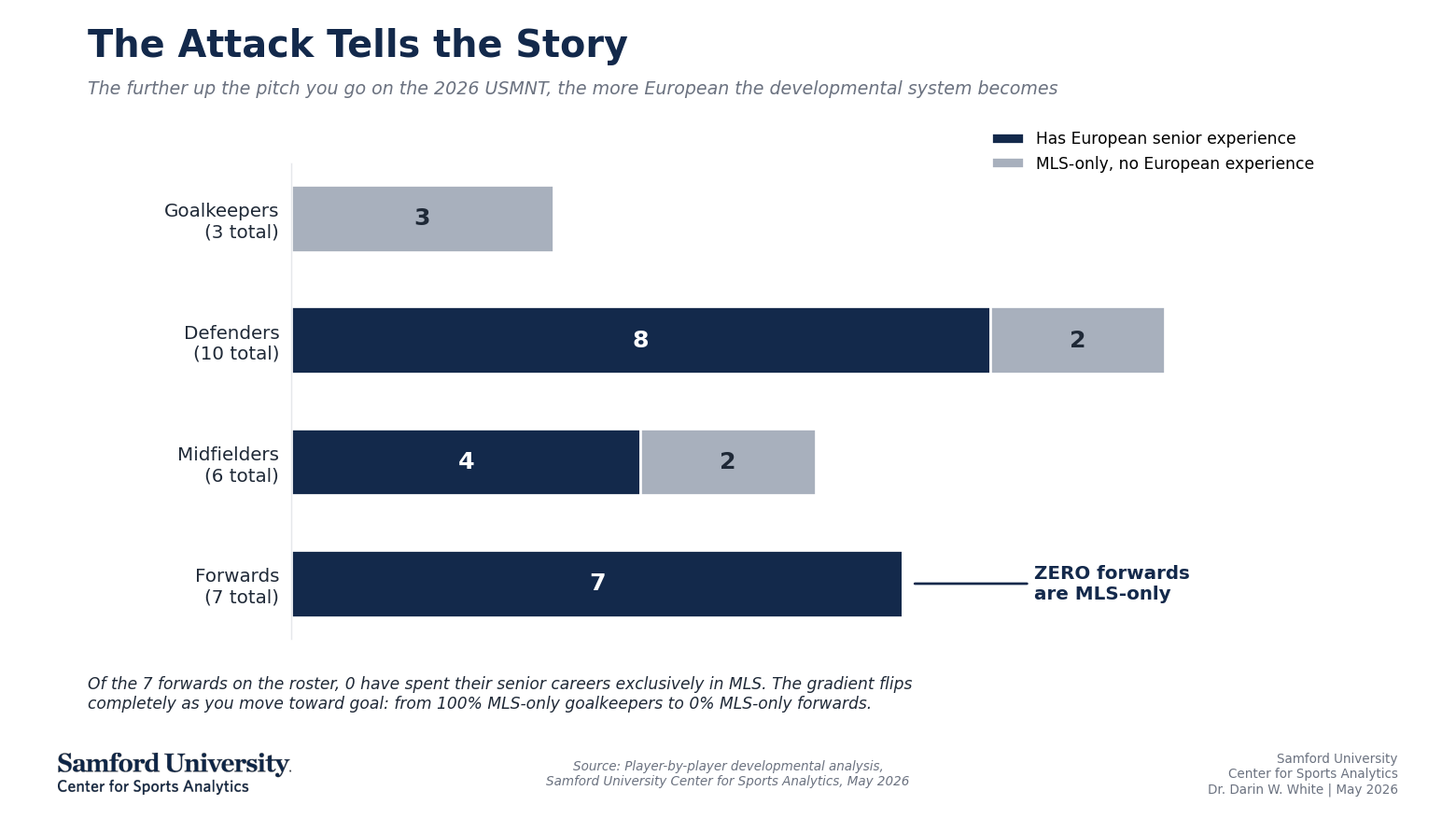
The further up the pitch you go on the 2026 USMNT, the more European the system that produced the players becomes.
Of the seven forwards on the 26-man squad, zero have spent their senior careers exclusively in MLS. Pulisic went to Dortmund at 16. Weah came up at PSG and went on to Lille, Juventus, and now Marseille. Aaronson came up at Philadelphia and was sold to Red Bull Salzburg. Balogun developed at Arsenal in London. Pepi went from FC Dallas to Augsburg, now PSV. Wright went to Schalke at 16 and has played in Germany, Sweden, Denmark, and Turkey. Zendejas went from FC Dallas to Chivas in Mexico's Liga MX as a teenager.
Of the six central and defensive midfielders, just two have spent their senior careers exclusively in MLS: Cristian Roldan at Seattle and Sebastian Berhalter at Vancouver. The other four, Adams, McKennie, Reyna, and Tillman, all play in Big Five leagues.
Of the ten defenders, just two have spent their senior careers exclusively in MLS: Miles Robinson at FC Cincinnati and Max Arfsten at Columbus. Tim Ream is back in MLS at Charlotte but spent more than a decade in the Premier League captaining Fulham. The other seven are abroad in top European leagues.
All three goalkeepers play in MLS.
The gradient is unmistakable. Goalkeepers play in MLS. Defenders are mostly European. Midfielders are mostly European. Forwards are entirely European. The attacking half of the United States team is, in developmental terms, an extension of the European soccer system. The piece of the field where MLS still produces our national-team-caliber players is the back third. Even there, the captain spent his career in England.
This is what it means, in practical terms, to say the American development system has been rebuilt. Not that MLS produces our match-deciding players. That European clubs do, and American teenagers are now competing for academy spots at those clubs alongside the world's best young players.
Finding 2: The Gap That Remains
Here is the other half of the story.
A system that produces world-class attackers from a federation-coordinated academy network is, in structural terms, the system every top soccer nation uses. The United States has built that system. The next question is whether the system produces enough.
The measure that best answers that question is Big Five league minutes: total playing time by a country's nationals in the five elite European leagues over the just-completed season. Why this measure, rather than population, FIFA rankings, market value, or raw player counts? Because no other single indicator has done a better job of predicting World Cup success over the last four decades. The CIES Football Observatory in Switzerland, which has tracked World Cup squad composition since the 1990s, identifies Big Five league participation as among its strongest predictive indicators. The empirical pattern bears it out.
Every World Cup final since 1986 has been won by the team with the greater concentration of Big Five league experience. Every World Cup semifinalist since 2002 has had a meaningful presence in the Big Five. The 2022 semifinalists were Argentina, France, Croatia, and Morocco, all of whom drew the spine of their squads from Big Five clubs. Big Five minutes are not the only thing that matters, but they are the closest thing to a single number that captures whether a country is producing elite-tier players at scale.
The dataset used to apply that measure is publicly available. FBref, one of the most authoritative public soccer statistics platforms, publishes a comprehensive list of every Big Five league player by nationality, including total minutes played, for each season. As of the just-completed 2025-26 season, the data tells a clear story.
The United States has 30 players who were rostered on a Big Five league team during the 2025-26 season. They combined for 35,885 total minutes of play. That is the verified, sourced size of the American Big Five player pool.
For comparison, also from FBref, the same metrics for major comparison nations:
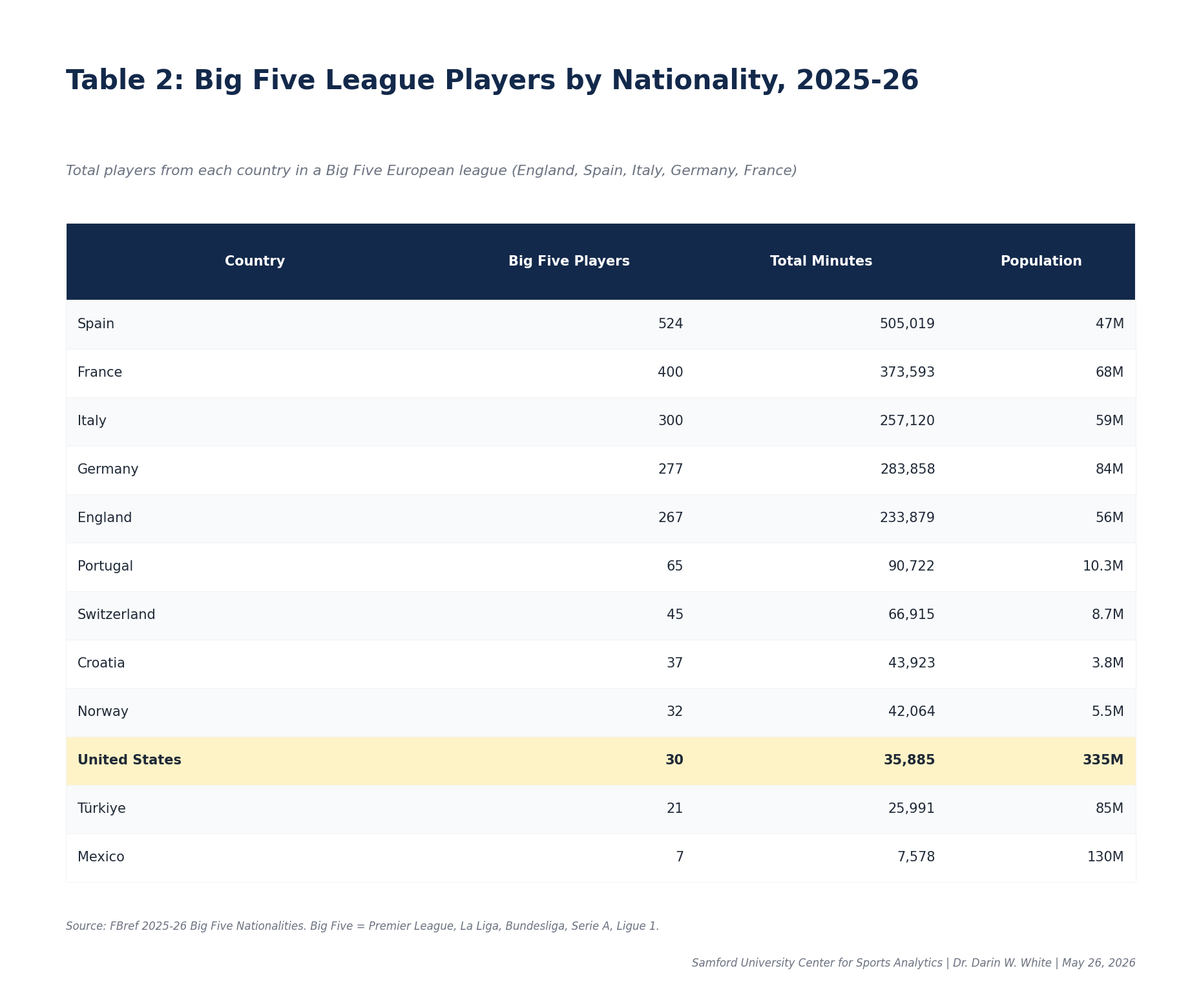
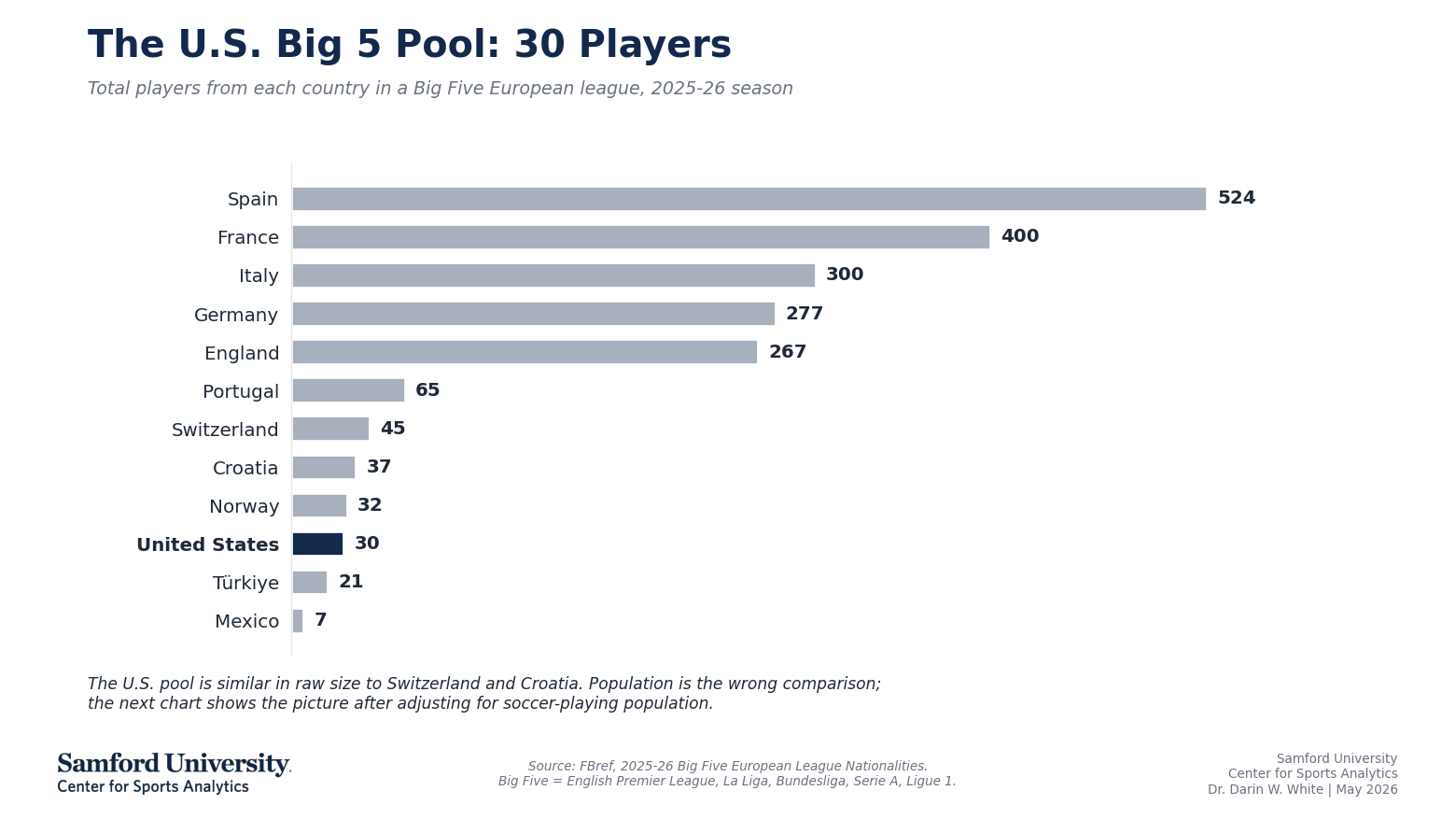
The United States has approximately the same number of Big Five players as Switzerland (45), Croatia (37), and Norway (32). Switzerland's population is 8.7 million. Croatia's is 3.8 million. Norway's is 5.5 million. The United States has 335 million people.
If you stop here and run the per-capita math on total population, you produce a number that looks devastating: the U.S. produces one Big Five player for every 11 million Americans, while Croatia produces one for every 100,000 Croats. A 100-to-1 gap.
But that comparison is not fair. And the fact that it's not fair is itself part of the explanation for why Americans look at the world soccer rankings and feel confused.
The Soccer-Playing Population, Not the General Population
The obvious objection to comparing the U.S. to Croatia on a per-capita basis is that soccer is not the number-one sport in the United States. Croatia's best athletes play soccer. America's best athletes are spread across football, basketball, baseball, hockey, and a dozen other sports. So, the population is not the right denominator. The right denominator is the number of registered male soccer players in each country, because that is the talent pool the country is actually drawing from.
Even on that fairer measure, the gap is still substantial. Here is the most important table in this article:
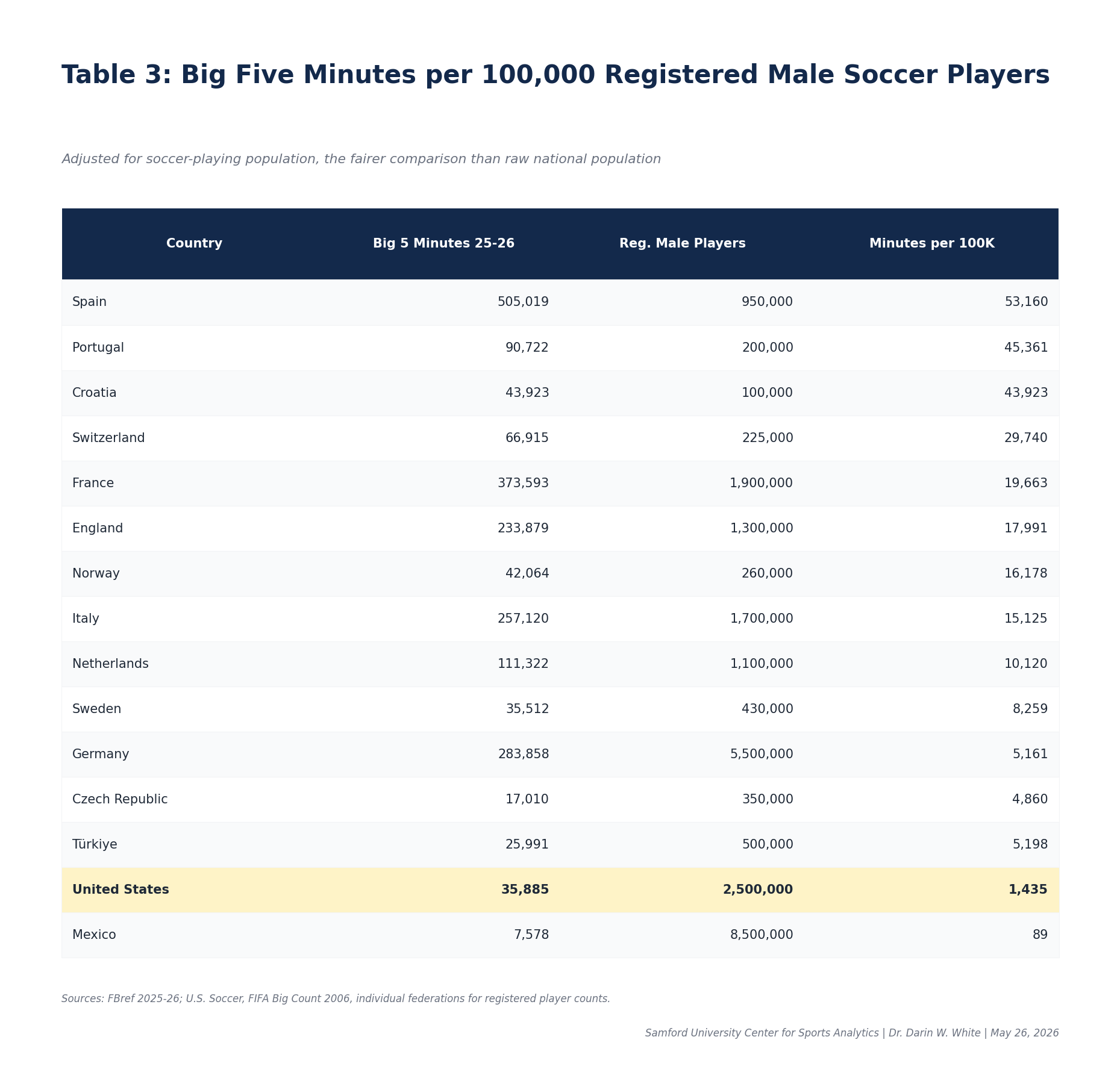
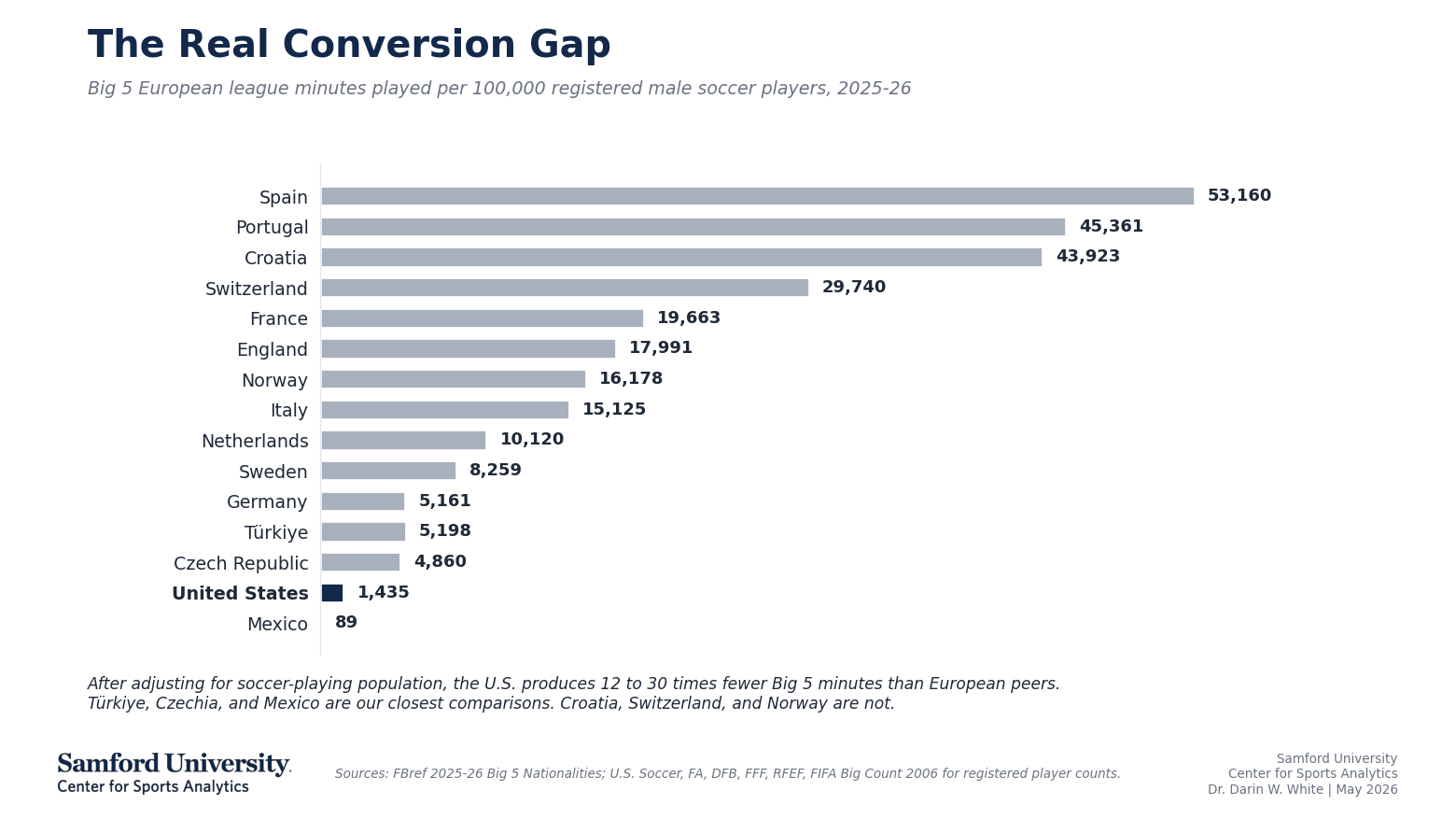
The United States produces 1,435 Big Five minutes per 100,000 registered male soccer players. Croatia produces 43,923 per 100,000, a 30-to-1 gap. Switzerland produces 29,740 per 100,000, a 21-to-1 gap. England produces 17,991, a 12.5-to-1 gap.
Even Germany, the country with by far the largest soccer-playing population in the comparison set (the German Football Association is the largest sports federation in the world, with around 5.5 million registered players), produces 3.6 times as many Big Five minutes per 100,000 registered males as the United States does.
This is not a story about Americans playing other sports. We have 2.5 million registered male soccer players, more than every comparison country in this article except Mexico and Germany. We have more registered male players than England, France, Spain, Switzerland, Norway, Croatia, and Sweden combined. Participation is not our problem. Conversion is.
"We have the players. We have the system. What we don't yet have is the conversion rate from American kid playing soccer to American adult playing at the highest level."
We're Not Switzerland. We're Türkiye.
This is where the article reframes a comparison that often gets made wrong.
When American fans ask why we can't beat Croatia, the implicit comparison is that we should be at Croatia's level. We are not. Croatia plays a different soccer game in a different cultural context with a different talent pipeline. So does Switzerland. So does Norway. These are small countries where soccer is the unrivaled cultural priority, where every promising eight-year-old enters a federation-coordinated pipeline, where the country's best athletes are funneled into a single sport.
That is not the United States. And it's worth understanding which countries are actually our peers in the global Big Five ecosystem.
Sorted by Big Five minutes per 100,000 registered male soccer players, the bottom of the table looks like this:
- Czech Republic: 4,860 minutes per 100,000 registered males
- Türkiye: 5,198 per 100,000
- Poland: 3,536 per 100,000
- United States: 1,435 per 100,000
- Mexico: 89 per 100,000
These are countries with large soccer-playing populations and significant domestic leagues, but where only a small fraction of the talent ever ends up in the Big Five. They are countries with mid-table or boundary-tier elite output, often with strong but not dominant national teams. They are countries that qualify for World Cups but rarely contend for them.
This is the cluster the United States actually belongs to. Türkiye, which the U.S. plays in Game 3 on June 25 at SoFi Stadium, is structurally our closest peer: a strong domestic league (the Süper Lig), a small cluster of stars in Europe (Hakan Çalhanoğlu at Inter Milan, Arda Güler at Real Madrid, Kenan Yıldız at Juventus), and a national team that produces extraordinary moments but plays inconsistent tournament football.
Mexico is the CONCACAF version of the same story: a dominant domestic league (Liga MX), a small Big Five contingent, and a soccer culture that is robust but does not export elite players at European volumes.
The United States is in this cluster, and that should not be cause for despair. Türkiye made the World Cup semifinals in 2002. Mexico has been a respected international program for decades. Poland and Czechia have produced moments of excellence at major tournaments. The cluster of large soccer-second nations is not a basement. It is a competitive tier.
What it is not, however, is the top tier. Becoming a permanent World Cup contender, the kind of nation that walks into every tournament with a legitimate chance of winning it the way England, Germany, France, Spain, and Brazil do, requires moving from our current cluster into the European top tier. That requires closing a 12- to 30-fold gap in Big Five player production per registered male soccer player. It is achievable. It is not yet achieved.
What This Means for the 2026 World Cup
For Americans about to watch the U.S. open the tournament on June 12 at SoFi Stadium against Paraguay, the analytical bottom line is this:
This roster is realistically capable of advancing to the Round of 16. A quarterfinal appearance, the deepest U.S. run since 2002, is plausible. That would be a meaningful result, and a credit to the system that produced this generation of players.
A semifinal or final would require the kind of tournament football that does not depend purely on talent depth. Tournament soccer is volatile. A single transcendent player on form, a few favorable matchups, defensive solidity under pressure, can produce results that long-term pool size cannot predict. Greece won Euro 2004 with one Premier League player. Italy missed the last three World Cups despite a player pool 10 times deeper than ours. The 2026 USMNT has
Christian Pulisic, who enters the tournament after his most productive Serie A season at AC Milan, and a coach in Mauricio Pochettino who took Tottenham to a Champions League final. If everything breaks right, this team is capable of a run that surprises even its supporters.
The cluster we currently belong to is the cluster of countries that show up at World Cups. The cluster we are trying to join is the cluster of countries that win them. The path from one to the other has been the project of the last 32 years. It will be the project of the next 32.
What the Article Doesn't Claim
For balance, three qualifications.
First, this analysis does not claim that elite-pool size determines World Cup outcomes. It does not. Tournament football is volatile, and the team that wins a World Cup is rarely the team with the deepest pool. It is the team that gels at the right moment.
Second, this is a snapshot, not a projection. There is a generation of American teenagers in European academies right now: Cavan Sullivan at Manchester City, Diego Kochen at Barcelona, Cole Campbell at Borussia Dortmund, Mathis Albert at Dortmund, Keyrol Figueroa at Liverpool, and a dozen others. The Five Paths Index will look different in 2030 and very different in 2034. Whether it looks meaningfully different and whether the conversion rate from American soccer player to elite player closes the gap with European peers will be determined by the next two World Cup cycles.
Third, none of this diminishes the achievement of the 2026 roster itself. The players representing our nation are the best collection of American talent ever assembled. They have earned the chance to compete on home soil. They deserve to be celebrated, not measured against an impossible standard.
What You Just Read, in Three Sentences
If you take nothing else from this analysis, take this:
- American soccer has been completely rebuilt since 1994. The pathway, the academies, the export pipeline, the entire system that produces the modern USMNT did not exist a generation ago and now exists at a scale that compares favorably to top European nations.
- Our elite player output, measured as Big Five league participation per registered male soccer player, still trails every European peer by a factor of 12 to 30. The system is right. The scale is not yet there.
- We belong to the cluster of large countries with strong domestic leagues and small Big Five exports: Türkiye, Mexico, Poland, Czechia. That is not where Americans want to be, but it is also not a basement. It is the cluster that shows up at World Cups. The next decade decides whether we move up from there.
When you watch the United States open the 2026 World Cup against Paraguay on June 12, you are watching what 32 years of rebuilding has produced. It is more than we have ever had. It is honest progress, achieved against a real gap. The path from here is what the next decade decides.
Methodology and Sources
This article is based on a player-by-player developmental analysis of all 26 players on the 2026 USMNT World Cup roster and all 22 players on the 1994 USMNT World Cup roster. Each developmental fact (youth club affiliation, high school participation, college career, age at first professional contract, age at first European transfer) was verified against at least two independent sources.
Primary data sources
- FBref (Sports Reference LLC): 2025-26 Big Five European League Nationalities dataset, https://fbref.com/en/comps/Big5/. Source for Big Five player counts and minutes played by nationality.
- CIES Football Observatory (International Centre for Sports Studies, Neuchâtel, Switzerland): Published methodology and indicators on Big Five league participation as a predictor of national team tournament success, drawing on Poli et al., 2010 through 2022 World Cup cycles.
- FBref: United States football players index, https://fbref.com/en/country/players/USA/United-States-Football-Players. Source for active U.S. player pool verification (7,570 total players tracked, 2,063 active in 2026).
- U.S. Soccer Federation: 2024 membership and registration data. Source for ~2.5 million estimate of registered male U.S. soccer players.
- FIFA Big Count 2006 (FIFA Communications Division): Baseline cross-country registered player data. Updated with federation-reported numbers where available.
- Individual national federations: Football Association (England), Deutscher Fußball-Bund (Germany), Fédération Française de Football (France), Real Federación Española de Fútbol (Spain), Schweizerischer Fussballverband (Switzerland), Norges Fotballforbund (Norway), Hrvatski Nogometni Savez (Croatia), Sveriges Fotbollförbund (Sweden), Türkiye Futbol Federasyonu (Türkiye), Federación Mexicana de Fútbol (Mexico).
- 2026 World Cup squad announcements from each national federation, published in May 2026.
Secondary sources used for verification
The Athletic, ESPN, Sports Illustrated, Reuters, Sky Sports, FourFourTwo, Goal.com, Transfermarkt, BBC, Bundesliga.com, Olympics.com, Daily Express, Yahoo Sports, FOX Sports.
Notes on methodology
- The "Big Five" leagues are the English Premier League, La Liga (Spain), Bundesliga (Germany), Serie A (Italy), and Ligue 1 (France). The Dutch Eredivisie is sometimes added as a tier-1.5 league but is excluded from the FBref Big Five comparison dataset.
- The choice of Big Five league minutes as the primary measure of elite-tier player output follows the CIES Football Observatory's published methodology (Poli et al., 2010-2022), which identifies Big Five league participation as among the strongest historical predictors of World Cup squad success.
- Registered male soccer player counts are best-available federation-reported estimates. Cross-country comparisons carry an estimated margin of error of plus or minus 15 percent. For the comparisons in this article (Big Five minutes per 100,000 registered males), the gap between the United States and European peer countries is large enough that this margin of error does not change the directional finding.
- The 1994 USMNT roster of 22 players is from the official FIFA World Cup 1994 USA squad list. The 2026 USMNT roster is the official 26-man squad announced by head coach Mauricio Pochettino on May 26, 2026, at The Rooftop at Pier 17 in Manhattan.
- This analysis was supported in part by computational assistance from Claude (Anthropic) for data verification, statistical analysis, and chart preparation. All findings, framing, and editorial decisions are the author's.
The complete dataset is available on request to dwhite1@samford.edu.
About the Authors
Dr Darin W. White is the Executive Director of Samford University's Center for Sports Analytics in Birmingham, Alabama. A former hall-of-fame college soccer coach who led youth programs to nine state championships over 15 years, he has conducted research on the cultural and economic dimensions of sport that has been cited in the Wall Street Journal, the Los Angeles Times, Forbes, the Washington Post, NPR, and Sports Illustrated. He can be reached at dwhite1@samford.edu.
Daniel W. White is a co-author of this analysis. He holds an MBA in Data Analytics from Samford University and a Master of Arts in Sport Management from the University of Alabama, and is a graduate of Samford's Sports Industry program in the Brock School of Business. He spent four years in marketing leadership at World Soccer Shop, the second-largest e-commerce soccer retailer in the United States, where he worked directly with Adidas, Nike, and Puma on joint marketing campaigns. A former competitive soccer player, Daniel won five Tennessee Division I state championships, represented Tennessee in the U.S. Soccer Olympic Development Program, and played college soccer before entering Samford's Sports Industry program. He brings a deep, first-hand knowledge of global club football to the analysis.


