


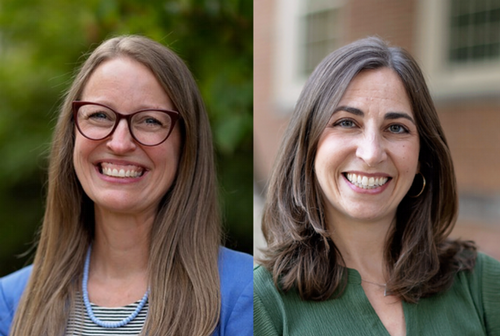
Two Samford University English professors are contributing to a national conversation about vocation, education and the formative role of the humanities through their scholarship with the Network for Vocation in Undergraduate Education (NetVUE).
Jennifer West, associate professor of English and director of Core Writing, and Julianne Sandberg, professor of English, will each write a four-part series for NetVUE’s Vocation Matters blog. Their work explores questions that also shape their teaching in Samford’s Department of English—how reading, writing and literature can help students discern their callings and consider the people they are becoming.
West’s series begins with an idea developed alongside her Samford students: the classroom as an “attention gym.”
The metaphor grew out of conversations in West’s Core Seminar course during the spring semester. As students discussed the challenges of learning in an increasingly distracted digital culture, they began comparing academic work to physical exercise—something that requires discipline, repetition and effort to produce growth.
“The main takeaway from my post is that class is like an attention gym, where we strengthen, stretch and develop our cognitive muscles,” West said. “Naming the work of learning as a kind of workout provides a helpful frame for the ways that the work of academics forms us as particular kinds of people.”
West said students have become increasingly thoughtful about the effects of the digital attention economy on their ability to focus and about their desire to develop healthier habits. Writing, she said, offers one way to resist distraction by requiring students to slow down, develop their thinking and engage carefully with the ideas of others.
For West, those skills extend beyond academic success.
“I am always trying to get students to see that the difficult work of writing can act as a kind of counter-formation for a busy, distracted mind,” she said, adding that those same abilities can support practices such as prayer, meditation on Scripture and attentiveness to people who are suffering.
Her students helped bring the metaphor to life. They discussed research as an intellectual workout and described the challenge of translating thoughts into words as stretching muscles that had grown weak from lack of use.
One student offered a particularly memorable comparison: Failing to put forth a strong effort in class is like “going to the gym and watching other people lift weights.”
Because the analogy helped students recognize the value of difficult academic work, West saw an opportunity to share it with educators beyond Samford through Vocation Matters.
Her involvement with NetVUE has also helped shape a broader approach to vocational exploration within Samford’s English program.
West and Sandberg have participated in NetVUE’s Writing Colloquy for vocation scholars and attended the organization’s conferences. West also became a NetVUE Faculty Fellow in 2024 through its Faculty Summer Seminar program.
“Being immersed in a conversation with fellow teacher-scholars that focuses on helping our students discern and respond to their various callings has given me a rich vocabulary for guiding English students to see their work as readers and writers as a key part of how God is forming them,” West said.
That formation, she said, prepares students not only for a variety of careers but also for the lives they hope to lead and the communities they will serve.
West sees the study of English as particularly suited to that work. NetVUE’s faculty programs and scholarly resources have encouraged her to think more deeply about the discipline as a way to cultivate “narrative thinking, imaginative empathy, ethical and responsible communication skills, and a hunger for beauty and justice.”
Those ideas are woven throughout the English major, including courses students encounter at the beginning and end of the program. This fall, Sandberg is teaching Introduction to Literature, a gateway course for English students, while West is teaching Senior Seminar.
West told her seniors that she believes each of them has been “summoned to this university, this major and this class as part of a story God is writing” for them and for the communities they will be called to love and serve.
Sandberg’s Vocation Matters series approaches similar questions through Shakespeare, vocational formation and uncertainty. Together, the two series demonstrate how scholarship beyond the classroom can inform the experiences Samford faculty create within it.
For West, NetVUE has also provided a community of educators across the country who are asking many of the same questions about teaching, vocation and formation.
“The organization has also connected me with colleagues across the country who are doing similar work,” West said, “and those relationships have also enriched me.”
West’s and Sandberg’s four-part series will continue on the Vocation Matters blog throughout the fall semester.
GIVE: Support impactful work at Howard College of Arts and Sciences.
