


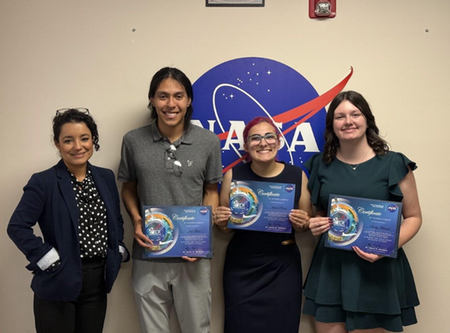
For Samford University student Anna Pharo, a summer internship at NASA’s Marshall Space Flight Center in Huntsville, Alabama, offered an opportunity to take skills developed in the classroom and apply them to a project with real-world implications.
Pharo, a geography major and sociology minor in Howard College of Arts and Sciences, participated in an internship through NASA’s Office of STEM Engagement. Working on an Earth sciences project, she served as the primary geographic information systems, or GIS, and geography student on a three-person team alongside two students with programming backgrounds.
Together, the team processed satellite data covering the continental United States using JavaScript and Python to produce cloud-free imagery. The project involved removing clouds and shadows from satellite data to create clearer images that could be used for further analysis.
Pharo focused much of her work on demonstrating potential applications for the processed data, including tracking urbanization and detecting agricultural drought. She also took primary responsibility for writing the team’s research paper and developing its StoryMap presentation.
For Pharo, the experience demonstrated just how directly her Samford coursework could translate to work at NASA.
“My GIS courses from Samford were extremely helpful for preparing me for my internship,” Pharo said. “They prepared me with not only the foundation but the specialized skills necessary for the internship.”
Her previous experience working with satellite imagery and land-cover data proved particularly valuable. Through her GIS coursework, Pharo had also developed experience with remote sensing and software including ArcGIS Pro and Google Earth Engine.
One Samford project had an especially direct connection to her work at NASA. In a previous GIS course, Pharo created a change-detection project examining the conversion of undeveloped land into developed land around Samford and Homewood High School. At NASA, she drew on that experience to create a larger change-detection map illustrating urbanization across Alabama.
Her academic preparation extended beyond technical GIS skills.
Pharo took the lead in creating the StoryMap her team used to present its findings, relying on presentation and communication skills she developed through her classes at Samford. She also served as the primary author of the team’s technical research paper, bringing together her teammates’ information and explanations into a cohesive document.
The team hopes to publish both its research paper and code.
While Pharo arrived with a strong background in GIS, the internship also challenged her to develop new skills. She had little coding experience before the summer and described learning to work with code as a steep learning curve.
That difference in expertise ultimately became an advantage for the team. While her teammates brought stronger programming backgrounds, Pharo contributed her knowledge of GIS concepts, satellite data and geographic analysis.
One of their largest technical challenges involved exporting processed data for the entire continental United States. The scale of the project required the team to continually find ways to optimize its process before successfully completing the export.
Beyond her own project, Pharo said one of the highlights of the summer was seeing the work of other NASA interns during a poster session.
She learned about projects involving subjects ranging from nuclear propulsion to solar sails and saw physical models representing some of the interns’ work. The experience helped her see the broader impact of the research taking place around her.
“It showed that the work we were doing was important and had real-world applications,” Pharo said.
Her sociology minor also provided another perspective on the experience. Pharo said her sociology courses helped her better understand the organizational dynamics of NASA, including the importance of collaboration among people and departments with different areas of expertise.
Most importantly, the summer expanded Pharo’s understanding of where geography could take her professionally.
Already interested in planetary cartography before arriving at NASA, she became even more interested in the specialized field after learning about the agency’s space-related projects. She also hopes to explore applications of GIS and geographic research involving natural and human-made disasters.
Pharo has since applied to NASA’s Pathways Internship Program, which could provide another opportunity to work with the agency and potentially continue there after graduating from Samford.
For a student who entered the summer prepared to put her geography skills to work, the experience ultimately showed Pharo both how much she had already learned and how much more she could do with it.
GIVE NOW: Support impactful work at Howard College of Arts and Sciences.
