


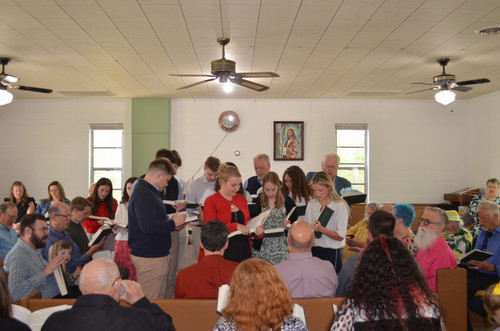
This semester, Samford history students taking Oral History: Family, Faith, Folklore and Food, taught by professor of history Jonathan Bass, stepped into a living tradition that has shaped Southern culture for generations: Sacred Harp singing.
For many, the experience began with curiosity and a steep learning curve.
“I had never heard of it before,” said senior J.P. Theriot. “I’d sung hymns in church, but nothing to that extent. Reading the notes and the sheet music was something totally alien to me.”
Sacred Harp, a form of shape-note singing rooted in early American religious traditions, relies on a distinct musical system that can feel unfamiliar to newcomers. Students quickly discovered that participating required more than just listening, but rather learning an entirely new language of music.
“It’s definitely a skill that can be learned,” said senior Christian Roberts. “But it takes years. It’s not necessarily about your voice—it’s about learning how to do it.”
For the class, the experience also carried a connection to Samford’s own history. Jim Brown, professor emeritus of history, helped teach students about Sacred Harp singing, drawing from decades of teaching, research and firsthand exploration of Southern folk traditions. Brown’s own introduction to Sacred Harp left a lasting impression on him, and his involvement helped students see the tradition not only as a subject of study, but as a living expression of faith, place and community.
That learning culminated in a visit to Pine Grove Primitive Baptist Church in DeKalb County, where students attended an all-day singing and “dinner on the grounds,” a longstanding tradition in Sacred Harp communities.
But what initially felt unfamiliar soon became something deeper.
AnnaBeth McCain, a sophomore from rural south Alabama, said the experience reshaped how she viewed the tradition itself.
“You hear about these traditions and assume they’ve died off,” she said. “But when we got there, it was alive and thriving. You could tell this wasn’t a dying art.”
That sense of continuity across generations, families and communities left a lasting impression on the students.
“There were kids leading songs and older people who had been doing it for decades,” said senior Ethan Crossan. “They’ve built this second family. They’re all very different people, but they’ve found unity in Christ through this worship.”
Students also saw how the tradition connects past and present in meaningful ways. Songs were often chosen in memory of loved ones, blending worship with remembrance.
“It wasn’t just for the people in the room,” Theriot said. “It was also for those who had passed. There’s a kind of continuity to it—young, old and those who have gone on.”
The Sacred Harp experience was just one part of a broader course designed to help students engage history through personal narratives. Throughout the semester, students conducted interviews with family members, community members and participants in the traditions they studied.
For sophomore Eady Davenport, that emphasis on storytelling changed how she understands history itself.
“Instead of just looking at a big historical event, you get to learn about individuals,” she said. “We interviewed a 99-year-old and a 7-year-old at the singing, and these individual stories really matter.”
That lesson also extended beyond the classroom. Several students described how interviewing family members opened new doors of connection.
“I interviewed my grandmother, and I learned things I never would have known,” McCain said. “It’s not just about recording history but about becoming closer to people.”
Others echoed that sentiment, noting how the course encouraged them to preserve stories that might otherwise be lost.
“It’s so important to get those stories while you still have them,” said sophomore Sarah Cochran. “So they can continue to live through you.”
For many students, the class itself felt like a hidden gem within Samford’s curriculum, an experience that brought together academic study and lived reality in a unique way.
“We went and did something we’ve been talking about for years,” said Crossan, who has taken multiple courses with Bass. “We didn’t just study it—we lived it.”
Bass said that integration of experience and reflection is at the heart of the course, even as the class itself evolved throughout the semester.
“I didn’t know what to expect,” he said. “But Sunday, it all came together. All four themes—family, faith, folklore and food—were right there in front of us."
For students, that moment of convergence was deeply personal.
“I think this class helped us feel more rooted in where we are,” one student said. “It made me appreciate the culture around us in a new way.”
In a fast-paced world where traditions can feel distant, the students discovered something enduring in Sacred Harp singing: a community bound not only by music, but by memory, faith and shared story.
And in the process, they found themselves becoming part of that story, too.
GIVE: Support impactful work at Howard College of Arts and Sciences.
