


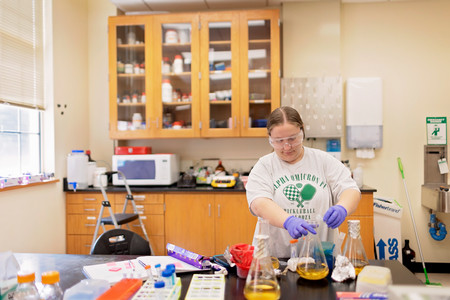
While many students are enjoying a well-earned summer break, laboratories throughout Samford University's Propst Hall remain filled with curiosity, collaboration and discovery as undergraduate researchers continue working alongside faculty mentors on projects with real-world impact.
From investigating the molecular mechanisms behind disease to reimagining chemistry education, students in the Department of Chemistry and Biochemistry are spending their summer developing research skills that extend far beyond the classroom while contributing to research with the potential to shape their respective fields.
For Molly Lockart, assistant professor of chemistry and biochemistry, summer provides students with the opportunity to fully immerse themselves in meaningful scientific inquiry.
This summer, students Landon Smith and Luke Keffer are studying cyclic GMP-AMP synthase (cGAS), an enzyme that plays a critical role in the body's innate immune response. Their research explores how replacing magnesium ions with manganese ions changes the enzyme's activity and coordination environment using advanced techniques including electron paramagnetic resonance spectroscopy, liquid chromatography-mass spectrometry and fluorescence polarization.
At the same time, student Chloe McCarver is using computational chemistry and magnetic resonance concepts to identify and characterize potential molecular qubit candidates, research that bridges chemistry and physics while connecting theoretical models with spectroscopic data.
"These projects provide Samford students with the opportunity to engage in authentic, publishable, interdisciplinary research that connects biochemistry, spectroscopy and computation," Lockart said. "Students gain hands-on experience with advanced techniques, contribute to unresolved research questions and develop the skills and confidence needed to excel in their next career steps."
Lockart noted that the cGAS project builds upon promising preliminary findings suggesting manganese substitution may alter enzyme regulation and inhibitor response, while the qubit project places students at the intersection of chemistry and physics through novel computational and spectroscopic research.
For McCarver, the summer research experience offers opportunities that are difficult to replicate during the academic year.
"Doing research at Samford over the summer is a wonderful opportunity," McCarver said. "There is more time to focus on research without the added stress of classwork and, compared to research during the school year, summer research allows for real-time results without large gaps of time between experiments. There is also additional time with professors to ask them questions and learn much more about the research topics than throughout the school year."
Luke Keffer said the experience has strengthened both his scientific understanding and appreciation for God's creation.
"It has been a blessing to explore the beauty of God's creation at the molecular level by researching the cGAS enzyme alongside amazing professors," Keffer said. "It's so inspiring that I'm able to contribute to discoveries that push the boundaries of science and benefit people across the globe."
Elsewhere in Propst Hall, Megan Connor and her students are approaching chemistry research from a different perspective by examining how students learn.
Connor's research team is designing an eye-tracking study that investigates how general chemistry textbooks influence students' cognitive load while learning challenging scientific concepts. The interdisciplinary project combines chemistry with educational psychology, cognitive psychology and the social sciences to better understand how instructional materials can improve student learning.
"Through this research experience, students learn to conduct interdisciplinary research spanning chemistry, educational and cognitive psychology and the social sciences," Connor said. "This interdisciplinary training prepares students for careers in academic research, STEM education, the learning sciences, data analytics, behavioral research and related fields."
Connor said the team's findings could ultimately help inform the design of general chemistry textbooks used around the world, giving students the opportunity to contribute to research with an international impact.
While each laboratory focuses on different scientific questions, the common thread is the opportunity for undergraduate students to work alongside faculty mentors on meaningful research that extends well beyond the classroom.
Even during the quieter summer months, the work taking place inside Propst Hall reflects Samford’s commitment to undergraduate research, academic excellence and preparing students to make meaningful contributions to science and society.
GIVE: Support impactful work at Howard College of Arts and Sciences.
