


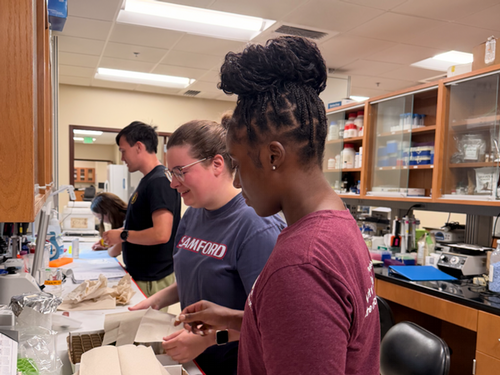
For junior neuroscience and biology double major Anna Caroline Flaming and junior neuroscience major Harrison Bradford, summer research offered an opportunity to investigate one of the most challenging questions in neuroscience: Could the gut provide clues for treating Alzheimer’s disease?
Through the Samford Psychology and Neuroscience Summer Research Fellowships, Flaming and Bradford spent 10 weeks investigating the relationship between gut bacteria and Alzheimer’s disease alongside Patricia Jumbo-Lucioni, associate professor in Samford’s McWhorter School of Pharmacy.
Jumbo-Lucioni joined Samford’s Department of Pharmaceutical, Social and Administrative Sciences in 2016. Her laboratory focuses on identifying potential therapeutic targets for Alzheimer’s disease, a chronic and progressive neurodegenerative condition that currently has no cure.
Flaming and Bradford’s projects approached that challenge by looking beyond the brain and examining the gut-brain axis, the communication system connecting the gastrointestinal tract and the brain. Research has shown that the types of bacteria present in the gut can influence that communication.
Of particular interest to Jumbo-Lucioni’s lab are postbiotics, metabolites produced and secreted by bacteria. Using fruit flies as a model of Alzheimer’s disease, Flaming and Bradford compared the effects of administering live Lactobacillus plantarum bacteria with the effects of the bacteria’s postbiotics.
Although the students worked toward a common goal, their projects examined different characteristics associated with Alzheimer’s disease.
Flaming worked with older flies to investigate locomotor impairments, which can occur with Alzheimer’s disease but have received less research attention.
“This summer I worked on a project which compared the efficacy of a bacteria and its secreted metabolites at correcting movement deficits in a fruit fly model of Alzheimer’s disease,” Flaming said.
Through locomotor testing, Flaming found that the bacterial metabolites increased climbing speed and climbing time in both control flies and flies modeling Alzheimer’s disease compared with flies that did not receive the metabolites.
Bradford focused on memory-related behavior in younger flies for his project, “The Impact of Lactobacillus plantarum and Its Byproducts on Memory in a Drosophila Model of Alzheimer’s Disease.”
“We investigated whether Lactobacillus plantarum and its postbiotic byproducts could influence memory-related behavior in a fruit fly model of Alzheimer’s disease,” Bradford said.
Bradford conducted memory experiments and later expanded the project to quantify amyloid-beta protein, a protein closely associated with Alzheimer’s disease, to investigate whether biological changes could be detected before and after treatment. Preliminary data support the therapeutic potential of postbiotics to mitigate memory deficits in flies modeling Alzheimer's disease.
Bradford and the research team are continuing to analyze data from female flies to determine whether they show similar improvements in memory-related deficits.
Together, the students’ findings suggest bacterial postbiotics could represent a promising therapeutic strategy in this fruit fly model of Alzheimer’s disease while providing a foundation for continued investigation.
The summer fellowship gave Flaming and Bradford dedicated time to advance their projects while receiving additional research training through a collaboration with the University of Alabama.
Working with Atulya Iyengar, professor in the University of Alabama’s Department of Biological Sciences, the team established a video-tracking system in Jumbo-Lucioni’s lab that allows researchers to characterize spontaneous movement in flies following treatment. Flaming took the lead in developing and establishing the protocol.
“Through a collaboration with the University of Alabama, I was able to learn new laboratory techniques that have enhanced my project and have allowed me to gain expertise on how to comprehensively evaluate locomotion behavior in a neurodegenerative disease model,” Flaming said.
For Bradford, the 10-week fellowship provided sustained experience with experimental design, data analysis and the day-to-day process of conducting scientific research.
“The experience gave me a much better understanding of what conducting research actually looks like and will in the future help prepare me for future research opportunities,” Bradford said.
Working closely with Jumbo-Lucioni and other students also gave Bradford experience navigating the collaborative nature of laboratory research. He learned to troubleshoot problems, follow a research timeline and take greater responsibility for leading his own project.
The experience, he said, strengthened his interest in neuroscience and medicine.
For Flaming, who is scheduled to graduate in May, the dedicated summer research period allowed her to complete a significant portion of her project before beginning her final academic year.
“I am very grateful to have been awarded the Samford Psychology and Neuroscience Summer Research Fellowship,” Flaming said. “This fellowship allowed me to complete a large portion of my project that I may not have otherwise been able to complete, as I am graduating in May.”
The fellowship also gave Flaming experience conducting research full time as she prepares to pursue a PhD after graduation. In addition to working independently on her project, she gained leadership experience by training students who were new to the lab.
Jumbo-Lucioni said those opportunities for professional development were an important part of the summer. Flaming and Bradford strengthened their oral communication skills through a final presentation while also mentoring and training junior students in techniques they mastered through their research.
The projects brought together students and faculty from multiple areas of study, providing another layer to the summer research experience.
“Bringing together pharmacy, neuroscience and biology students on a common research project has also created a meaningful experience in interdisciplinary collaboration and teamwork for both students and faculty,” Jumbo-Lucioni said.
The students’ work will continue beyond the fellowship. Flaming and Bradford plan to present their research as part of their final capstone presentations at the end of the fall semester and pursue opportunities to share their findings at national conferences.
Flaming plans to present her work in November at the Annual Biomedical Research Conference for Minoritized Scientists, or ABRCMS. Remaining fellowship funding will help support her attendance at the conference, where she will have the opportunity to share her research with a national audience and learn more about research and graduate programs across the country.
“This opportunity also gave me the valuable experience of participating in research full time, which will help me prepare as I plan to pursue a PhD next fall,” Flaming said.
The Psychology and Neuroscience Summer Research Fellowships are supported by alumni giving, helping provide students with opportunities to pursue intensive research and professional development beyond the classroom.
“This funding was provided by psychology alumni in order to give students here at Samford opportunities beyond what most students could dream of,” said Rob Elsner, chair of Samford’s Department of Psychology and co-chair of the neuroscience program. “No matter how wonderful an experience they had, our alumni are committed to make even better experiences for our current and future students.”
For both students, the fellowship provided an opportunity to move beyond learning about scientific research in the classroom and take an active role in the process—from designing experiments and analyzing data to troubleshooting challenges, collaborating with other researchers and determining the next questions their work could help answer.
