


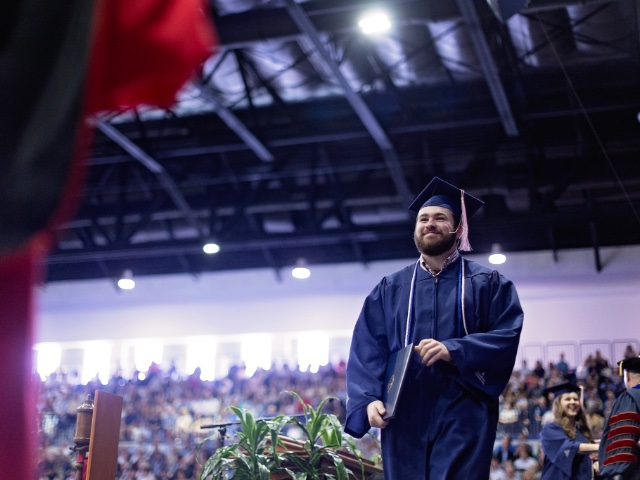
The band is quiet just moments before the music begins. On stage, keyboardist Briggs Cooper ’26 glances around at the musicians he trusts most—friends, collaborators, teammates—and says a few final words before the lights come up. He has’s repeated this ritual countless times during his years at Samford University, and it’s one he knows will continue long after graduation.
“That feeling right before a show,” Cooper said. “Knowing what we crafted together is about to come to life—those moments of shared energy and connection are moments I won’t forget or take for granted.”
Cooper crossed the stage at commencement on May 2, earning a Bachelor of Arts in Commercial Music. He left Samford as a leader shaped by collaboration and community.
What began four years ago as a desire to sharpen his technical skills evolved into a broader calling rooted in authenticity, purpose and people. Cooper arrived at Samford and the School of the Arts thinking growth meant merely becoming a better keyboard player.
 “While that has turned out to be true, I have become a better arranger, music director, producer and overall person shaped by the faculty and diverse opportunities within the commercial music program,” he said.
Growth was fueled by performance and the realization that music carries meaning beyond the stage. Through working with ensembles like Lakeshore and artists like senior commercial music student Via Vicary, Cooper began to see music’s impact in deeper, quieter ways.
“One of my favorite things about music, as cliché as it sounds, is the way it can convey messages that words alone can’t,” he said. “I’ve grown to see how live music, or music in general, can resonate with someone in ways we may not immediately see.”
As that perspective took hold, so did a new understanding of purpose. Samford helped Cooper see music not simply as a career, but as a form of service—a way to support others, communicate meaning and create space for connection.

Some of the most formative lessons came outside of rehearsals. Cooper learned the importance of authenticity, particularly in leadership. “I’ve learned to always unapologetically be myself,” he said. “It’s easy to fall into doing something a certain way because someone else did it first, but trusting my own voice and approach has mattered.”
The School of the Arts became a training ground for that mindset, shaping how Cooper thinks about leadership today. For him, directing music was only part of the role.
“Leadership isn’t just about musical direction,” he said. “It’s about serving the people you’re working with and creating an environment where others can thrive—where, at the end, you can say, ‘We did it.’”
That philosophy was reinforced through his work performing and directing alongside fellow alumnus Dylan Clotfelter ’26, Vicary, and juniors Davis Dooley and Thomas Saunders. Over time, rehearsals turned into trust, and collaboration turned into friendship.
“What meant the most was the trust they placed in me musically and personally,” Cooper said. “That trust pushed me to grow, and it taught me the importance of creating spaces where people feel supported and heard.”
 Balancing the roles of student, performer, music director and friend often stretched Cooper outside his comfort zone. There were seasons when everything seemed to collide at once. Those challenges taught him discipline, time management and the importance of staying grounded.
“It showed me that I’m capable of more than I thought,” he said, “especially when I stay focused and rely on the people around me.”
Leaving Samford, Cooper feels prepared to step into professional musical environments with confidence and adaptability. He’s hopeful for new collaborations and relationships, yet it is the community at Samford that he values most.
“Thank you for the family you’ve created,” Cooper said. “The relationships here were never surface-level. People invested in me, challenged me and supported me through both successes and struggles. That sense of family is what I will carry with me and what I hope to recreate wherever I go next, in music and in life.”
Samford was not just a place where Cooper refined his sound. It is where he learned how to lead, how to serve and how to let music speak for something greater.
