


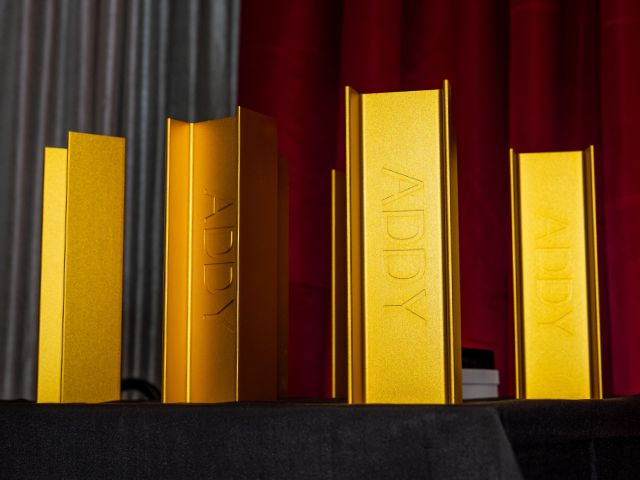
Two Samford University faculty members were recognized by the Birmingham chapter of the American Advertising Federation, earning ADDY Awards for creative work that reflects professional excellence and a deep commitment to the creative process.
Geoff Sciacca, associate professor of graphic design, and Wink Winkler, assistant professor of game design, received honors for projects that showcase storytelling, craft and intentional decision-making—all hallmarks of the work they bring into the classroom in the School of the Arts.
While the finished pieces earned recognition from industry peers, both faculty members point to the process behind the work as the most meaningful aspect professionally and pedagogically.
A Poster with Purpose
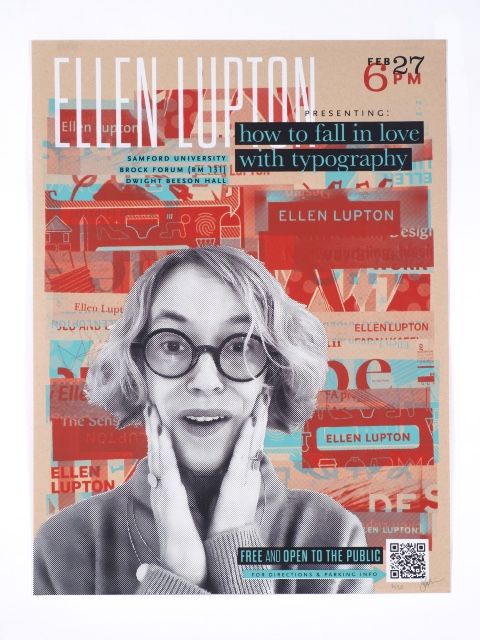 Sciacca’s silver ADDY-winning piece was created to promote a campus visit by Ellen Lupton, an internationally recognized designer, typographer and educator. When Sciacca learned Lupton would be coming to Samford for a lecture and workshop, he wanted the promotional materials to reflect the significance of the guest and the values of the design program.
“She’s a big enough name as a designer, typographer, author, educator and activist that we were able to draw people in from as far as Auburn and Mississippi State,” Sciacca said.
Rather than approaching the poster as a purely digital design, Sciacca chose to screen print the piece, producing a limited-edition run that blurred the line between graphic design and traditional printmaking. The poster draws upon Lupton’s well-known social media typographic videos—often set against a soft red backdrop and open with her signature “oh no!”—while layering imagery drawn from the covers of her many books.
“I wanted to create something that was very ‘Ellen Lupton’ while also still being very me,” Sciacca said. “Screen printing allows me to take a piece of graphic design and output it as a limited-edition piece of printmaking, where I’m mixing the inks and physically applying the color to the paper.”
Sciacca, who has been screen printing for more than 20 years, said the physicality of the process remains central to his creative practice. Each color in the design required a separate screen, carefully aligned and printed one at a time, resulting in 120 individual impressions across a 30-print edition.
“For those who may not be familiar, screen printing allows you to separate an image into a limited number of colors and reproduce each one by hand,” he said. “If you want something to look hand-done, you’re always going to be better off actually doing it by hand.”
The most challenging aspect, he said, was finding the right balance between honoring Lupton’s visual language and staying true to his own design voice.
“While I have tremendous respect for Lupton, she and I have very different design styles,” Sciacca said. “It was important to find a balance between both.”
Producing a Story in Seconds
 Winkler’s gold and silver ADDY-winning project came from a very different discipline, but with the same emphasis on clarity and intentional storytelling. During his second year of involvement with the Red Sea International Film Festival, he co-created and the official festival ident, the short opening film that played before each screening. Idents are designed to establish tone and identity in just a few seconds, and his creative process required precise creative direction and disciplined decision-making.
“With an ident, you’ve only got a few seconds to set the tone before the audience even knows what they’re watching,” Winkler said. “From the beginning, our goal was to make something that felt premium, cinematic and culturally intentional, but still simple enough to read instantly.”
The project centered on a universal creative experience: the moment of discovery that sparks a desire to tell a story. Winkler described the narrative as a kind of emotional origin story, visualized through children encountering something beautiful and feeling compelled to capture and share it.
Early development focused on rhythm, timing and silhouette, using beat boards, storyboards and animatics to test how the piece communicated at speed. As producer, Winkler oversaw the creative pipeline from concept through delivery, coordinating teams, managing schedules and protecting the clarity of the final piece.
“One of the biggest evolutions was the storytelling element,” Winkler said. “The kids weren’t in the original concept. We realized the ident needed a human heart.”
That realization led to simplification—an essential but sometimes difficult part of the producing process.
“There’s always that moment where you realize the coolest version isn’t the clearest version,” he said. “My job was making sure we could move fast without drifting. We had a short runway—about 60 days from concept to delivery.”
Creative Practice in the Classroom
Sciacca and Winkler said continuing to produce professional work keeps their teaching grounded and relevant.
Whenever possible, Sciacca brings students into the creative journey by sharing works in progress and discussing challenges as they arise.
“I think it’s valuable for students to see that their faculty are still active, professional artists trying to visually solve similar problems to what we assign them,” he said.
For Winkler, working outside the classroom reinforces lessons about scope, iteration and collaboration.
“Craft isn’t just talent—it’s iteration, relationships and clarity,” he said. “Real-world work always has constraints, and learning to make decisions within those constraints is a critical professional skill.”
Together, these Birmingham ADDY Awards highlight how Samford faculty integrate professional practice, thoughtful process and high creative standards—modeling for students what it looks like to work with excellence, intention and integrity in the creative industries. Art and Design Faculty Earn Birmingham ADDY Awards
