


On a school fence in Fairfield, Alabama, elementary students pieced together a colorful mural—each panel different, each voice visible. In Titusville, Alabama, an urban neighborhood rich in history and potential, data became a diagnostic tool to prescribe healthier futures. Thousands of miles away in the Dominican Republic, students listened first, observing how people gather, move and live before ever lifting a pencil to design.
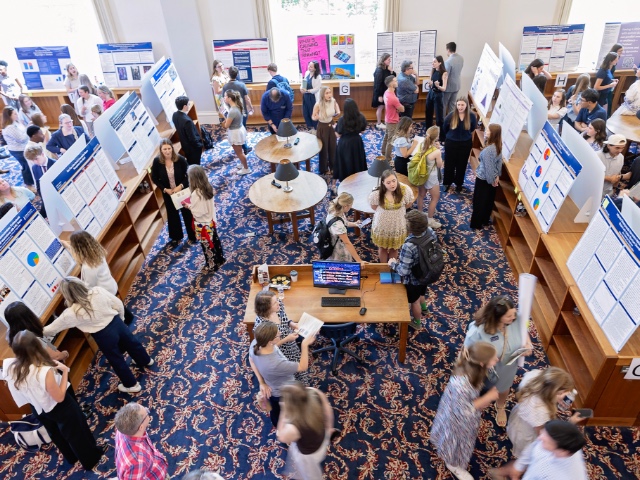
At the 2026 Samford Student Research Colloquia, architecture seniors Mari Douglas and Tori Turner and graduate student Mia Edens presented research projects that spanned classrooms, communities and continents. Their work took different forms, but it shared one central conviction: architecture is not just about buildings, but about people—and the responsibility designers carry to serve them well.
Aaron Brakke, assistant professor of architecture & interior design, mentored all three students throughout their research and studio work. He noted that this year marked the first time students from the Department of Architecture & Interior Design presented research at the Samford Student Research Colloquia.
“Design research recognizes that knowledge is not only found through reading and analysis,” Brakke said. “It is also produced through the different ways designers work, such as drawing, modeling, testing and making. Through these activities, students gain insights from the design process and transform creative exploration into substantive knowledge.”
Together, the projects illustrated the cornerstone of Samford’s architecture program: human-centered design—an approach that begins with listening, learning and responding to real needs.
Learning to Design Before Learning the Rules
Douglas presented research based on larger class projects that brought architectural and interior design concepts into K–12 classrooms, examining how early exposure to design thinking can reshape the way students learn and create.
 Douglas’ research drew in part from community-based projects completed through Samford’s Creative Investigations course, where architecture and interior design students are first introduced to design research methods. One such project involved elementary students at Robinson Primary School in Fairfield, Alabama, working alongside Samford students to create a collaborative mural.
  Creativity became collective, and each child installed individual plastic squares of various colors, forming a bulldog and their school’s name on the fence facing the community—an exercise in both imagination and belonging.
With high school students at Restoration Academy, the work went beyond theory. Students were encouraged to explore ideas conceptually before making them tangible. This approach initially challenged the way they were used to thinking. Douglas recalled how students struggled to move beyond literal interpretations when asked what “home” meant, often responding with concrete objects like a bed. With encouragement, their thinking shifted to more abstract and emotional ideas—safe, cozy and loved—a moment Douglas said marked a breakthrough in how students began to understand design.
“Architectural thinking invites curiosity,” Douglas explained. “When students learn to see creativity as something they’re allowed to explore, learning becomes more human.”
Her project suggests architecture’s influence starts far earlier than the drafting table, shaping how students approach problems long before they ever consider a design career.
Measuring Health Beyond the Doctor’s Office
While Douglas focused on early imagination, Edens approached architecture through accountability. Her research asked a complex question: How can designers prove that architecture makes communities healthier?
 Drawing from socioeconomic data and urban policy history, Edens developed a framework she calls the Neighborhood Health Benchmarker—a tool that evaluates a community as a doctor might examine a patient. Access to fresh food, walkability, public transit, health care and housing variety become “vital signs,” revealing where interventions are most needed.
The data informed her proposed design for the Titusville, Alabama, community: a multifunctional agricultural center that combines green space, food production and clinical access—addressing health as the presence of opportunity instead of the absence of illness.
“Health is more than having a hospital nearby,” Edens said. “It’s walking down a shaded street, talking with a neighbor, having access to affordable food. Architecture shapes all of that.”
Crucial to her approach is a feedback loop that measures a building’s impact after it’s built. By continuously assessing whether a design actually improves community outcomes, Edens argues architecture becomes accountable, transparent and trustworthy.
Her project reframes design as an ongoing relationship with a community, not a finished product.
Designing With, Not For
Turner’s research shifted the lens globally, examining how immersive, community-engaged design education shapes socially responsive architects. Her work centered on a multidisciplinary field experience in the Dominican Republic, where architecture, interior design and performing arts students worked alongside a real community.
 Rather than designing from afar, students lived within the context they were studying—observing daily rhythms and learning how culture, movement and gathering shape space. Architecture and interior design students studied the built environment while performing arts students engaged the community through performances at schools and public spaces.
The experience, Turner said, changed everything.
“We weren’t guessing what the community needed,” she said. “We experienced it, which made our designs feel more real and intentional. I’ve learned that design isn’t just about designing buildings. It’s about designing buildings to give dignity to the people they serve.”
 Working across disciplines—and across cultures—introduced challenges in communication and perspective, but those tensions became lessons. Students learned how different design lenses balance one another and how collaboration mirrors professional practice.
This project was the first time many had designed for a real client.
“It showed that students need real experiences where they can listen, observe, and understand a community instead of making assumptions from a distance,” Turner said. “By working directly with a community, we began to see that design carries a responsibility and that decisions have real impacts. This project emphasized that socially responsive design comes from understanding, listening, and experiencing.”
A Shared Vision
Together, the three projects reveal a common thread: architecture as a practice of care. Whether nurturing creativity in children, restoring dignity through data-driven design or engaging communities as partners rather than subjects, each student challenged traditional notions of what architects do and whom they serve.
At the 2026 Student Research Colloquia, their work did more than showcase academic excellence. It told a larger story about a discipline—and a program—committed to shaping designers who see buildings not as ends, but as means to human flourishing.
As these students demonstrated, the future of architecture may be defined less by what is built and more by how thoughtfully and humbly it begins.
