


Humanity is craving humanity.
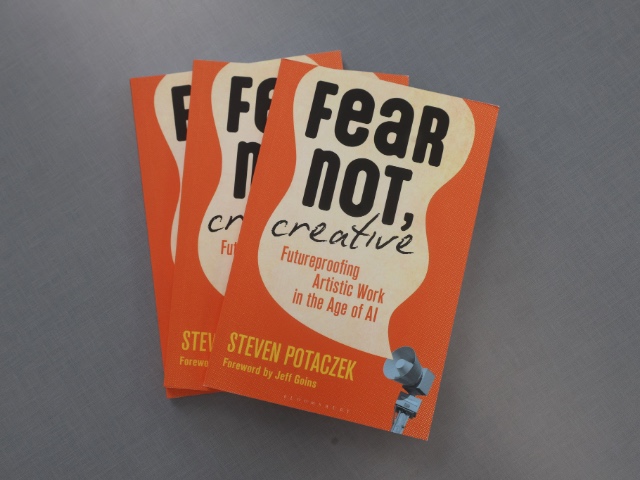
That conviction sits at the center of Steven Potaczek's new book, Fear Not, Creative: Futureproofing Artistic Work in the Age of AI. As artificial intelligence continues to reshape industries and fuel predictions about the future of work, the director of Samford University's commercial music program is asking a different question entirely: What happens when technology can generate content, but cannot create the kind of connection people are longing for?
The book, scheduled for release Oct. 1, grew out of conversations Potaczek was having with students, colleagues and fellow artists who shared a common concern.
"Is AI going to replace me? Will there even be any work left for me to do?," they asked.
After hearing those questions repeatedly, Potaczek realized the fear surrounding artificial intelligence has become as significant as the technology itself. Rather than offering what he describes as either panic or blind optimism, Potaczek set out to create a practical guide for navigating a rapidly changing creative landscape. At its core, the book argues that while technology can transform the tools artists use, it cannot alter the essence of creativity itself. The conviction was strengthened during the writing process when he discovered that today's AI debate is only the latest chapter in a much older story.
"We tend to talk about artificial intelligence as though it suddenly appeared in the last few years, but the term itself was coined in 1955," he said. "What we're experiencing isn't entirely new."
Throughout history, artists have repeatedly adapted to disruptive technologies, from the camera to the computer. In Potaczek's view, creative expression has never disappeared because of innovation. Instead, artists have consistently found new ways to use emerging tools in service of timeless human impulses.
"The history of creativity is not a graveyard of obsolete artists," he said. "It's a story of artists continually picking up new tools and discovering new ways to make something beautiful."
That perspective is informed by Potaczek's own professional journey. Over the course of his career, he has witnessed dramatic changes in music production technology, moving from multitrack tape recorders to dedicated hard disk recorders to sophisticated digital software. Yet those changes never altered the source of artistic expression.
"It's not about what tool I use to capture creativity," he said. "They're just tools."
What concerns Potaczek is not technology itself, but the growing tendency to confuse technological capability with creativity.
“An overreliance on AI is like pushing a button on a vending machine and then saying that you made that bag of potato chips,” he said.
While generative AI can produce songs, images, essays and videos in seconds, he argues that truly meaningful art emerges from lived experience, imagination and the willingness to see the world in unexpected ways.
He points to what artists call "defamiliarization" -- presenting ordinary experiences through fresh and surprising language or imagery. Instead of simply describing a difficult relationship, for example, a songwriter might describe it as "slow dancing in a burning room," transforming a familiar feeling into something vivid and memorable.
"AI is built on what has already been done in the past," Potaczek said. "Essentially, AI generates average content. That's not what makes for great art."
That message is particularly relevant for today's college students, many of whom are preparing to enter industries being reshaped by artificial intelligence.
Potaczek does not dismiss the significance of the technology. He readily acknowledges that AI is changing the creative marketplace and that students should learn how to use emerging tools. At the same time, he cautions against allowing those tools to become substitutes for original thinking, craftsmanship and creative voice.
"Students should absolutely learn the tools, but never mistake them for quality solutions," he said. "If students can learn to use the tools as just that, they may arrive at better solutions faster."
He worries that overreliance on AI can lead to safe, predictable outcomes rather than bold or transformative work.
"It can't be edgy, contrarian or prophetic," Potaczek said. "These things remain the sole possession of human artists."
The same philosophy shapes his approach to teaching at Samford. Universities have a responsibility to help students understand emerging technologies, Potaczek said, but their purpose extends beyond teaching the latest software or platforms. Developing discernment, critical thinking and ethical awareness is equally important.
"I don't think our job is simply to teach students how to push the newest buttons," he said. "Our job is to teach them how to think."
Those questions become especially important within Christian higher education. Potaczek believes students should wrestle with the ethical implications of artificial intelligence, including concerns surrounding intellectual property, compensation for artists, environmental costs and the dignity of the people whose work contributes to AI training systems.
"We shouldn't teach students merely how to use technology," he said. "We should teach them how to use technology without surrendering their humanity to it."
Ultimately, Fear Not, Creative is less a book about artificial intelligence than it is a book about people. Potaczek points to growing research on loneliness and social isolation as evidence that human connection remains one of society's deepest needs. He argues that art will continue to matter because it creates meaningful connections that technology alone cannot replicate.
"It's like saying the pencil took away cave drawings," he said. "The medium may have changed, but the purpose is the same: connection."
When readers close the book, Potaczek hopes they leave with a renewed sense of freedom and purpose.
"Nothing should steal the joy of creating," he said.
Drawing on a favorite quote from choreographer Martha Graham, Potaczek believes every person possesses a unique voice and perspective that cannot be replicated.
“There is only one of you in all time, this expression is unique, and if you block it, it will never exist through any other medium; and be lost. The world will not have it. It is not your business to determine how good it is, not how it compares with other expression. It is your business to keep it yours clearly and directly, to keep the channel open.”
--Martha Graham
In a culture increasingly captivated by artificial intelligence, he sees that truth not as a limitation, but as an invitation.
Potaczek argues that the future of creativity will not be determined by algorithms. It will belong to the people willing to cultivate their craft, embrace their humanity and continue creating something only they can bring into the world.
