


When Calista McIntyre emerged from a Milan subway station on a cool summer morning, she expected to find breakfast. Instead, she found herself standing in silence.
Rising before her was the Duomo di Milano, its intricate marble façade glowing in the morning light. Though a café reservation and guided tour awaited, she and her companions lingered in the square, captivated by one of the world's most iconic cathedrals.
"It truly took my breath away," she said.
That moment of awe became symbolic of a much larger experience.
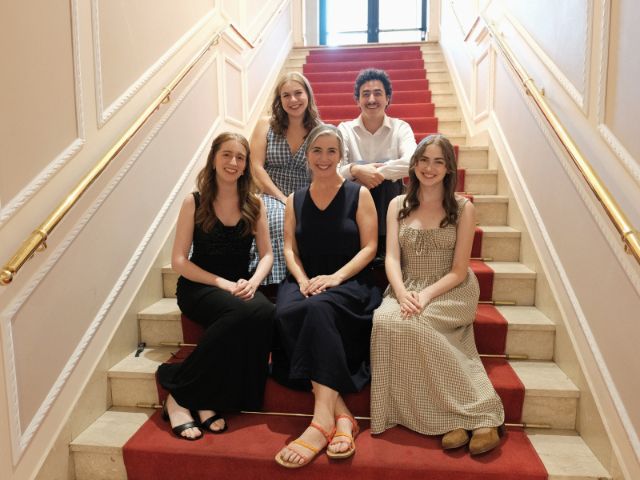
This summer, several Samford University students traveled to Verona, Italy, to participate in Opera Viva's Young Artists Program, an immersive training experience that brings emerging performers together with internationally recognized faculty from across the globe. Among the program's faculty was Kristin Kenning, professor of voice and director of Samford Opera.
"Opera Viva offered these young artists the chance to test their preparation and skill in elegant Verona with exceptional musicians guiding them to new heights as performers and vocalists," said Kristin Kenning. "I was proud to see them meet the challenge of a demanding young artist program and excited they could learn in the culture that created opera."
Participants were challenged to refine their artistry while studying in the country where opera was born. By the program's conclusion, the students had gained more than advanced musical instruction and performance experience. They returned with renewed confidence, deeper artistic perspective and a firsthand understanding of opera's enduring place in Italian culture.
Opera is often viewed in the United States as a specialized discipline, admired by devoted audiences but largely removed from everyday life. Italy told a different story.
There, students encountered a culture where opera remains woven into the fabric of daily living, shaping schedules, conversations, traditions and community life.
"It was so beautiful to see the arts mean so much to so many people on a level you don't experience here at home," said Calista McIntyre, a junior majoring in musical theatre.
The difference was impossible to miss. In Italy, opera was not confined to concert halls or conservatories. Restaurants adjusted their schedules around performances. Locals spoke about productions with enthusiasm. Everyday people knew the stories and melodies of operas that many Americans might never encounter.
"Opera isn't a forgotten art form reserved for the pretentious and elite," said Avery Kate Anderson, a junior majoring in music with an emphasis on vocal performance. "It is deeply entrenched in Italian culture."
That cultural immersion extended well beyond the classroom.
Students wandered historic streets between rehearsals, explored centuries-old landmarks and adapted to a pace of life that felt markedly different from home. Rather than rushing from one obligation to the next, Italians seemed to move deliberately, taking time to enjoy conversations, meals and daily routines.
"The daily rhythm was the most memorable for me," Anderson reflected. "Waking up to a beautiful sunrise, taking the bus into town to get a coffee and a pastry, walking around with no particular direction or place to be."
Those quiet moments became as meaningful as the performances themselves.
Yet Opera Viva was far from a vacation. Days were filled with lessons, coaching, rehearsals and performances led by faculty from some of the nation's most respected music programs. The students found themselves surrounded by accomplished artists whose expectations pushed them to new levels of growth.
That challenge was especially significant for McIntyre, one of only two musical theatre students participating in the program. Many of her peers had spent years focusing almost exclusively on vocal performance, while her background was more broadly distributed among singing, acting and dance.
Being surrounded by highly trained singers could have been intimidating. Instead, it became a catalyst.
"I am a strong believer that if you think you're the best in the room, you are in the wrong room," she said.
The experience pushed her to pursue a higher level of vocal technique and make the most of every opportunity available. In private lessons and masterclasses, concepts that had felt elusive for years suddenly clicked into place. Technical breakthroughs involving vocal agility, breath management and range expansion transformed how she approached singing.
Working with nationally recognized faculty also helped reshape her confidence as a performer. Throughout the program, professors repeatedly praised her ability to communicate emotion and tell stories through music. Hearing that encouragement in an environment filled with exceptionally talented singers made a lasting impact.
"I have always struggled to be a cheerleader for myself when it comes to performing," McIntyre said. "Being told that I stood out in the performance aspect of opera was especially helpful to gaining confidence."
While confidence emerged as a common theme, the growth each student experienced looked different. Exposure to multiple teachers and artistic perspectives challenged performers to think critically about their own approach to music-making. With so many accomplished professionals offering feedback, students quickly discovered that there was rarely just one correct answer.
"This program helped me gain confidence to make my own decisions musically," said Anderson. "I had to learn how to use the information I was given to make confident decisions for my own performance rather than strictly following one person's ideas."
That realization represents an important milestone for any young artist. Technical skills can be taught, but developing an artistic voice requires the ability to process different viewpoints and determine what best serves both the performer and the music.
The learning extended beyond technique and artistry. Throughout the program, faculty members engaged participants in open conversations about mental health, wellness and the realities of sustaining a career in the performing arts. Several shared their own experiences with therapy and emphasized the importance of caring for the artist, not just the art.
Those discussions left a powerful impression.
"A new perspective that I am bringing back to Samford is just how important it is to be looking out for your mental health as a performer," McIntyre said.
Faculty encouraged participants to view seeking help not as a weakness, but as a strength. In an industry often defined by intense expectations and vulnerability, that message resonated deeply.
Some of the most memorable lessons came from simply being present. One highlight of their time in Italy was attending a performance of La Bohème in the Verona Arena, the ancient Roman amphitheater that remains one of opera's most iconic venues. Sitting among thousands of audience members in a space where generations have gathered to experience music and storytelling, they witnessed the enduring power of the art form they have chosen to pursue.
The experience reinforced something they had been discovering throughout their weeks in Verona: opera is not merely a subject to study. It is a living tradition, one that continues to connect people across cultures, languages and generations.
By the end of the program, the students returned home with stronger technique, fresh artistic perspectives and memories that will remain with them long after the final curtain call. More importantly, they returned with a deeper understanding of themselves as artists.
"This program helped me gain confidence to make my own decisions musically," Anderson said. "I had to learn how to use the information I was given to make confident decisions for my own performance rather than strictly following one person's ideas."
McIntyre echoed that sense of growth.
"The number of connections, memories, improvements and friends I made was beyond what I could ever have hoped for," she said.
Experiences like Opera Viva demonstrate the initiative and ambition of Samford students as they seek opportunities to develop their craft beyond the classroom and the university. Through world-class mentorship, artistic challenges and immersion in the culture that gave birth to opera, these students discovered new confidence in their abilities and a deeper appreciation for the art form they hope to share with others.
Sometimes, that growth begins with an unexpected moment of wonder, standing in a city square thousands of miles from home, gazing up at a cathedral and realizing the world has suddenly become much larger than it was before.
