


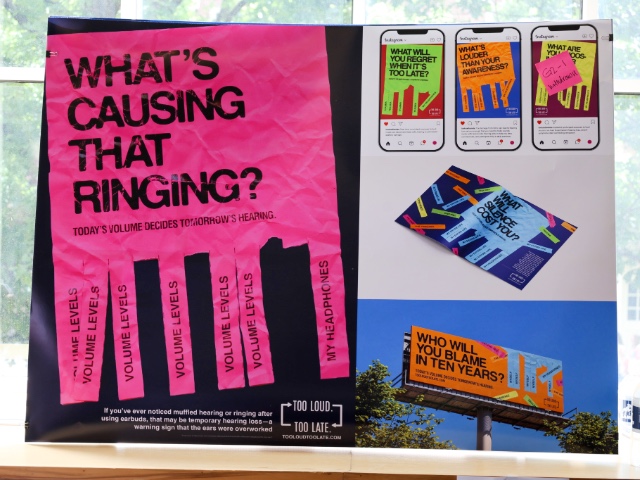
The most powerful warnings are not always loud, and the most urgent stories are not always visible.
That idea stood at the center of the 2026 Samford Student Research Colloquia when Madeline Walters and Marlee Jones, junior graphic design students, presented projects that asked people to pause, reconsider and look closer at the risks and realities hiding in plain sight. Though their research explored vastly different subjects—unsafe headphone volume levels and hidden poverty—both students leveragedvisual design as a way to expose what often goes unnoticed in daily life.
Their work demonstrated how graphic design can move beyond aesthetics, becoming a research-informed practice that shapes awareness, empathy and behavior.
Geoff Sciacca, associate professor of graphic design mentored Walters and Jones. He noted that this year marked the first time students from the Department of Art and Design presented research at the Samford Student Research Colloquia.
“The class project was a Social Awareness Campaign where students are challenged to use graphic design as a means of impacting social change—design for good,” Sciacca said. “I have a reference librarian come to class and help them research their chosen topics with the goal that they will create concepts that inform, challenge, question and motivate a target audience about their social issue.”
Walters’ research examined the long-term effects of unsafe listening habits, particularly through headphones and live music environments. A lifelong music lover and frequent concertgoer, she wanted to understand the consequences of volume levels that many people dismiss as harmless.
“Music is something almost everyone can relate to,” Walters said. “Whether it’s headphones, concerts, loud events or speakers, it’s important for everyone to listen at safe levels to protect their hearing over time.”
What surprised her most was how damage accumulates quietly. Walters’ research showed that destructive volume levels slowly deteriorate and muffle sound before people realize anything is wrong. In some cases, that damage can become permanent.
To communicate that risk, Walters designed a public health campaign grounded in credible, scholarly research while remaining visually immediate. She began by studying scientific literature before translating data into designs meant to catch attention quickly.
One of her most effective design choices was the use of tear-off-style posters replicated across the campaign. Bright colors, bold typography and direct questions invited viewers to interact physically and digitally with the message. She created a visual metaphor for the way hearing can be slowly “torn away” without intervention.
“I hope people start questioning their choices regarding volume,” Walters said. “Protecting your hearing now means you can enjoy it longer later.”
Jones’ project confronted a different kind of invisibility.
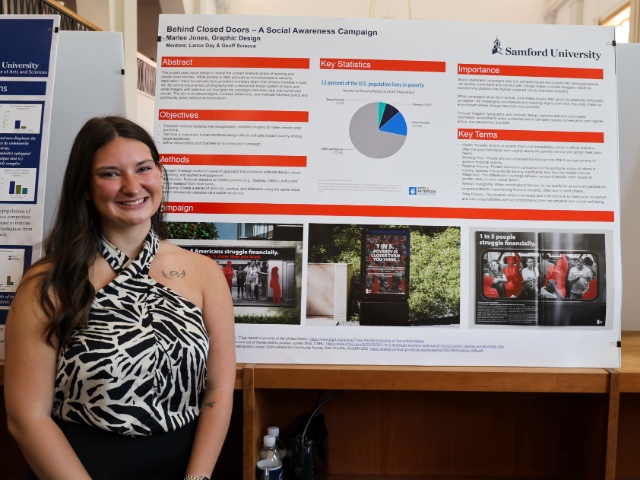 Her campaign, Behind Closed Doors, focused on hidden poverty—financial hardship that does not match common stereotypes of need. Jones drew inspiration from her volunteer work at Feeding Families of North Alabama, where she encountered people whose struggles were not immediately apparent.
“The longer I volunteered, the more I met people who could be anyone’s neighbor, coworker or friend,” Jones said. “I realized how much hardship exists that we never see.”
Jones structured her campaign around the statistic that one in five people experience food insecurity, using the number as both a factual anchor and an emotional prompt. Rather than overwhelm viewers with information, she intentionally let the data speak.
“It forces viewers to look at those around them and do the math,” Jones said. “I wanted them to sit with that number and feel the weight of it.”
Visually, Jones paired black-and-white photography with selective red highlights to draw attention to critical facts. The stripped-down palette removed visual distractions, while short, restrained phrases allowed space for reflection.
“Subtlety mirrors the reality of hidden poverty,” Jones said. “If imagery is too dramatic, people assume it doesn’t apply to anyone they know. Familiarity makes it harder to ignore.”
That recognition—of oneself, of others, of shared vulnerability—was central to her goal. Rather than offering solutions, Jones hoped her designs would inspire empathy.
“You never really know what someone is going through behind closed doors,” she said. “If one person pauses before making an assumption, then the campaign has succeeded.”
Together, Walters and Jones showcased how research-driven design can influence public understanding, whether it prompts safer health choices or more compassionate perspectives. Each demonstrated that some of the most effective forms of communication do not shout. Instead, they invite viewers to notice what is already there—the quiet damage of everyday habits and the unseen burdens carried by those around us. Sometimes, research simply requires looking and helping others learn how to see.
