



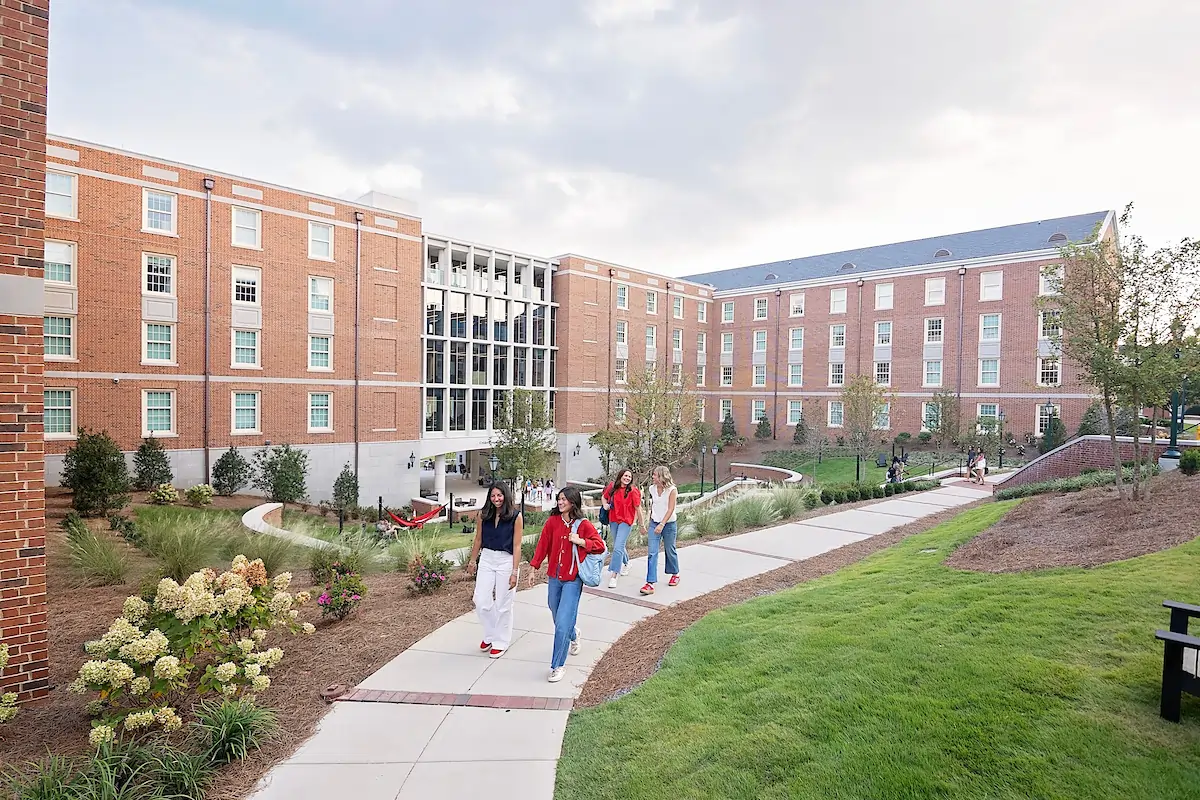
As you crest the hill of Montague Drive, passing Hodges Chapel on your right and Pete Hanna Stadium on your left, the view of the newly constructed Audrey Lattimore Gaston and Marvin L. Mann Halls takes your breath away. The freshman residence complex stands distinct with its Georgian-Colonial architecture and alive with an energy that rivals Ben Brown Plaza on a perfect fall day.
For the first time in years, all freshmen who live on campus reside in one of five central residence halls: Vail, Smith, Pittman, Gaston or Mann, reserving the residence halls in east and west campus for upper-division students. The surrounding landscaping has been reimagined, creating outdoors spaces, like Crider Commons and Buck Plaza, with beauty and functionality that aligns with its indoor counterparts.
For many freshmen, a residence hall is their first home away from home, so by bringing the freshman class together in one centralized location, it quickly becomes a place defined by community, comfort and security—as well as a proximity to student life that can’t be beat.
What the Class of 2029 may not realize is the intentional work that has led to this exact point in Samford’s history. In December 2022, President Beck A. Taylor announced Samford Horizons: A Blueprint for Tomorrow, a long-term campus master plan that was unanimously endorsed by the Board of Trustees. The first phase is now complete, including the renovation of the Caf, the construction of the 165,000-square-foot Campus Recreation, Wellness and Athletics Complex, two Greek residence halls, the 512 beds now available in Gaston and Mann Halls and a 550-stall parking deck expansion.
The impact of these projects has been felt immediately, transforming student life and elevating Samford’s residential experience to meet the needs of students today.
Missional Distinctiveness
Roughly $300 million was invested into phase one of Samford Horizons, a figure made possible through the generosity of many who saw the vision for the future of Samford.
“One of Samford’s longstanding distinctives is residential education—inviting the vast majority of students to live, learn, work and play on campus in a supportive Christian environment,” said President Taylor. “Many colleges and universities in the U.S. are struggling to maintain their enrollments, and I think a reason so many are in trouble is because they’ve watered down their missional distinctiveness.”
One of Samford’s strengths is its ability to attract undergraduate students who want a traditional college experience. The university has worked to bolster this strength through these investments, creating spaces that contribute to its vibrant and growing student life.
David Presley, executive director of admission for Samford, sees this demand for a traditional college experience firsthand through his conversations with high schoolers. “Students and families today are looking for more than just a college,” he said. “Increasingly, they desire a place that balances strong academics, community and outcomes. That’s exactly where Samford shines.”
Committed to its mission to nurture students in their development of intellect, creativity, faith and personhood, Samford offers nationally recognized academic programs, a personalized learning environment with small class sizes, and incredible outcomes, including the fact that 97% of undergraduate alumni are working or are in further study within six months of graduation.
“Samford subscribes to the education of the whole person. The formation of individuals in mind, heart and soul requires incarnational presence and mentorship. Students who live on campus are closer to the people and programs that Samford offers to ensure students are successful and growing as faithful adults,” said President Taylor.
Proximity to Opportunity
When students live on campus, they receive the gift of proximity to the robust opportunities Samford offers. With more than 200 student organizations, hundreds of spiritual life events, 24 intramural sports and so much more, many students have to learn how to balance the abundance of opportunities with their existing academic commitments.
Blake Andres, a junior majoring in both business management and Spanish, will graduate with a long résumé of involvement and experience. He’s a University Fellow and Ragland Scholar. He participates in Step Sing, and volunteers with the Office of Community Engagement. He completed multiple internships through his major in Brock School of Business, and he even took advantage of a study abroad opportunity to Spain.
If you ask him which activity holds the best memories, Andres is quick to speak about the men’s club soccer team. “I grew up playing soccer, so having the opportunity to
continue playing in college has been a huge blessing for me,” he said.
Andres is a true representation of many Samford students who enthusiastically say “yes” to the opportunities presented to them—embracing activities that are both familiar and new.
“Being at Samford has led to my growth in independence and confidence to succeed in the classroom and the everyday world, providing me with experiences that push me out of my comfort zone,” he said. “More importantly, being a Samford student has played a major role in my spiritual growth. Being surrounded by so many positive Christian influences has given me many opportunities to learn more about God and grow closer to Him.”
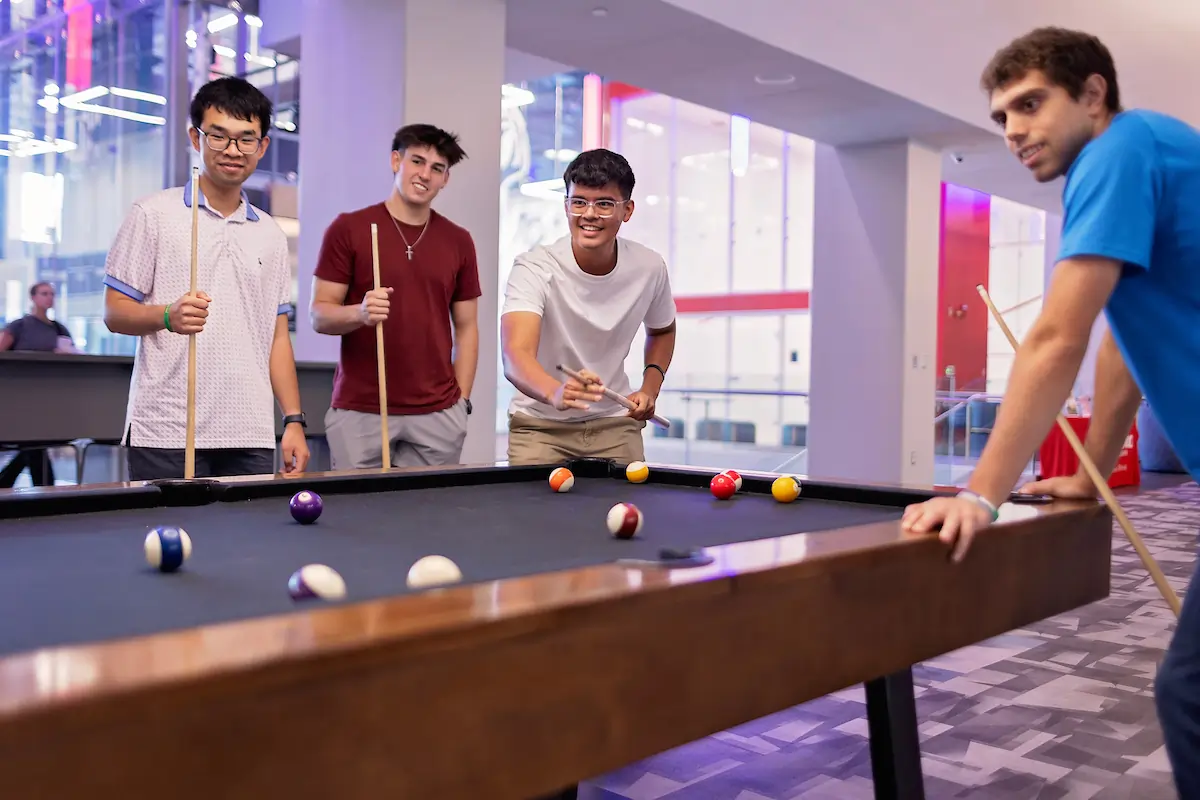
While a vibrant student life is not new to Samford, recent campus investments have taken things to a new level. You need to look no further than the Campus Recreation, Wellness and Athletics Complex to see the proof of this statement. The facilities go beyond a space that houses exercise equipment. It’s truly a campus hub, gathering students to enjoy a meal, join a workout class, play pool or participate in esports. In January, the space fills with Step Sing groups, practicing for the coveted Sweepstakes trophy.
"Students who live on campus are closer to the people and programs that Samford offers to ensure students are successful and growing as faithful adults."
— President Beck A. Taylor
Just up the hill from the complex is Samford’s West Campus Residence Halls, which includes 11 houses for active sororities and fraternities. Greek life at Samford is comprised of 18 Panhellenic, Interfraternity Council and National Pan-Hellenic Council chapters. More than 2,600 Samford students participate, representing 60% of the undergraduate population.
Senior ShaTajma Doss said she came to Samford with dreams to be a nurse as well as a member of Delta Sigma Theta Sorority, Inc. Now in her final year of nursing school, she serves as president of the Sigma Eta chapter of Delta Sigma Theta Sorority, Inc. While this is an outcome she hoped for, she didn’t anticipate the personal growth that would come with the leadership role.
“I don’t like public speaking. That’s not my thing,” Doss said. So, when Abraham Evans, assistant director of Greek life called her this summer to speak at orientation about her experience in a NPHC sorority, Doss had to step out of her comfort zone.
“I told incoming freshmen that Greek life is what got me on that stage to be able to talk to them,” she said. “I stepped out because the people around me gave me a push and encouraged me to use my voice.”
Doss’ story is a beautiful outcome of what Greek life at Samford is all about. “Students are encouraged to grow as leaders, serve others, and support one another in meaningful ways,” said Clint Coulter, director of Greek life. “Chapters offer countless opportunities for members to discover their gifts and make a real impact. Greek life isn’t just another activity—it’s a space where students find belonging, develop confidence and prepare for life after college with the support of friends who become like family.”
This fall, Samford reported a 98% bid match rate from Panhellenic recruitment. Among the highest percentages in the nation as reported by the National Panhellenic Council, this means 98% of the girls who wanted to join a sorority were given the opportunity.
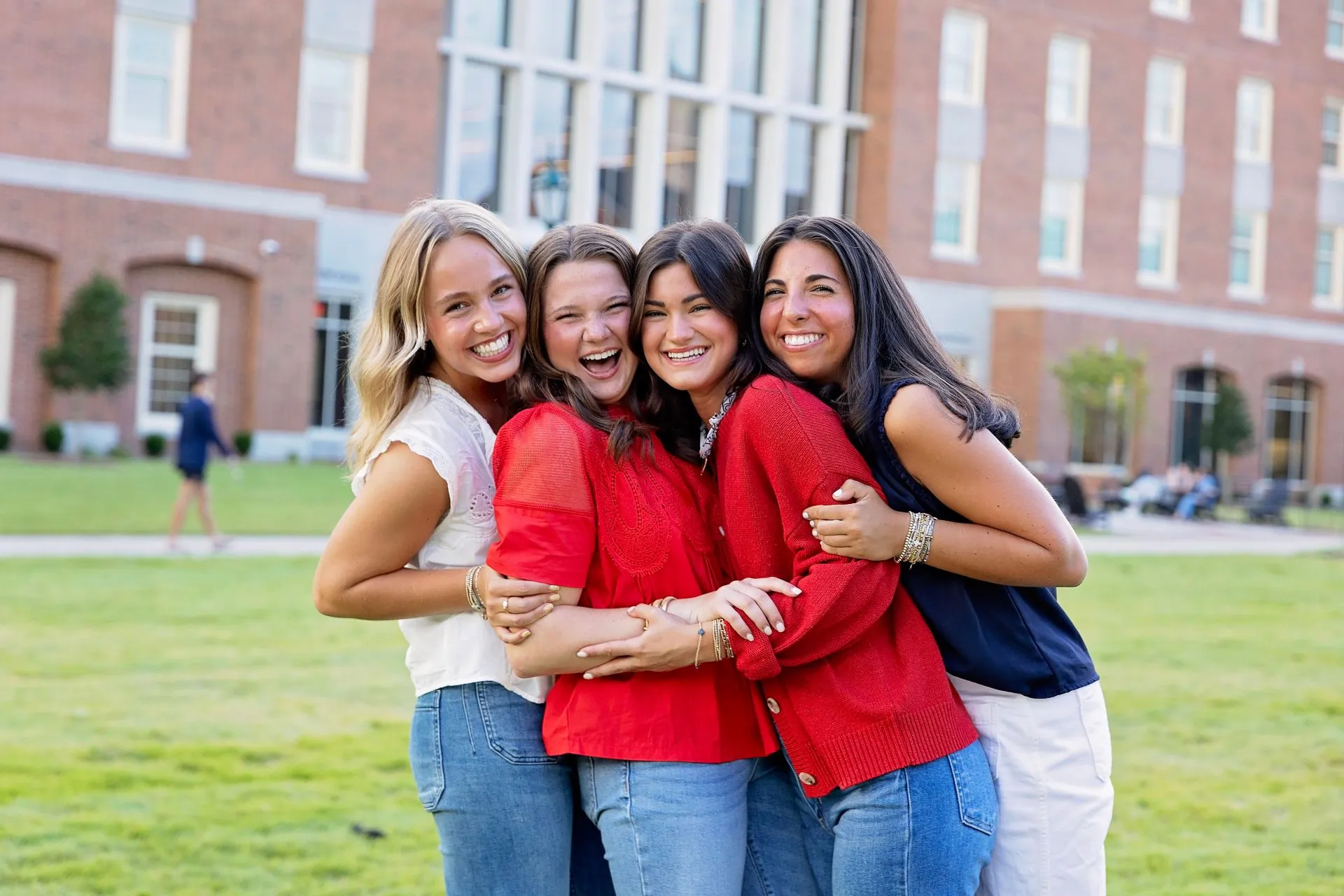
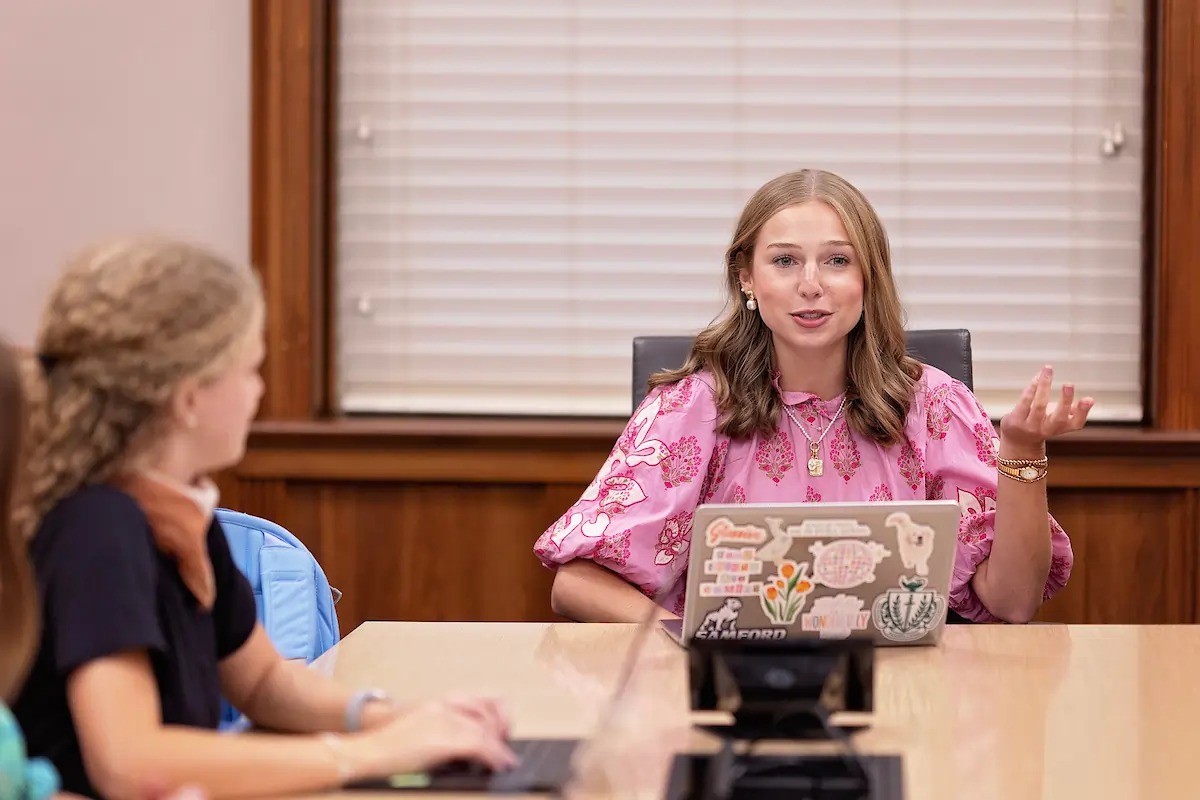 Ella Ingram, a senior public health major, serves as Panhellenic president this year, and this statistic makes her very proud. “It took a lot of effort to achieve this, and it speaks to the work of people who came before me,” she said. “It’s a reflection of the culture that Samford has created.”
Ingram is a member of Alpha Omicron Pi, which is one of the two sororities who moved into the newly constructed Greek residence halls this fall. She recalls how the energy in the Bill and Kimeran Stevens Plaza, located between the new houses, during recruitment was electric.
Alpha Omicron Pi shares the plaza with Kappa Delta and Tri Delta, fostering relationships that go beyond Greek letters. “My favorite part about serving on Panhellenic is meeting people from the different chapters,” Ingram said. “With the proximity of the new houses, it’s easier to build community among the sororities. You walk out the front door, and there are your friends.”
Intentional Connections
When students talk about their experience at Samford, community is a popular word. Ingram speaks of it when she reflects on her time in Greek life. Andres credits the men’s club soccer team for many of his closest friends. Commonality—sharing similar passions and interests—naturally brings people together.
When students declare a major, they step into an academic community where shared passions and professional pursuits push each other to excel in their studies. For example, Moffett & Sanders School of Nursing uses a cohort model for undergraduate students to navigate the curriculum, completing classes and clinicals at the same time.
“We spend a lot of time together,” said Sam Martin, a senior nursing major. “While our cohort started to make connections from the first day of class, it picked up when we started practicing for validations. And you know, with clinicals, there are long days and early mornings—which are made better when we carpool to the hospital.”
Even after spending the entire day together, Martin said their cohort still wants to meet up again—for dinner, a game of pickleball or time to study. “We’re not sick of each other,” he said. “We all just get along so well that it feels natural to do something together that can help us de-stress.”
And then there is community that is developed by shared experiences.
The Samford Outdoor Adventure Club is the largest student organization on campus today. They have a group message on GroupMe with more than 900 students, roughly 20% of the undergraduate population. Started by a group of friends who love the outdoors, the club organizes weekend trips to go camping, rafting and skiing. They also host weekly gatherings on campus and two service days each semester, volunteering in the community.
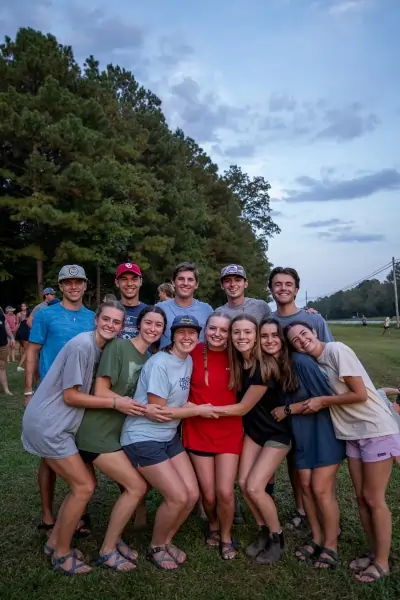 From their first camping trip in fall 2022, the Samford Outdoor Adventure Club sought to develop trips with the novice in mind. The club’s leadership arrives early and sets up every tent. They purchase groceries and organize meals. “We want people who haven’t had these experience to come and enjoy it,” said Jacob Barham, a senior finance major and one of the club’s founders.
It’s not uncommon for a group of friends to go camping or to spend a weekend at the beach together, but the spirit behind the formation of this club aligns with what makes the Samford community so special. A conversation between two friends started a flame that, through the enthusiasm of others, fanned into a fire. They didn’t want to go camping by themselves, they wanted to invite as many people as they could to come along with them.
“When you look at Scripture, you see that Jesus would constantly depart from the group and go to a mountaintop to pray. We wanted to extend that offer to other people on campus, to get away for the weekend and get a breath of fresh air,” Barham said.
These weekend trips involve times of worship and devotionals. Spiritual development has always been at the foundation of the Samford Outdoor Adventure Club. Its first gathering was a worship service on the balcony of Cooney Hall.
Last year, The Wall Street Journal ranked Samford 2nd of all colleges and universities in the nation for character development. This ranking is a strong reflection of the Samford community—students, employees, parents and alumni—who model good character for others to emulate.
“If you find your community at Samford—or wherever you are—you’re going to want to be there longer,” said Bryan Gill, director of the Office of Faith, Learning and Vocation and one of three advisers to the Samford Outdoor Adventure Club. “At Samford, students are surrounded by different voices sharing the same message—pointing people to grow in their faith. We want students to know that true development involves every aspect of their lives, from academics to community involvement, from spiritual life to our social life.”
Faith Formation
Anchored in Christian understanding, Samford seeks to be a place where faith can be fostered, especially among undergraduate students who—potentially for the first time—are developing a relationship with Jesus that is completely their own.
Samford’s Office of Spiritual Life serves as a centralized hub for this purpose. They facilitate the Freshman Retreat at the start of the year, campus worship every Tuesday morning, and small groups and cadres for students to dive deeper in biblical study. The work they do—day in and day out—to foster a community centered around Jesus naturally creates more opportunities for worship and ministry, led and nurtured by the students themselves.
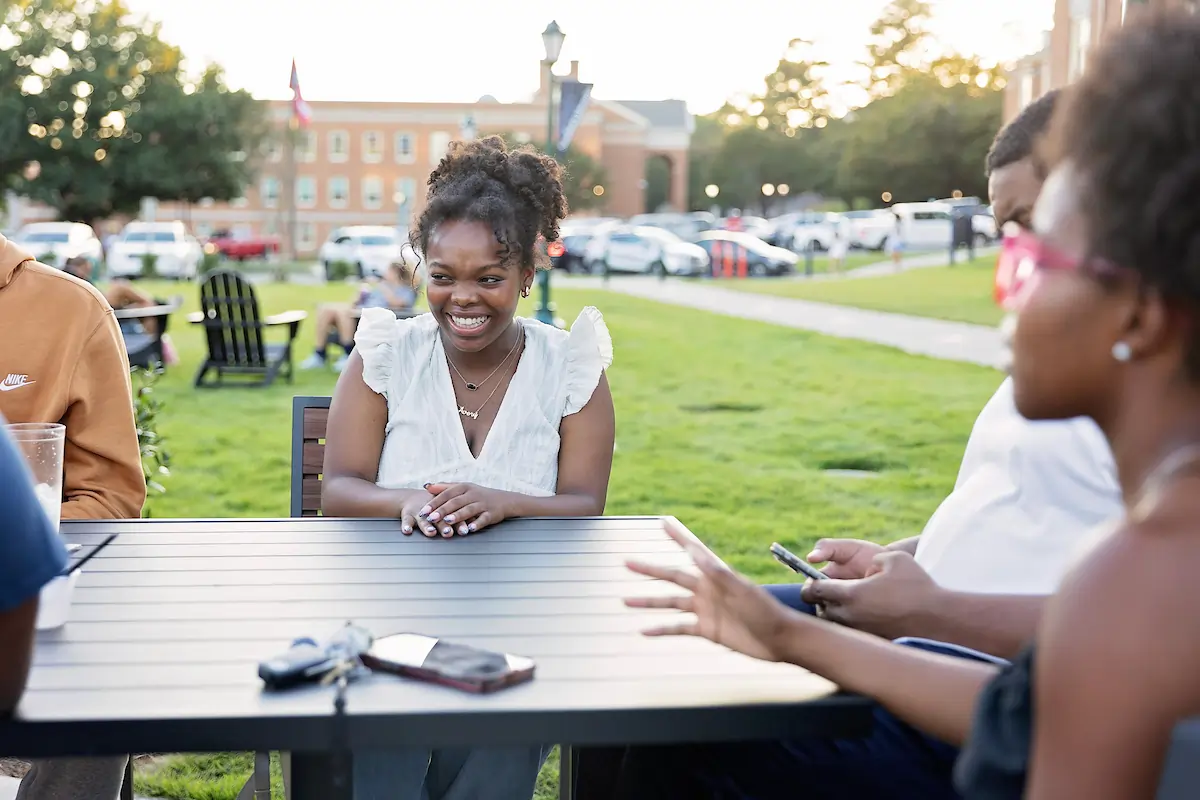 Avery Jackson, a sophomore biochemistry major, is involved in RANSOM, a campus ministry that started at Samford more than a decade ago by students. This year, she serves on its leadership team, and she credits the ministry for being a stepping stone for her faith.
“I joined, hesitant of my ability to serve, but expectant of the Lord to show up and use me and my friends for His glory and to share His love to others. I’ve grown in my prayer life for others, for the ministry, for those who are lost,” she said.
RANSOM gathers in Brooks Auditorium every Monday night, drawing a large crowd each week. “The community at RANSOM is just that welcoming. It bridges the gap with community and builds a familial relationship with everyone. Because of RANSOM I have lasting connections and friendships with Samford alumni and my fellow peers,” she said.
Samford has many long-standing ministries on campus, serving students and the community, but there is always room for more, as demonstrated by freshman-led worship.
During Connections Weekend, freshman Micah Strawn felt a stirring in his heart. He invited his classmates— people he just met—to meet in the common area between Gaston and Mann Halls for a time of worship. Word spread quickly; nearly 80 students showed up.
“I realized afterward that I couldn’t remember exactly how I assembled the worship band,” Strawn said. “It was clear that the Lord just brought us together.”
Word of mouth continued to spread. When Strawn and his peers showed up the following week, it was immediately evident that the indoor space would be too small. They pivoted, inviting students to meet them outside in Crider Commons instead.
The result—the voices of more than 250 freshmen lifted in worship could be heard from every corner of campus. Crider Commons, an outdoor space connecting the freshman residence halls, suddenly became a place with a greater purpose—to gather, to forge friendships and to worship God.
This story was first published in the fall 2025 issue of Samford magazine. Read the issue online.
