


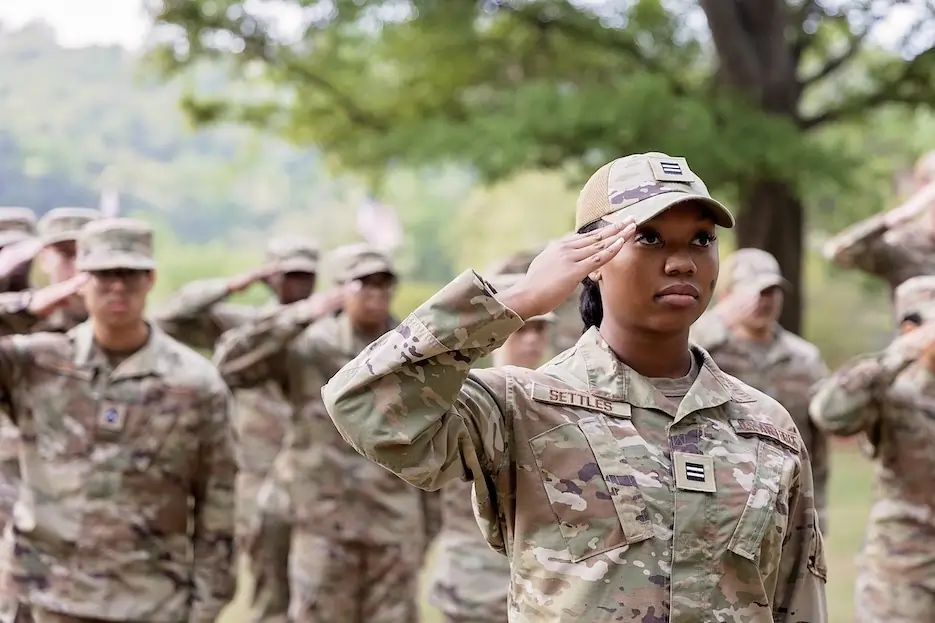
The sun rises over Reid Chapel as the cadets of Air Force ROTC Detatchment 012 stand in formation at the end of their Friday morning leadership lab. Other students walk across campus to make their 8 a.m. classes, but these 40 cadets are completely still, awaiting further commands.
ROTC is one of three commissioning pathways to becoming an Air Force officer. Compared with those at the United States Air Force Academy or Officer Training School, the opportunities ROTC offers its cadets are distinct.
When students join ROTC, they gain exposure to the Air Force through classes, physical training, teamwork and leadership drills. This comes in conjunction with academic studies and the other activities of traditional college life. Samford is one of 36 host universities in its region, and while most students from Detachment 012 attend Samford, the group also includes students from the University of Alabama at Birmingham (UAB), University of Montevallo, Miles College, Jefferson State Community College and the University of Alabama in Huntsville. Collectively they’re nicknamed the Iron Warriors.
Character development has been at the heart of the ROTC program since Detachment 012 was established at Samford in 1972. 2nd Lt. Shaniya Jacobs-Lanier ’26, who just graduated with a degree in biochemistry, has seen many personal opportunities for leadership during her formative college years. “Leadership experience is less about learning how to be the person in the front of the room but knowing how to work with other people and how to best manage different tasks,” she said.
New cadets face a sharp learning curve, quickly learning lessons in operations, leadership and discipline through ROTC-specific courses. After their sophomore year comes field training, which Detachment 012 commander Lt. Col. Drew Johnson called “a kind of crucible.”
The three-week training at Maxwell Air Force Base in Montgomery involves intensive assessment. “They are thrown in and have to make it work,” Johnson said. “How are they going to meet objectives, show how they can lead, how they can follow?”
Cadets are tested on everything they learned during the first half of the program. This is thanks to the upper-classmen in ROTC, as once they complete field training, students return to the detachment as leaders. ROTC is completely student-run by the juniors and seniors who completed field training. Johnson said his team provides mentorship and guidance, but operations and planning are left to the cadets.
Jacobs-Lanier reflected on wisdom absorbed from detachment leaders during her freshman and sophomore years and the skills development that will serve her in the Air Force. “I was learning things weekly in the leadership and teamwork settings,” she said. “It’s basically like intense learning on how to be an adult, and one that other people like to be around.”
As a leader, Jacobs-Lanier hopes she helped other cadets appreciate the character-building values of the Air Force and Samford. When the Friday morning’s leadership lab wraps up and cadets are released to their other college duties, detachment leaders head to the Caf, where they eat breakfast together. They are gaining invaluable lessons in leading and fostering relationships with future fellow Air Force officers.
My Fellow Wingmen
Some students in Detachment 012 took a less traditional route to military service. Samir Crooker started college at UAB, where as a second-semester freshman he decided to give ROTC a try. The program quickly turned his life around. He transferred to Samford in fall 2025 at the start of his sophomore year, largely because of the strong community he found in ROTC.
“I’ve grown the most through the people that I have been spending time with,” Crooker said. “I learn from my peers to be more humble, faithful and resilient.”
The people he stands shoulder to shoulder with in formation are his favorite thing about the Iron Warriors.
Being on Samford’s campus, Crooker feels encouraged to excel academically and grow in his Christian faith. ROTC, while demanding much of cadets, still gives students the opportunity to experience some of the best aspects of college as they prepare to be commissioned in the Air Force. He is involved with Reformed University Fellowship, where he embraces opportunities to worship the Lord with friends. Thanks to the examples of servant leadership set by the upperclassmen, he is consistently reminded how to serve others in the military and in life.
“I thank the Lord, and I thank ROTC for bringing me here. I love it here at Samford,” Crooker said.
The son of an Air Force pilot, Will Free has long known he wanted to duplicate his father’s career path. Growing up as a military kid, Free had many conversations with his dad about service and wanted to join ROTC before going into the Air Force to intentionally pursue relationships as a college student while training to become an officer. Initially, Free was unsure if he would find an environment that allowed for both. But as he has just finished his sophomore year, he said he found it at Samford by serving as an ambassador, a member of the Alpha Tau Omega fraternity and a ROTC cadet.
“It’s been a huge blessing getting to pursue community through marching, running or through just getting involved on campus as a normal college student,” he said.
Through ROTC, Free was instantly introduced to other students from across the Birmingham area. He appreciates being able to remain a tight-knit group despite attending different colleges, and values seeing a perspective different from his own. When he’s commissioned, he will be exposed to fellow officers from many different backgrounds.
“ROTC is one of the most unique opportunities on campus because you get a peek into the lives of students at other campuses," Free said. "The dynamic has been really cool to see how we are all growing and developing through these first few years.”
Free will be attending field training this summer, something his fellow cadet, JT Van Nostrand, completed last summer. Van Nostrand, who just finished his junior year at Samford, believes every cadet in Detachment 012 will be prepared when their time comes for field training.
“It’s said that tough times create tough people,” Van Nostrand said. “I believe ROTC has been doing that not only in my life, but in my fellow wingmen’s lives as well.”
The Mission is the Same
As commander, Johnson said that he and his team try to ensure that students pursue excellence in their officer training and classes at Samford.
Van Nostrand said he has seen this effect in his life through ROTC—specifically with helping him to fight complacency and improve his time management. An engineering physics major, Van Nostrand hopes to serve his country by designing vehicles or supporting equipment on base. Waking up early and doing drills helps him build discipline to focus on his studies, and the Samford community motivates him to be dedicated to Christ.
“It is a rare instance of a culture so founded on biblical principles that it pushes me to work hard to accomplish my goals for myself,” he said. “The community here is unmatched, as I have never seen a campus so full of loving people who are so willing to drop everything to help someone in need.”
The holistic approach to the pursuit of excellence is where Van Nostrand sees the mission align between the military and Samford. The Air Force’s mission statement—Fly. Fight. Win.—calls officers to sacrifice their time and personal freedoms while serving the United States of America.
“At Samford, and in life, it is my priority to remain a Christian who seeks out the best way to grow mentally and spiritually, and to do everything in life to the best of my ability,” Van Nostrand said.
Capt. Carson Kennedy ’17, one of the officers overseeing Detachment 012, said he sees a strong correlation between the Air Force’s focus on preparing officers for a lifetime of service with the values that Samford strives to instill in students. Kennedy, who participated in ROTC three out of his four years at Samford, said the university placed an emphasis on understanding calling and using talents to serve something greater than yourself.
Helping shape the next generation of ROTC cadets feels surreal to Kennedy. Knowing the impact the program made on him, he believes that the Iron Warriors will be prepared to step out into service.
“Both institutions prioritize more than just professional success, and that shared foundation makes Samford an ideal environment for developing future Air and Space Force officers committed to leading lives of integrity,” Kennedy said.
Jacobs-Lanier exemplifies how academic success and dedicated training helps prepare Air Force ROTC cadets at Samford. Days after commencement, she was commissioned during a May 4 ceremony in Reid Chapel—a building that served as a backdrop for countless early morning training sessions. She plans to attend dental school and then make her career as an Air Force dentist.
Because of the discipline instilled in her through ROTC and the support she received while studying at Samford, Jacobs-Lanier feels prepared for her next step of service.
“I’ve learned so much, from freshman year all the way through to being a leader,” she said. “That, paired with my professors being intentional about making sure all students are taken care of, has allowed me to be successful time and time again.”
