


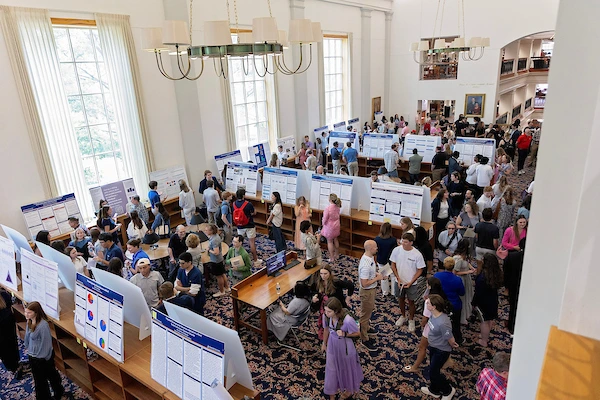
The 5th annual Samford University Student Research Colloquia saw over 170 undergraduate and graduate students gather in Davis Library to present scholarship ranging from the effects of listening to true crime podcasts to evaluations of the athleticism of single-sport and multi-sport youth athletes.
The event has doubled in size since it first began in 2022. Linnea Minnema, director of grants and sponsored programs, said the colloquia is her favorite of the academic year. She loves watching faculty talk with students from completely different disciplines, learning from the students about what they are currently finding exciting and inspiring.
“Each time we do this event, we hear from students, faculty, staff, parents, community members and university leadership about how meaningful it is,” she said. “Students have a chance to show their creativity and intellect, faculty and staff have a chance to support and celebrate the good work students are doing, and we all fellowship together outside of our regular patterns and groups.”
Several presenters researched how artificial intelligence (AI) would impact areas of nursing, computer science, engineering and psychology. Ella Fordham, Kate Maze and Ana Michelle Vandiver are psychology majors whose presentation focused on whether knowledge of the arts would make it easier to detect whether an image, video or song was created by AI.
The research titled “Human Touch or Digital Brush: Does having an artistic background help differentiate between human-made and AI-made art?” springs from the trio's mutual interest in the growth of AI art and a desire to see arts and humanities education regain popularity in academia. Vandiver said presenting the group’s findings helped her learn to prepare for future opportunities.
“The opportunity to present gives me exposure to an environment that I am unfamiliar with and a little uncomfortable with. This has allowed me to grow in my skills, which I will need after college and in my career,” she said.
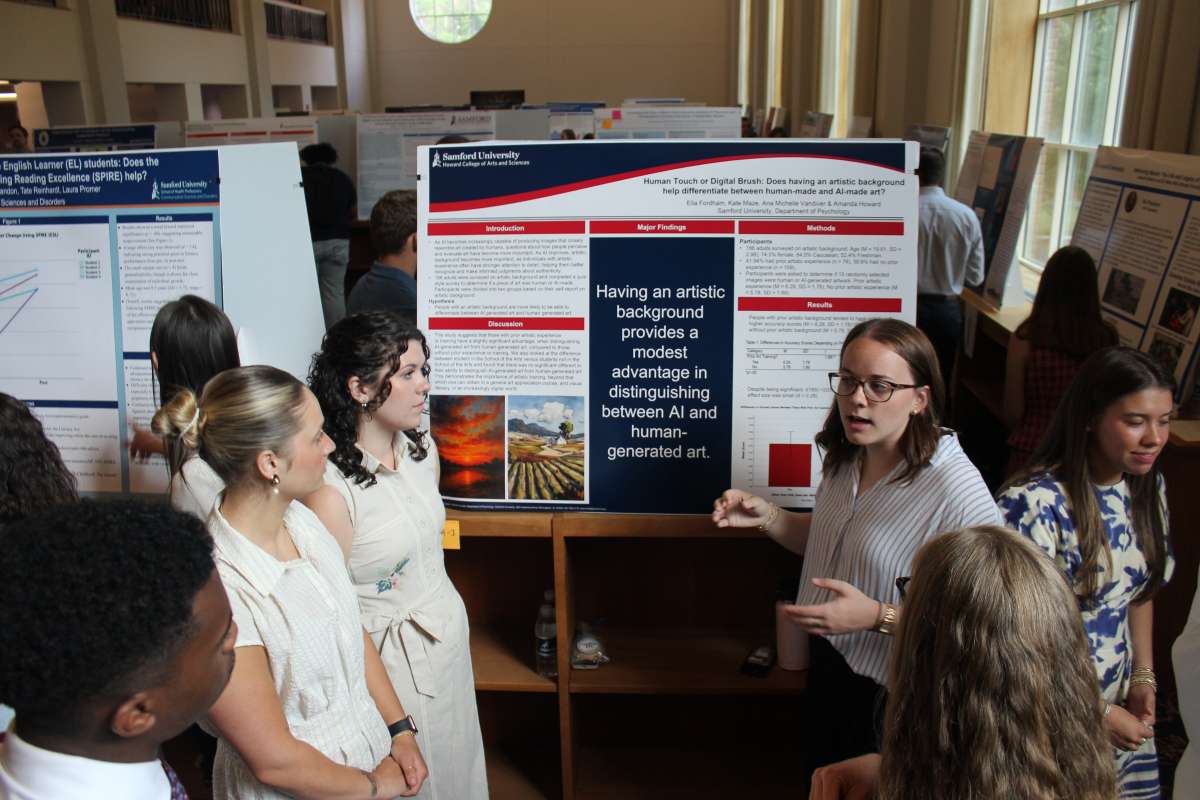
Fordham and Maze, both looking ahead to graduate school, said the event was the perfect opportunity to present in a setting that is less intimidating and focused on students sharing their findings with others, learning about topics outside their main field of study and expanding their knowledge.
“I plan to attend law school, so this opportunity offers a space to present formally without the pressure of a courtroom. This experience has been invaluable to my ability to speak and present information in a public setting,” Maze said.
The event is led by the Research Advisory Collaborative in partnership with the Office of Research at Samford and exemplifies three pillars of the university’s strategic plan, Fidelitas: academic distinction, community celebration and student engagement.
2026 Student Research Colloquia Winners:
Undergraduate Winners
Amanda Williams (Biology, mentored by Riley Lovejoy)
Mckayla Bean, Carter Britt, Elizabeth Tremblay-Cox (Chemistry, mentored by Megan Connor)
Sara Erenda, Alaina Su, Ariana Usher (Psychology, mentored by Stephen Chew)
Abby Morrow (Neuroscience, mentored by Patty Jumbo-Lucioni, Greg Gorman, Brad Bennett)
Callie Cook, Julianne Ross, Shiloh King (Kinesiology, mentored by Tyler Williams, Mallory Marshall)
Abigail Nowlin, Caroline Thompson, Isabel Harrell, Megan Dalfonso (Communications Sciences & Disorders, mentored by Angie Barber)
Anna Caroline Flaming (Neuroscience, mentored by Patty Jumbo-Lucioni, Brad Bennett)
Greta Liedtke (Biology, mentored by Betsy Dobbins)
Ethan Koch (Computer Science, mentored by Scott Crews)
Grant King (Computer Science, mentored by Brian Toone)
Joseph Schefano (Biology, mentored by Anthony Overton)
Mariam Sanavi (Geography, mentored by Jonathan Flemming)
Aidan Reyes (Economics, mentored by Anna Leigh Stone)
Graduate Winners
Raven Chaney (Pharmacy, mentored by Georges Adunlin)
Jamiah Files (Pharmacy, mentored by Danielle Cruthirds, Patty Jumbo-Lucioni)
Stacy W. Taylor (Nursing, mentored by Annette Hess, Lisa Gurley)
Mia Edens (Architecture & Interior Design, mentored by Aaron Brakke)
See below for school-specific coverage on the Samford Research Colloquia:
Orleen Beeson School of Education
